• HOME
  • NEWS
  • EXPLORE
    • CAREER
      • Companies
      • Jobs
    • EVENTS
    • iGEM
      • News
      • Team
    • PHOTOS
    • VIDEO
    • WIKI
  • BLOG
  • COMMUNITY
    • FACEBOOK
    • INSTAGRAM
    • TWITTER
Saturday, February 7, 2026
BIOENGINEER.ORG
No Result
View All Result
  • Login
  • HOME
  • NEWS
  • EXPLORE
    • CAREER
      • Companies
      • Jobs
        • Lecturer
        • PhD Studentship
        • Postdoc
        • Research Assistant
    • EVENTS
    • iGEM
      • News
      • Team
    • PHOTOS
    • VIDEO
    • WIKI
  • BLOG
  • COMMUNITY
    • FACEBOOK
    • INSTAGRAM
    • TWITTER
  • HOME
  • NEWS
  • EXPLORE
    • CAREER
      • Companies
      • Jobs
        • Lecturer
        • PhD Studentship
        • Postdoc
        • Research Assistant
    • EVENTS
    • iGEM
      • News
      • Team
    • PHOTOS
    • VIDEO
    • WIKI
  • BLOG
  • COMMUNITY
    • FACEBOOK
    • INSTAGRAM
    • TWITTER
No Result
View All Result
Bioengineer.org
No Result
View All Result
Home NEWS Science News Biology

Brain receptor pulls open electrical gate like a puppet master

Bioengineer by Bioengineer
June 30, 2020
in Biology
Reading Time: 3 mins read
0
IMAGE
Share on FacebookShare on TwitterShare on LinkedinShare on RedditShare on Telegram

IMAGE

Credit: Furukawa lab/CSHL, 2020

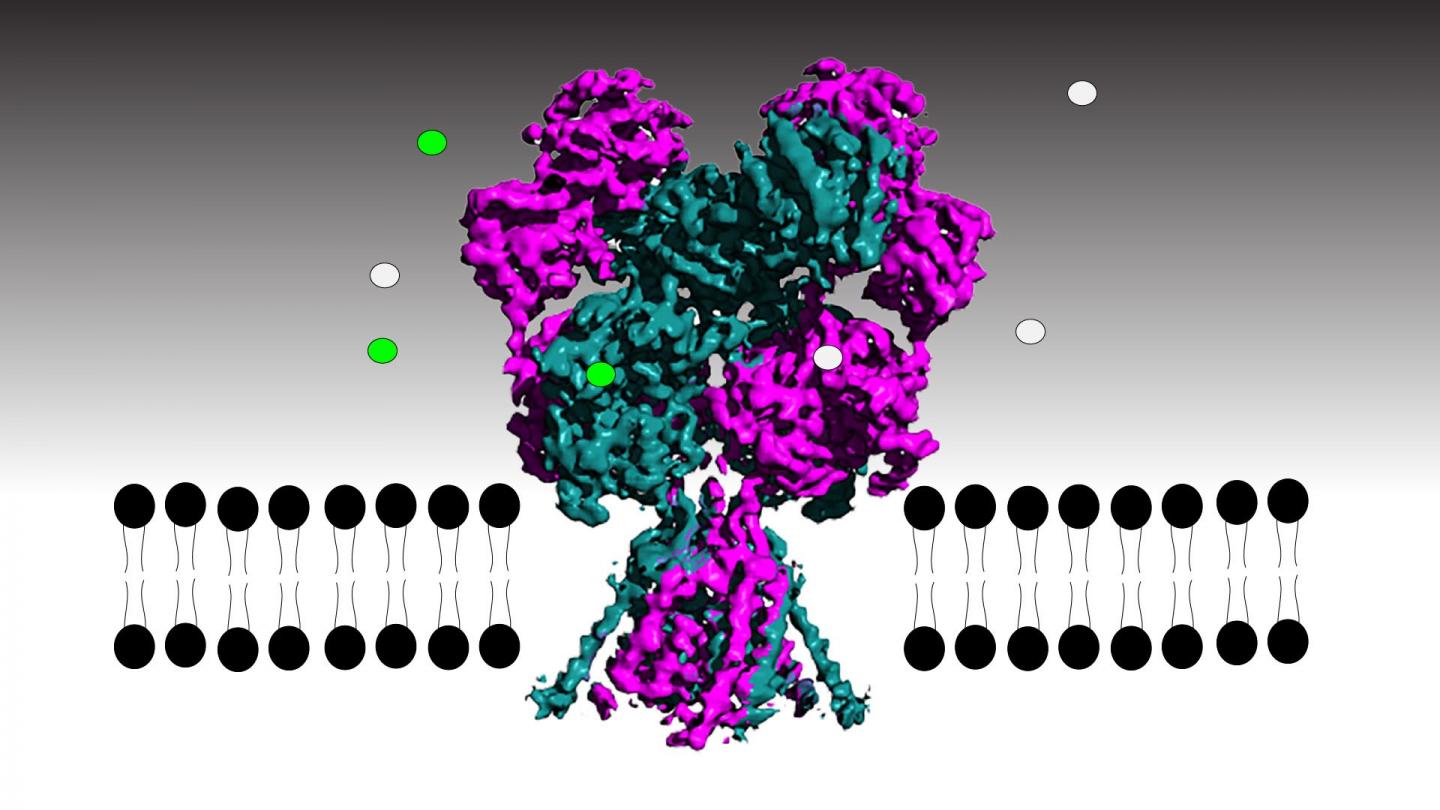
For the first time, researchers in the lab of CSHL Professor Hiro Furukawa have been able to track each atom in the NMDA receptor, an important brain protein, as it transmits or inhibits neural signals. Critical for brain development and function, the receptor converts chemical messages between cells into electrical signals within a neuron. The key to transmitting that information is opening the receptor’s built-in ion channel, a hollow pore that allows electrically charged ions to flow. Unlocking the receptor’s ion channel is like working a stringed puppet–rock one part of the receptor and slender filaments pull open the channel’s gate. Rock it a little differently, the filaments loosen, and the gate snaps shut. Understanding how the receptor works could lead to better treatments for Alzheimer’s disease, depression, epilepsy, stroke, or schizophrenia.

Using high resolution electron cryo-microscopy (cryo-EM) and a series of specially constructed receptors, the scientists were able to follow every twist and turn of receptor parts as they bind natural and synthetic compounds, rock open the gate, and let it shut again.

The NMDA receptor is embedded in the neuronal membrane with the receptor binding portion on the outside of the cell and the ion channel spanning the cell membrane. When activating molecules glycine and glutamic acid bind to the ligand-binding domain (LBD) in the right way, the LBD rocks, pulling a loop or filament attached to the ion channel gate to open it. But if an antagonist binds, the loop loosens so much that the LBD cannot pull open the gate. Furukawa says:

“This is all happening because the subunit arrangement changes quite dramatically upon binding to the inhibitor. It all comes down to the stretching and non-stretching of the loop between the ligand-binding domain and the ion channel. They’re really a series of conformations or events that are happening outside [the cell], and it eventually gets translated to the ion channel activity,”

Formerly, the stretching of the loops and their effect on the opening and closing of the ion channel were pure speculation on Furukawa’s part. Now he has the data to prove what before he could only imagine.

Watch “How does the NMDA receptor work?”: https://www.youtube.com/watch?v=5zqBsPmH8ck

There are multiple conformations when glycine and glutamate are bound to NMDA receptor’s Ligand Binding Domain (LBD). In going from non-active to active state, there is going to be a rolling motion–I’m going to go back again–there’s going to be a rolling motion of Ligand Binding Domain. Here is the loop that tethers Ligand Binding Domain and a transmembrane domain. And the transmembrane domain forms the ion channel pore. When this rolling motion happens, it is that the loop that tethers that transmembrane domain would be stretched. When the loop is stretched, what happens is that the residues, or amino acids, that are forming the ion channel pore is stretched apart.

This discovery will enable researchers to develop better drugs to control the NMDA receptor’s activity, which can be involved in Alzheimer’s disease, depression, schizophrenia, stroke, and epilepsy. The insights gained in this study may also be applicable to other receptor-mediated ion channels.

###

Media Contact
Sara Roncero-Menendez
[email protected]

Original Source

https://www.cshl.edu/brain-receptor-pulls-open-electrical-gate-like-a-puppet-master/

Tags: AlzheimerBiologyMedicine/Healthneurobiology
Share12Tweet8Share2ShareShareShare2

Related Posts

Florida Cane Toad: Complex Spread and Selective Evolution

Florida Cane Toad: Complex Spread and Selective Evolution

February 7, 2026
New Study Uncovers Mechanism Behind Burn Pit Particulate Matter–Induced Lung Inflammation

New Study Uncovers Mechanism Behind Burn Pit Particulate Matter–Induced Lung Inflammation

February 6, 2026

DeepBlastoid: Advancing Automated and Efficient Evaluation of Human Blastoids with Deep Learning

February 6, 2026

Navigating the Gut: The Role of Formic Acid in the Microbiome

February 6, 2026
Please login to join discussion

POPULAR NEWS

  • Robotic Ureteral Reconstruction: A Novel Approach

    Robotic Ureteral Reconstruction: A Novel Approach

    82 shares
    Share 33 Tweet 21
  • Digital Privacy: Health Data Control in Incarceration

    63 shares
    Share 25 Tweet 16
  • Study Reveals Lipid Accumulation in ME/CFS Cells

    57 shares
    Share 23 Tweet 14
  • Breakthrough in RNA Research Accelerates Medical Innovations Timeline

    53 shares
    Share 21 Tweet 13

About

We bring you the latest biotechnology news from best research centers and universities around the world. Check our website.

Follow us

Recent News

Phage-Antibiotic Combo Beats Resistant Peritoneal Infection

Boosting Remote Healthcare: Stepped-Wedge Trial Insights

Barriers and Boosters of Seniors’ Physical Activity in Karachi

Subscribe to Blog via Email

Enter your email address to subscribe to this blog and receive notifications of new posts by email.

Join 73 other subscribers
  • Contact Us

Bioengineer.org © Copyright 2023 All Rights Reserved.

Welcome Back!

Login to your account below

Forgotten Password?

Retrieve your password

Please enter your username or email address to reset your password.

Log In
No Result
View All Result
  • Homepages
    • Home Page 1
    • Home Page 2
  • News
  • National
  • Business
  • Health
  • Lifestyle
  • Science

Bioengineer.org © Copyright 2023 All Rights Reserved.