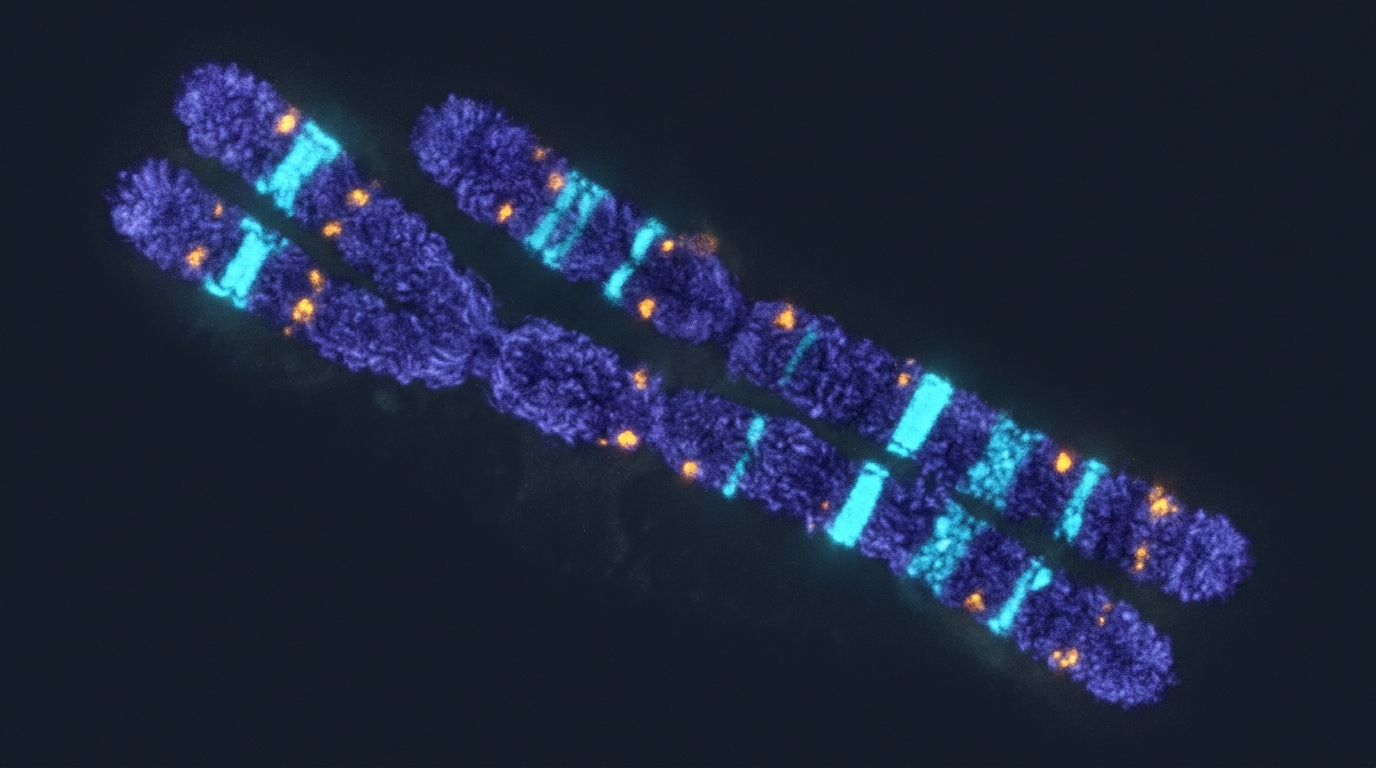
Published in Algorithms for Molecular Biology, the study presents an annotation-free approach that offers a useful alternative to standard methods, which typically depend on protein-coding gene models. The authors demonstrate that their algorithm performs particularly well for closely related genomes, where it can outperform annotation-based techniques by capturing a denser map of syntenic DNA.
Synteny refers to the conservation of gene order across different genomes, serving as a critical indicator of homology in comparative genomics. While sequence similarity is the most common method for identifying orthologous genes, it is often insufficient due to genome duplications and rapid sequence divergence. Current software tools, such as DAGchainer and MCScanX, require genome annotations as input, effectively restricting synteny detection to protein-coding genes. This limitation means that non-coding regions, which constitute a large fraction of eukaryotic genomes, are largely ignored in standard synteny maps.
The core idea behind AncST is to identify “sufficiently unique” DNA sequences that can serve as unambiguous anchors for synteny detection. The team defines these anchors based on their distinctiveness within a genome, ensuring that they have no other similar matches in the same sequence. By pre-computing these anchor candidates for each genome independently, the method avoids the need for complete pairwise alignments of entire genomes, which are computationally intensive. This preprocessing step allows for a more efficient identification of syntenic regions, particularly when high resolution is required for closely related species.
To generate these anchor candidates, the researchers utilized k-mer statistics to identify regions of DNA that are distinct from the rest of the genome. They calculated the frequency of short DNA substrings, or k-mers, across the genome to determine which sequences are sufficiently unique. The tool then filters these candidates using a blast comparison against the same genome to verify their uniqueness. This process results in a set of anchor candidates that are not biased toward specific biological functions, unlike gene annotations, which can be unevenly distributed across gene-rich and gene-poor regions.
The study compared the performance of AncST against annotation-based synteny detection using a test set of 16 insect genomes covering Diptera, Lepidoptera, and Coleoptera. The team used MCScanX to extract syntenic regions from both the AncST anchors and standard ORF annotations. The results showed that the annotation-free approach recovers significantly more syntenic DNA between closely related genomes. Specifically, AncST anchors covered about 86% of the genomic positions of annotated ORFs in Drosophila melanogaster, whereas the annotated ORFs covered only about 20% of the AncST anchors.
For more distantly related species, the annotation-based approach remained superior. This is because amino acid sequences can identify homology in highly diverged sequences where nucleic acid alignments become insensitive. The authors note that while AncST excels at small and moderate phylogenetic distances, it fails at very large evolutionary distances where the additional information from predicted protein sequences is required to establish homology. This distinction highlights the complementary nature of the two approaches, with AncST providing higher resolution for recent evolutionary events.
The tool also demonstrated its utility in tracking genomic innovations and rearrangements. In a showcase example, the team traced Hox gene clusters across the 16 species. The dense map of synteny anchors allowed them to identify potential rearrangements, including a recent shift in the order of two Hox clusters between Drosophila melanogaster and Drosophila yakuba. This finding, which was not previously noticed to the authors’ knowledge, illustrates how the non-coding DNA between coding regions is packed with synteny anchors that can reveal subtle evolutionary changes.
Computational efficiency is a key advantage of the AncST pipeline. The preprocessing step, which involves calculating mappability and blast searches, is performed once per genome. For the test dataset of 16 species, the computation of anchor candidates and pairwise matches required less than 16 hours on a high-performance computing cluster with 160 cores. The most time-intensive steps were the mappability computation and the blast searches of candidates against their own genomes. This efficiency makes the method practical for large-scale comparative genomics studies.
The authors acknowledge several limitations of the current approach. The method relies on the assumption that anchor candidates are sufficiently unique, which may not hold for recently duplicated sequences that have not yet diverged. Additionally, the k-mer statistics used to identify candidates may overlook some potential anchors. The team suggests that future work could involve locally optimizing anchor candidates to handle repetitive subsequences and extending the approach to account for anchors with a small number of similar matches in the same genome.
The study concludes that AncST provides a robust and efficient alternative to annotation-based synteny detection. By operating directly on unannotated genomic DNA, the tool offers a denser and more uniform coverage of syntenic regions, particularly for closely related genomes. This capability is valuable for tracking genomic innovations and understanding the evolutionary history of genome organization. The authors have made a prototype of the pipeline available online, along with precomputed anchors for different sets of species, to facilitate further research in comparative genomics.
The theoretical framework underpinning AncST distinguishes between simple sequence similarity and the stricter requirement of reciprocal uniqueness. For a DNA segment to qualify as a valid synteny anchor, it must be a unique reciprocal match with a corresponding segment in another genome. The authors formalize this by defining a string as sufficiently unique if its distance to all other non-overlapping subsequences in the same genome exceeds a specific threshold. This ensures that the segment does not have ambiguous matches within its own genome, which is a common issue in repetitive genomic regions. By establishing this uniqueness first, the method can then identify anchor matches between two genomes where the distance between the segments is less than half the minimum uniqueness threshold of either genome. This mathematical guarantee allows the tool to identify orthologous regions without needing to compute complete pairwise alignments of all genomic sequences, a process that is computationally expensive and complicated by non-unique homologies.
The implementation of this theory relies on a two-stage filtering process to manage computational complexity. The first stage uses k-mer statistics to pre-compute candidate regions. The researchers calculated the frequency of short DNA substrings, specifically using a default k-mer length of 13, to identify regions that are distinct from the rest of the genome. They retained only those windows in the 15th percentile of aggregated k-mer frequencies, effectively filtering out highly repetitive sequences. To ensure robustness, the method also tested different k-mer lengths, including 15 and 21, with varying allowances for mismatches. The second stage involves a blast comparison of these candidates against the same genome to verify their uniqueness. This step assigns a similarity score to each candidate, representing the level of uniqueness within the genome. Only candidates that meet specific score thresholds are retained as potential anchors for cross-species comparison.
When comparing the performance of AncST against annotation-based methods, the study revealed distinct advantages depending on phylogenetic distance. For closely related genomes, the annotation-free approach recovered significantly more syntenic DNA. In the case of Drosophila melanogaster, AncST anchors covered approximately 86% of the genomic positions of annotated open reading frames, while the annotated ORFs covered only about 20% of the AncST anchors. This higher coverage is attributed to the fact that annotation-based methods are restricted to protein-coding genes, which are sparsely distributed and often miss non-coding conserved regions. In contrast, AncST anchors are distributed more uniformly across the genome, capturing a denser map of syntenic regions. This density is particularly useful for detecting small local rearrangements or genomic innovations that might be missed by the coarser resolution of gene-based anchors.
However, the study also identified clear limitations for more distantly related species. As evolutionary distance increases, nucleic acid alignments become less sensitive, and the ability to detect homology through raw DNA sequences diminishes. In these cases, the annotation-based approach, which relies on amino acid sequences, remains superior. Amino acid alignments can identify homology in highly diverged sequences where nucleotide-level comparisons fail. The authors noted that for large phylogenetic distances, the additional information provided by predicted protein sequences is necessary to establish homology. This suggests that AncST is best suited for comparative genomics studies involving closely related species, while traditional annotation-based tools remain essential for broader phylogenetic analyses. The complementary nature of these methods highlights the importance of selecting the appropriate tool based on the evolutionary scope of the study.
The practical application of AncST was demonstrated by tracing Hox gene clusters across the 16 insect species in the test set. The Hox gene cluster is known for its highly conserved synteny in animal phyla, but the study revealed variations such as cluster breaks, inversions, and duplications. The dense map of synteny anchors allowed the researchers to identify potential rearrangements that were not previously reported. For instance, they observed a recent shift in the order of two Hox clusters between Drosophila melanogaster and Drosophila yakuba, likely due to inversions. This finding illustrates how the non-coding DNA between coding regions is packed with synteny anchors that can reveal subtle evolutionary changes. The ability to track these rearrangements provides valuable insights into the evolutionary history of genome organization and the mechanisms driving genomic innovation.
Computational efficiency is another significant advantage of the AncST pipeline. The preprocessing step, which involves calculating mappability and performing blast searches, is performed once per genome and can be stored as a simple annotation track. This allows for efficient reuse in multiple comparative analyses. For the test dataset of 16 species, the computation of anchor candidates and pairwise matches required less than 16 hours on a high-performance computing cluster with 160 cores. The most time-intensive steps were the mappability computation and the blast searches of candidates against their own genomes. This efficiency makes the method practical for large-scale comparative genomics studies, where the computational cost of traditional alignment methods can be prohibitive. The authors have made a prototype of the pipeline available online, along with precomputed anchors for different sets of species, to facilitate further research and application in the field.
Subject of Research: Annotation-free genome-wide synteny detection using unique DNA anchors
Article Title: Unbiased anchors for reliable genome-wide synteny detection
Article References: Käther, K. K., Remmel, A., Lemke, S., & Stadler, P. F. (2025). Unbiased anchors for reliable genome-wide synteny detection. Algorithms for Molecular Biology, 20(1), Article 5. https://doi.org/10.1186/s13015-025-00275-9
Image Credits: AI Generated
DOI: 10.1186/s13015-025-00275-9
Keywords: synteny detection, comparative genomics, genome annotation, orthology inference, k-mer statistics, AncST tool, genomic rearrangements, bioinformatics, Unbiased, anchors, reliable, genome-wide
News Source: Juliet Wilcox. (November 13, 2026). New Tool Finds Genome Synteny Without Gene Annotations. Scienmag.