• HOME
  • NEWS
  • EXPLORE
    • CAREER
      • Companies
      • Jobs
    • EVENTS
    • iGEM
      • News
      • Team
    • PHOTOS
    • VIDEO
    • WIKI
  • BLOG
  • COMMUNITY
    • FACEBOOK
    • INSTAGRAM
    • TWITTER
Thursday, June 25, 2026
BIOENGINEER.ORG
No Result
View All Result
  • Login
  • HOME
  • NEWS
  • EXPLORE
    • CAREER
      • Companies
      • Jobs
        • Lecturer
        • PhD Studentship
        • Postdoc
        • Research Assistant
    • EVENTS
    • iGEM
      • News
      • Team
    • PHOTOS
    • VIDEO
    • WIKI
  • BLOG
  • COMMUNITY
    • FACEBOOK
    • INSTAGRAM
    • TWITTER
  • HOME
  • NEWS
  • EXPLORE
    • CAREER
      • Companies
      • Jobs
        • Lecturer
        • PhD Studentship
        • Postdoc
        • Research Assistant
    • EVENTS
    • iGEM
      • News
      • Team
    • PHOTOS
    • VIDEO
    • WIKI
  • BLOG
  • COMMUNITY
    • FACEBOOK
    • INSTAGRAM
    • TWITTER
No Result
View All Result
Bioengineer.org
No Result
View All Result
Home NEWS Science News Chemistry

Brain research sheds light on the molecular mechanisms of depression

Bioengineer by Bioengineer
June 16, 2020
in Chemistry
Reading Time: 2 mins read
0
IMAGE
Share on FacebookShare on TwitterShare on LinkedinShare on RedditShare on Telegram

IMAGE

Credit: Lauri Nummenmaa

A new study conducted in Turku, Finland, reveals how symptoms indicating depression and anxiety are linked to brain function changes already in healthy individuals.

Researchers of the national Turku PET Centre have shown that the opioid system in the brain is connected to mood changes associated with depression and anxiety.

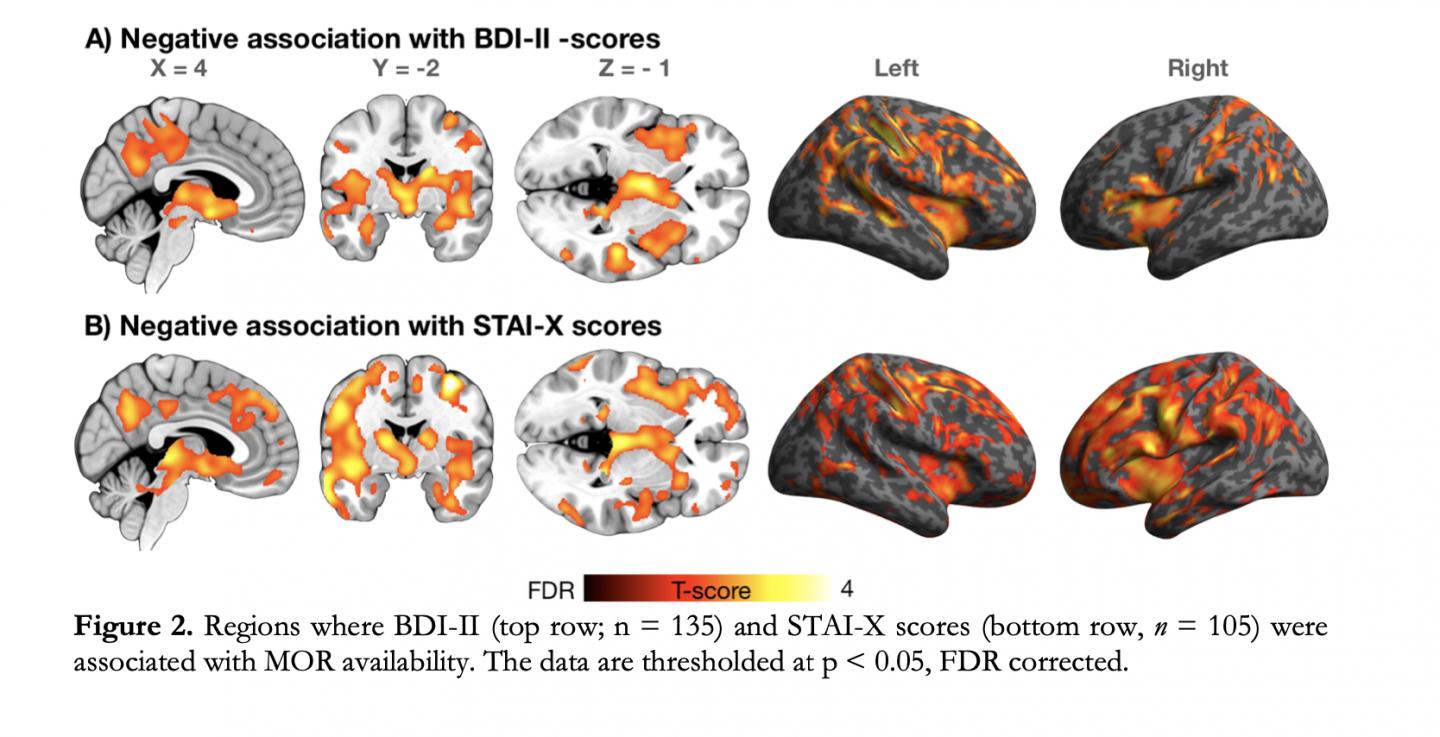
Depression and anxiety are typically associated with lowered mood and decreased experience of pleasure. Opioids regulate the feelings of pain and pleasure in the brain. The new study conducted in Turku shows that the symptoms associated with depression and anxiety are connected to changes in the brain’s opioid system already in healthy individuals.

– We found that the more depressive and anxious symptoms the subjects had, the less opioid receptors there were in their brain. These receptors function like small “docks” that are influenced by both the brains own opioids as well as opiates. These type of opioid-mediated mood changes can be an important mechanism in the central nervous system, says Professor Lauri Nummenmaa from the University of Turku.

– These results show that the mood changes indicating depression can be detected in the brain already early on. Both the brain’s own opioids and synthetic opiate-based drugs regulate mood. Based on the results, drugs that have an effect on the opioid system can help in the treatment of depression, adds Nummenmaa.

The study was conducted with Positron Emission Tomography (PET) and altogether 135 volunteers participated as subjects. A small dose of radioactive tracer binding to the brain’s opioid receptors was injected in their circulation. The decay of the tracers was measured with a PET camera, whereas the depressive and anxious symptoms of the subjects were measured with questionnaires.

The study is based on the AIVO database hosted by Turku University Hospital and Turku PET Centre. The database contains different in vivo molecular brain scans for extensive analyses: https://aivo.utu.fi/

###

The results have been published in the Neuropsychopharmacology journal.

The study was funded by the Academy of Finland and Sigrid Jusélius Foundation.

Media Contact
Lauri Nummenmaa
[email protected]

Original Source

https://www.utu.fi/en/news/press-release/brain-research-sheds-light-on-the-molecular-mechanisms-of-depression

Related Journal Article

http://dx.doi.org/10.1038/s41386-020-0725-9

Tags: Depression/AngerDiagnosticsMedicine/HealthMental HealthNeurochemistryPharmaceutical SciencesStress/Anxiety
Share12Tweet8Share2ShareShareShare2

Related Posts

AI and Physics Collaborate to Design Advanced Hydrogen Storage Materials

June 25, 2026

International Team Including Dresden Scientists Develops Novel Designer Proteins for Advanced Study of Living Tissue

June 25, 2026

New Study Uncovers Key Factors Driving Water Chemistry in Nanoscale Environments

June 25, 2026

Plasma Technology Extends Catalyst Lifespan in Hydrogen Production

June 24, 2026
Please login to join discussion

POPULAR NEWS

  • Saying Goodbye to PGY-6: Pediatric Fellowship Realities

    103 shares
    Share 41 Tweet 26
  • Multi-Hospital Study Reveals Long Covid Burden Is Twice as High as Current Estimates

    92 shares
    Share 36 Tweet 23
  • Detection of EDCs in Breast Milk and Infant Urine Up to Six Months Highlights Early Exposure Risks

    77 shares
    Share 31 Tweet 19
  • New Drug Candidate Developed at McMaster Shows Potential for Treating Brain Cancer

    58 shares
    Share 23 Tweet 15

About

We bring you the latest biotechnology news from best research centers and universities around the world. Check our website.

Follow us

Recent News

Tracking Lanthanide-Labeled Microplastics in Plants

POSTECH Researchers Slash Cost of Reconstituted Cell-Free Systems by 95%

AI and Physics Collaborate to Design Advanced Hydrogen Storage Materials

Subscribe to Blog via Email

Enter your email address to subscribe to this blog and receive notifications of new posts by email.

Join 82 other subscribers
  • Contact Us

Bioengineer.org © Copyright 2023 All Rights Reserved.

Welcome Back!

Login to your account below

Forgotten Password?

Retrieve your password

Please enter your username or email address to reset your password.

Log In
No Result
View All Result
  • Homepages
    • Home Page 1
    • Home Page 2
  • News
  • National
  • Business
  • Health
  • Lifestyle
  • Science

Bioengineer.org © Copyright 2023 All Rights Reserved.