• HOME
  • NEWS
  • EXPLORE
    • CAREER
      • Companies
      • Jobs
    • EVENTS
    • iGEM
      • News
      • Team
    • PHOTOS
    • VIDEO
    • WIKI
  • BLOG
  • COMMUNITY
    • FACEBOOK
    • INSTAGRAM
    • TWITTER
Saturday, February 7, 2026
BIOENGINEER.ORG
No Result
View All Result
  • Login
  • HOME
  • NEWS
  • EXPLORE
    • CAREER
      • Companies
      • Jobs
        • Lecturer
        • PhD Studentship
        • Postdoc
        • Research Assistant
    • EVENTS
    • iGEM
      • News
      • Team
    • PHOTOS
    • VIDEO
    • WIKI
  • BLOG
  • COMMUNITY
    • FACEBOOK
    • INSTAGRAM
    • TWITTER
  • HOME
  • NEWS
  • EXPLORE
    • CAREER
      • Companies
      • Jobs
        • Lecturer
        • PhD Studentship
        • Postdoc
        • Research Assistant
    • EVENTS
    • iGEM
      • News
      • Team
    • PHOTOS
    • VIDEO
    • WIKI
  • BLOG
  • COMMUNITY
    • FACEBOOK
    • INSTAGRAM
    • TWITTER
No Result
View All Result
Bioengineer.org
No Result
View All Result
Home NEWS Science News Chemistry

Flushing toilets create clouds of virus-containing particles

Bioengineer by Bioengineer
June 16, 2020
in Chemistry
Reading Time: 3 mins read
0
IMAGE
Share on FacebookShare on TwitterShare on LinkedinShare on RedditShare on Telegram

Coronavirus could be transmitted through a long-lasting cloud of virus-containing aerosol droplets ejected from a flushing toilet.
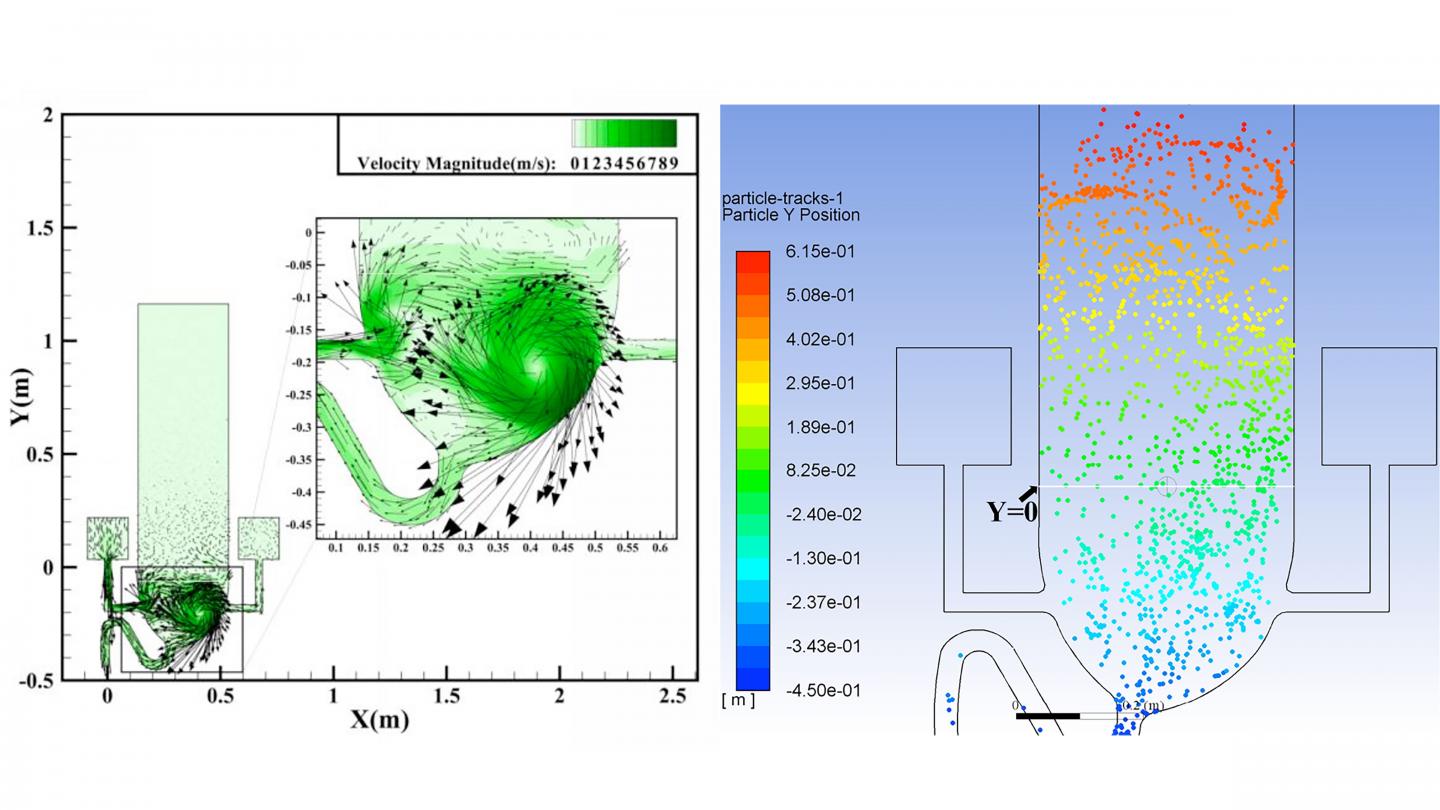
IMAGE

Credit: J.-X. Wang

WASHINGTON, June 16, 2020 — Researchers used a computer simulation to show how a flushing toilet can create a cloud of virus-containing aerosol droplets that is large and widespread and lasts long enough that the droplets could be breathed in by others.

With recent studies showing the novel coronavirus that causes COVID-19 can survive in the human digestive tract and show up in feces of the infected, this raises the possibility the disease could be transmitted with the use of toilets.

Toilet flushing creates a great deal of turbulence, and qualitative evidence suggests this can spread both bacteria and viruses. The public, however, remains largely unaware of this infection pathway, since few quantitative studies have been carried out to investigate this possible mechanism.

In the journal Physics of Fluids, by AIP Publishing, precise computer models were used to simulate water and air flows in a flushing toilet and the resulting droplet cloud. The investigators used a standard set of fluid dynamic formulas, known as the Navier-Stokes equations, to simulate flushing in two types of toilet — one with a single inlet for flushing water, and another with two inlets to create a rotating flow.

The investigators also used a discrete phase model to simulate movement of the numerous tiny droplets likely to be ejected from the toilet bowl into the air. A similar model was used recently to simulate the movement of aerosol droplets ejected during a human cough. (See https://publishing.aip.org/publications/latest-content/six-feet-not-far-enough-to-stop-virus-transmission-in-light-winds/.)

The results of the simulations were striking.

As water pours into the toilet bowl from one side, it strikes the opposite side, creating vortices. These vortices continue upward into the air above the bowl, carrying droplets to a height of nearly 3 feet, where they might be inhaled or settle onto surfaces. These droplets are so small they float in the air for over a minute. A toilet with two inlet ports for water generates an even greater velocity of upward flowing aerosol particles.

“One can foresee that the velocity will be even higher when a toilet is used frequently, such as in the case of a family toilet during a busy time or a public toilet serving a densely populated area,” said co-author Ji-Xiang Wang, of Yangzhou University.

The simulations show that nearly 60% of the ejected particles rise high above the seat for a toilet with two inlet ports. A solution to this deadly problem is to simply close the lid before flushing, since this should decrease aerosol spread.

However, in many countries, including the United States, toilets in public restrooms are often without lids. This poses a serious hazard. The investigators also suggest a better toilet design would include a lid that closes automatically before flushing.

###

The article, “Can a toilet promote virus transmission? From a fluid dynamics perspective,” is authored by Yun-Yun Li, Ji-Xiang Wang and Xi Chen. The article will appear in Physics of Fluids on June 16, 2020 (DOI: 10.1063/5.0013318). Thereafter, it can be accessed at https://aip.scitation.org/doi/10.1063/5.0013318.

ABOUT THE JOURNAL

Physics of Fluids is devoted to the publication of original theoretical, computational, and experimental contributions to the dynamics of gases, liquids, and complex fluids. See https://aip.scitation.org/journal/phf.

Media Contact
Larry Frum
[email protected]

Related Journal Article

http://dx.doi.org/10.1063/5.0013318

Tags: BiologyBiomechanics/BiophysicsChemistry/Physics/Materials SciencesDiagnosticsMedicine/HealthVirology
Share12Tweet8Share2ShareShareShare2

Related Posts

blank

Breakthrough in Environmental Cleanup: Scientists Develop Solar-Activated Biochar for Faster Remediation

February 7, 2026
blank

Cutting Costs: Making Hydrogen Fuel Cells More Affordable

February 6, 2026

Scientists Develop Hand-Held “Levitating” Time Crystals

February 6, 2026

Observing a Key Green-Energy Catalyst Dissolve Atom by Atom

February 6, 2026
Please login to join discussion

POPULAR NEWS

  • Robotic Ureteral Reconstruction: A Novel Approach

    Robotic Ureteral Reconstruction: A Novel Approach

    82 shares
    Share 33 Tweet 21
  • Digital Privacy: Health Data Control in Incarceration

    63 shares
    Share 25 Tweet 16
  • Study Reveals Lipid Accumulation in ME/CFS Cells

    57 shares
    Share 23 Tweet 14
  • Breakthrough in RNA Research Accelerates Medical Innovations Timeline

    53 shares
    Share 21 Tweet 13

About

We bring you the latest biotechnology news from best research centers and universities around the world. Check our website.

Follow us

Recent News

Decoding Prostate Cancer Origins via snFLARE-seq, mxFRIZNGRND

Digital Health Perspectives from Baltic Sea Experts

Florida Cane Toad: Complex Spread and Selective Evolution

Subscribe to Blog via Email

Enter your email address to subscribe to this blog and receive notifications of new posts by email.

Join 73 other subscribers
  • Contact Us

Bioengineer.org © Copyright 2023 All Rights Reserved.

Welcome Back!

Login to your account below

Forgotten Password?

Retrieve your password

Please enter your username or email address to reset your password.

Log In
No Result
View All Result
  • Homepages
    • Home Page 1
    • Home Page 2
  • News
  • National
  • Business
  • Health
  • Lifestyle
  • Science

Bioengineer.org © Copyright 2023 All Rights Reserved.