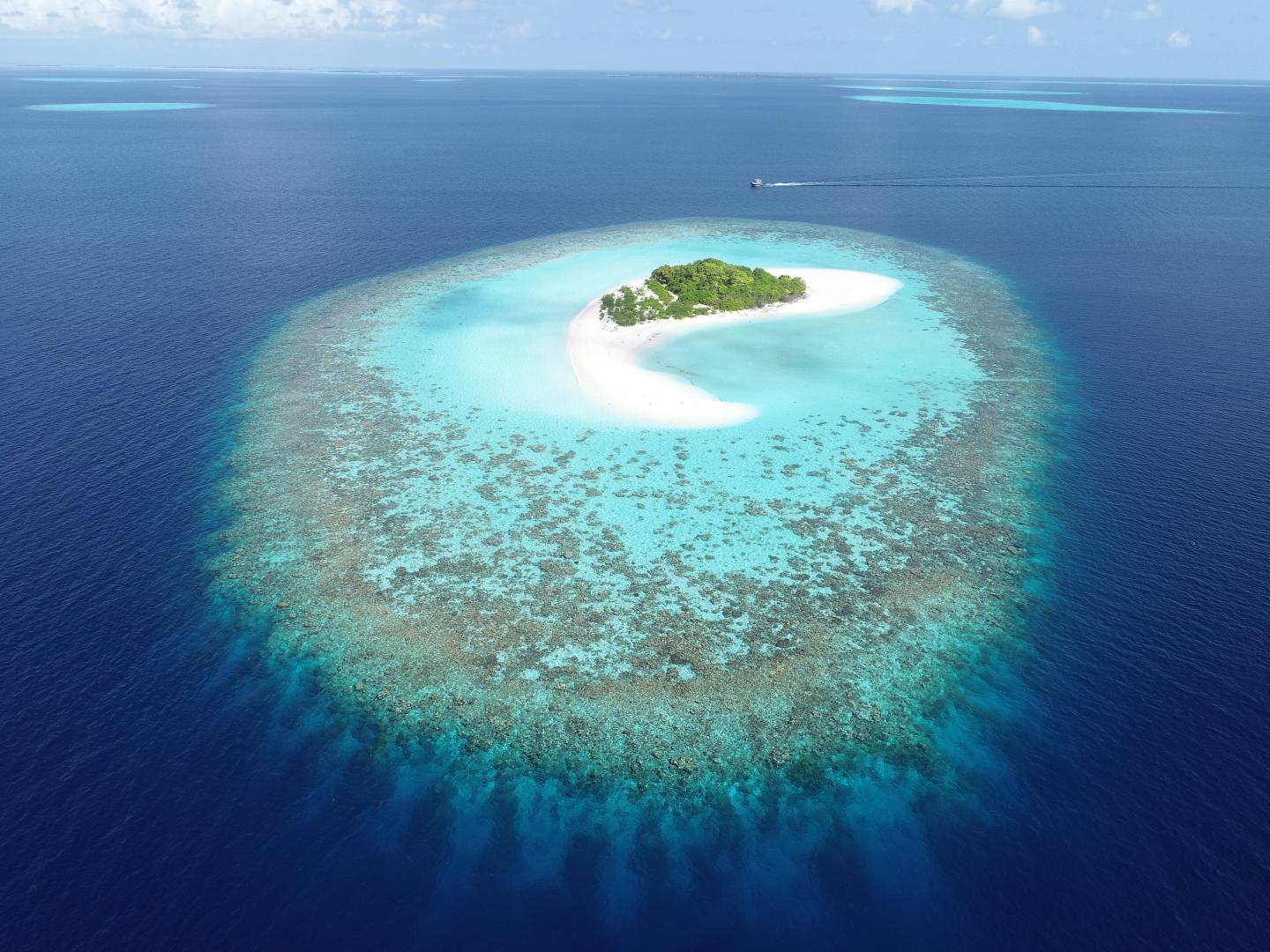
Credit: Gerd Masselink/University of Plymouth
Coral reef islands across the world could naturally adapt to survive the impact of rising sea levels, according to new research.
The increased flooding caused by the changing global climate has been predicted to render such communities – where sandy or gravel islands sit on top of coral reef platforms – uninhabitable within decades.
However, an international study led by the University of Plymouth (UK) suggests that perceived fate is far from a foregone conclusion.
The research, published in Science Advances, for the first time uses numerical modelling of island morphology alongside physical model experiments to simulate how reef islands – which provide the only habitable land in atoll nations – can respond when sea levels rise.
The results show that islands composed of gravel material can evolve in the face of overtopping waves, with sediment from the beach face being transferred to the island’s surface.
This means the island’s crest is being raised as sea level rises, with scientists saying such natural adaptation may provide an alternative future that can potentially support near-term habitability, albeit with additional management challenges, possibly involving sediment nourishment, mobile infrastructure and flood-proof housing.
The research was led by Gerd Masselink, Professor of Coastal Geomorphology in Plymouth, working with colleagues at the University of Auckland (New Zealand) and Simon Fraser University (Canada).
Professor Masselink, who heads Plymouth’s Coastal Processes Research Group, said: “In the face of climate change and sea level rise, coral reef islands are among the most vulnerable coastal environments on the planet. Previous research into the future habitability of these islands typically considers them inert structures unable to adjust to rising sea level. Invariably, these studies predict significantly increased risk of coastal flooding and island inundation, and the concept of ‘island loss’ has become entrenched in discourses regarding the future of coral reef island communities. In turn, this has led to attention being focused on either building structural coastal defences or the exodus of island communities, with limited consideration of alternative adaptation strategies.
“It is important to realise that these coral reef islands have developed over hundreds to thousands of years as a result of energetic wave conditions removing material from the reef structure and depositing the material towards the back of reef platforms, thereby creating islands. The height of their surface is actually determined by the most energetic wave conditions, therefore overtopping, flooding and island inundation are necessary, albeit inconvenient and sometime hazardous, processes required for island maintenance.”
Co-author Professor Paul Kench, currently Dean of Science at Simon Fraser University, Canada, said: “The model provides a step-change in our ability to simulate future island responses to sea level rise and better resolve what the on-ground transformations will look like for island communities. Importantly, our results suggest that island drowning within the next few decades is not universally inevitable. Understanding how islands will physically change due to sea level rise provides alternative options for island communities to deal with the consequences of climate change. It is important to stress there is no one-size-fits-all strategy that will be viable for all island communities – but neither are all islands doomed.”
For the research, scientists created a scale model of Fatato Island, part of the Funafuti Atoll in Tuvalu, and placed it in the Coastal Ocean and Sediment Transport (COAST) Lab at the University of Plymouth.
It was then subjected to a series of experiments designed to simulate predicted sea level rises with the results showing that the island’s crest rose with the rising sea level, while retreating inland, as a result of water overwashing the island and depositing sediment on the island’s surface.
A numerical model was validated using these laboratory experiments, and three numerical modelling scenarios were then used to assess how the island adjusted to a sea level rise of 0.75m, the global average increase predicted for 2100 by the Intergovernmental Panel on Climate Change.
During the numerical simulations, the island crest rose by just under 0.7m, showing that islands can keep up with rising level and confirming the laboratory experiments, although the precise future rate of sea level rise will be critical in determining their future.
###
Media Contact
Alan Williams
[email protected]