• HOME
  • NEWS
  • EXPLORE
    • CAREER
      • Companies
      • Jobs
    • EVENTS
    • iGEM
      • News
      • Team
    • PHOTOS
    • VIDEO
    • WIKI
  • BLOG
  • COMMUNITY
    • FACEBOOK
    • INSTAGRAM
    • TWITTER
Sunday, June 28, 2026
BIOENGINEER.ORG
No Result
View All Result
  • Login
  • HOME
  • NEWS
  • EXPLORE
    • CAREER
      • Companies
      • Jobs
        • Lecturer
        • PhD Studentship
        • Postdoc
        • Research Assistant
    • EVENTS
    • iGEM
      • News
      • Team
    • PHOTOS
    • VIDEO
    • WIKI
  • BLOG
  • COMMUNITY
    • FACEBOOK
    • INSTAGRAM
    • TWITTER
  • HOME
  • NEWS
  • EXPLORE
    • CAREER
      • Companies
      • Jobs
        • Lecturer
        • PhD Studentship
        • Postdoc
        • Research Assistant
    • EVENTS
    • iGEM
      • News
      • Team
    • PHOTOS
    • VIDEO
    • WIKI
  • BLOG
  • COMMUNITY
    • FACEBOOK
    • INSTAGRAM
    • TWITTER
No Result
View All Result
Bioengineer.org
No Result
View All Result
Home NEWS Science News Biology

Bacteria fed by algae biochemicals can harm coral health

Bioengineer by Bioengineer
June 3, 2020
in Biology
Reading Time: 3 mins read
0
IMAGE
Share on FacebookShare on TwitterShare on LinkedinShare on RedditShare on Telegram

IMAGE

Credit: Ty Roach

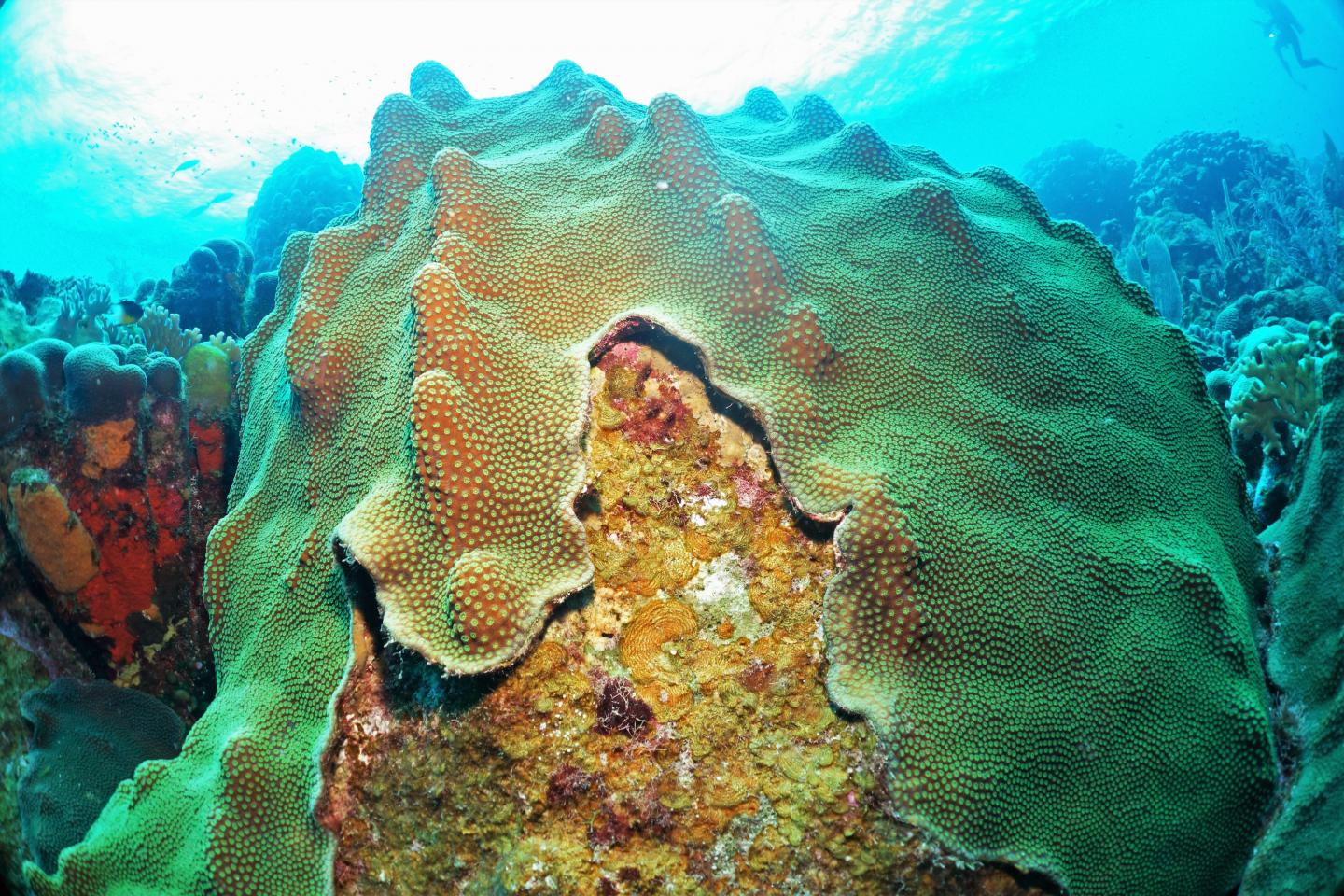
Though corals worldwide are threatened due to climate change and local stressors, the front lines of the battle are microscopic in scale. Under stress, many reefs that were formerly dominated by coral are shifting to systems dominated by turf and fleshy algae. A new study, published in PNAS on June 1 and led by researchers at the University of Hawai’i (UH) at Mānoa and San Diego State University (SDSU), found that the outcome of the competition between coral and turf algae is determined by the assemblage of microbes at the interface where the contenders meet.

All plants and animals are associated with communities of viruses and microbes–their microbiome–that interact via a suite of chemicals produced by their metabolism, termed metabolites. The new study, largely conducted at SDSU, investigated the role of each component, host organisms, viruses, bacteria, and metabolites, in coral-turf algal interactions. The researchers gathered data on genes, proteins and metabolic products associated with corals and algae on a reef and directly looked at the bacteria and viruses under a microscope.

“We found that when coral interacts with turf algae on a reef, there is a unique chemical and bacterial community that forms at the interface between these two organisms, an emergent microbiome,” said Ty Roach, postdoctoral researcher at the Hawai’i Institute of Marine Biology in the UH Mānoa School of Ocean and Earth Science and Technology and co-lead author of the study. “This interface community is made up of larger bacterial cells that use energy at a faster rate. Our data suggest that this change in bacterial size and energy use, which can negatively affect coral, is driven by a change in which types of bacteria dominate the microbiome.”

“Our chemical analysis indicates this change is driven by bacteria that feed on algal-derived biochemicals, a phenomenon we call the Algal Feeding Hypothesis,” said co-lead author Mark Little, doctoral candidate. “Interestingly, these changes in bacterial groups and their energy use, which comes from feeding on specific chemicals, are similar to changes seen in the human gut, with dominant bacteria linked to obesity.” 

Coral reefs are valued for their cultural and ecological importance, providing protection against storms and waves, and serve as reservoirs of biodiversity. Restoring coral cover and building reef resilience provides the foundation essential to a functional and healthy reef ecosystem, which is critical for the surrounding community.

“This highlights the fact that many ecological interactions between organisms are actually mediated by viruses and bacteria,” said Forest Rohwer, biology professor and senior author of the study. “This provides opportunities to engineer probiotics to alleviate the effects of stressors on corals.”  

The research team plans to use the insight gained from this study to design and test probiotic blends for use on corals. In this way, they aim to utilize personalized medicine techniques to help corals gain an ecological advantage over competitors such as harmful algae. 

###

Media Contact
Marcie Grabowski
[email protected]

Original Source

https://www.soest.hawaii.edu/soestwp/announce/news/bacteria-fed-by-algae-biochemicals-can-harm-coral-health/

Related Journal Article

http://dx.doi.org/10.1073/pnas.1915455117

Tags: BacteriologyBiologyClimate ChangeEcology/EnvironmentGeneticsMarine/Freshwater BiologyMolecular BiologyOceanographyParasitologyPopulation Biology
Share12Tweet8Share2ShareShareShare2

Related Posts

Natural Hallucinogens: Evolution’s Ecological Tools, Not Mere Chemical Byproducts

June 25, 2026

This Famous Butterfly Revealed: Three Distinct Species Hidden in One

June 25, 2026

Scientists Attack Soybean Cyst Nematode by Starving Its Food Source

June 25, 2026

Decoding the Secret Code of a Crucial Immune Sensor

June 24, 2026
Please login to join discussion

POPULAR NEWS

  • Saying Goodbye to PGY-6: Pediatric Fellowship Realities

    103 shares
    Share 41 Tweet 26
  • Multi-Hospital Study Reveals Long Covid Burden Is Twice as High as Current Estimates

    92 shares
    Share 36 Tweet 23
  • Detection of EDCs in Breast Milk and Infant Urine Up to Six Months Highlights Early Exposure Risks

    77 shares
    Share 31 Tweet 19
  • New Drug Candidate Developed at McMaster Shows Potential for Treating Brain Cancer

    58 shares
    Share 23 Tweet 15

About

We bring you the latest biotechnology news from best research centers and universities around the world. Check our website.

Follow us

Recent News

Tracking Lanthanide-Labeled Microplastics in Plants

POSTECH Researchers Slash Cost of Reconstituted Cell-Free Systems by 95%

AI and Physics Collaborate to Design Advanced Hydrogen Storage Materials

Subscribe to Blog via Email

Success! An email was just sent to confirm your subscription. Please find the email now and click 'Confirm' to start subscribing.

Join 82 other subscribers
  • Contact Us

Bioengineer.org © Copyright 2023 All Rights Reserved.

Welcome Back!

Login to your account below

Forgotten Password?

Retrieve your password

Please enter your username or email address to reset your password.

Log In
No Result
View All Result
  • Homepages
    • Home Page 1
    • Home Page 2
  • News
  • National
  • Business
  • Health
  • Lifestyle
  • Science

Bioengineer.org © Copyright 2023 All Rights Reserved.