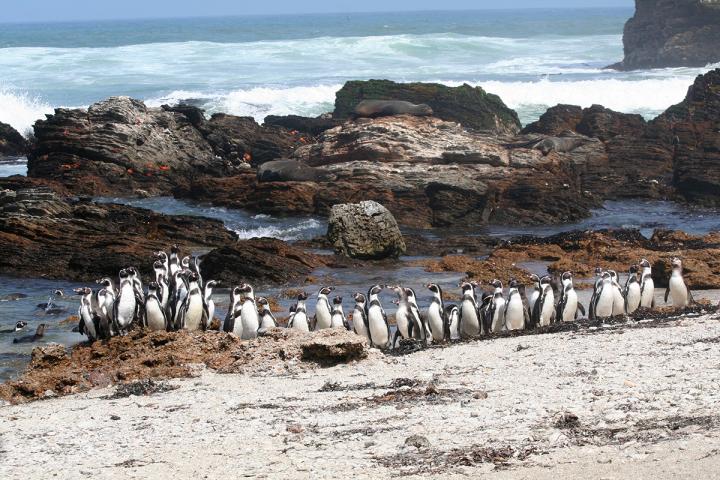
Credit: Photo by Michael Adkesson
CHAMPAIGN, Ill. — From March to December every year, Humboldt penguins nest in vast colonies on the Peruvian and Chilean coasts. The lucky ones find prime habitat for their nests in deep deposits of chalky guano where they can dig out sheltered burrows. The rest must look for rocky outcrops or other protected spaces that are more exposed to predators and environmental extremes.
In a new study, researchers looked at metabolic markers in the blood of 30 Humboldt penguins nesting in the Punta San Juan Marine Protected Area in Peru. The scientists wanted to know if there were metabolic differences between penguins nesting in the guano-rich burrows and in the exposed areas.
Nesting success is critical to the Humboldt penguins’ long-term survival as a species. Decades of aggressive guano harvesting in the late 19th and early 20th centuries – a practice eventually replaced with more sustainable methods – depleted the Peruvian coastline and near-shore islands of their historical bird guano deposits that provided habitat for nesting penguins. Guano mining, climate change and other threats have led to a dramatic decline in Humboldt penguin populations across their range. Today, there are only about 32,000 of the birds – down from hundreds of thousands less than a century ago – and their numbers continue to fall.
“Punta San Juan and other protected marine areas and reserves along the coast of Peru still provide some protected sites with good guano deposits that the penguins are able to dig into to make their nests,” said Dr. Michael Adkesson, the vice president of clinical medicine for the Chicago Zoological Society, which operates Brookfield Zoo.
Adkesson led the research with David Schaeffer, a professor emeritus of veterinary clinical medicine at the University of Illinois at Urbana-Champaign; and Jeff Levengood, a researcher with the Illinois Natural History Survey.
“We know from studies by Peruvian biologists that penguins produce more chicks with higher survival rates when they are able to dig burrow nests into guano deposits,” Adkesson said. “So we wanted to see if we could detect – based on the blood of these birds – metabolic differences that would indicate the penguins nesting in less ideal nest sites were using more energy to deal with the fact that they’re more exposed to the weather and predators.”
The task was a challenge because few studies have analyzed blood metabolites in birds and the researchers did not have a hypothesis about what they would find, said Schaeffer, who, with Levengood, conducted the statistical analyses of 19 saccharide metabolites.
Their work revealed that penguins in sheltered and unsheltered locations had consistent – and distinct – patterns of several sugars in their blood. The blood sugars that best predicted the birds’ nesting habitat included arabinose, maltose, glucose-6-phosphate and levoglucosenone.
That last sugar is a metabolic byproduct of exposure to a pollutant, levoglucosan, which is generated by the burning of cellulose. Setting fire to agricultural waste is common in regions near the nesting colony. Forest fires also generate levoglucosan. This metabolite was higher in the birds in exposed nests.
“This unexpected finding is one of the few indicators that we have that the unsheltered penguins are being exposed to more air pollution than their counterparts in burrows,” Schaeffer said.
The differences in the other saccharides likely reflect the extra metabolic stresses the penguins in exposed nest sites experience, the researchers said. More research is needed to tease out the relationships between these metabolites and their health.
“This is another tool in the toolbox of understanding what’s going on with the penguins in this region,” Adkesson said. “We know the penguins can adapt to the lack of good nesting habitat to some extent, but it’s not ideal for the long-term survival of the species. We hope that by looking at what’s going on in their blood we can better predict how changes in the environment will affect their health and reproductive success, with the ultimate goal of shaping conservation strategies that protect the penguins and their habitat.”
###
The researchers report their findings in the journal PLOS ONE.
The INHS is a division of the Prairie Research Institute at the U. of I.
Editor’s notes:
To reach Michael Adkesson, email [email protected].
To reach David Schaeffer, email [email protected].
To reach Sondra Katzen, communications director for the Chicago Zoological Society, call 708-688-8351; email: [email protected].
The paper “Effects of nest type and sex on blood saccharide profiles in Humboldt penguins (Spheniscus homboldtii): Implications for habitat conservation” is available online and from the U. of I. News Bureau.
Media Contact
Diana Yates, Life Sciences Editor, U. of I. News Bureau
[email protected]
Original Source
https:/
Related Journal Article
http://dx.