Credit: University of Texas at Austin
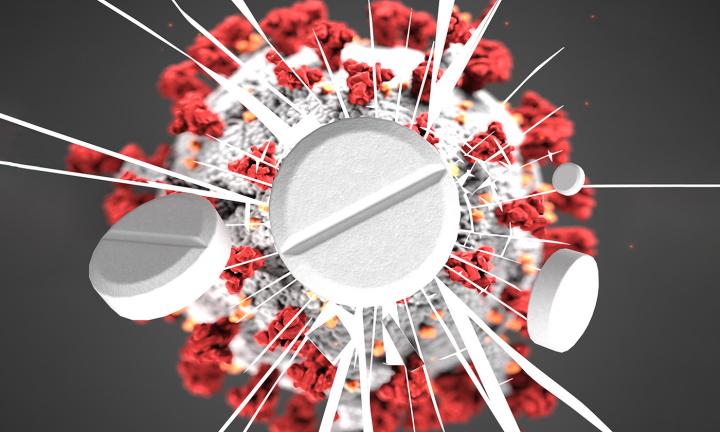
A new study from researchers at The University of Texas at Austin has found that some antivirals are useful for more than helping sick people get better — they also can prevent thousands of deaths and hundreds of thousands of virus cases if used in the early stages of infection.
The study, published today in the journal Nature Communications, focused on influenza and has implications for the coronavirus that causes COVID-19. By modeling the impact of a pair of leading flu drugs, the team found significant differences in effects between oseltamivir, an older antiviral treatment for flu that patients know by the name Tamiflu, and a newer one, baloxavir, which is sold under the brand name Xofluza.
The researchers found that the newer treatment — by effectively and rapidly stopping virus replication — dramatically reduced the length of time that an infected person is contagious and, therefore, better limited the spread of flu.
“We found that treating even 10% of infected patients with baloxavir shortly after the onset of their symptoms can indirectly prevent millions of infections and save thousands of lives during a typical influenza season,” said Robert Krug, a professor emeritus of molecular biosciences, writing for a blog that accompanied the paper.
Early basic research discoveries by Krug informed the development of baloxavir.
Krug and a team of epidemiological modelers headed by Lauren Ancel Meyers, a professor of integrative biology, concluded from the study that having a similarly effective antiviral treatment for the coronavirus would help to prevent thousands of infections and deaths. Creating such an antiviral would take time and new strategies in public health planning, but the benefits for patients, communities and health care settings could be profound.
“Imagine a drug that quashes viral load within a day and thus radically shortens the contagious period,” said Meyers, who models the spread of viruses including the virus that causes COVID-19. “Basically, we could isolate COVID-19 cases pharmaceutically rather than physically and disrupt chains of transmission.”
To date, most COVID-19 drug research efforts have prioritized existing antivirals that can be deployed quickly to treat the most seriously ill patients coping with life-threatening symptoms. The scientists acknowledge it would represent a shift to develop a new antiviral for the coronavirus, to be used early in an infection with the aim of curtailing viral replication, just as baloxavir does for flu.
“It may seem counterintuitive to focus on treatments, not for the critically ill patient in need of a life-saving intervention, but rather for the seemingly healthy patient shortly after a COVID-19 positive test,” Krug said. “Nonetheless, our analysis shows that the right early-stage antiviral treatment can block transmission to others and, in the long run, may well save more lives.”
Postdoctoral researcher Zhanwei Du carried out many of the modeling studies. UT graduate student Ciara Nugent and Alison P. Galvani of the Yale School of Public Health co-authored the paper, “Modeling mitigation of influenza epidemics by baloxavir.” The team also wrote a companion blog post about the implications for COVID-19.
###
The research was supported by grants from the National Institutes of Health, including throuthrough the Models of Infectious Disease Agent Study (MIDAS) program.
Media Contact
Christine Sinatra
[email protected]
Related Journal Article
http://dx.