Credit: by Shanshan Chen, Jianfeng Chen, Xiangdong Zhang, Zhi-Yuan Li, and Jiafang Li
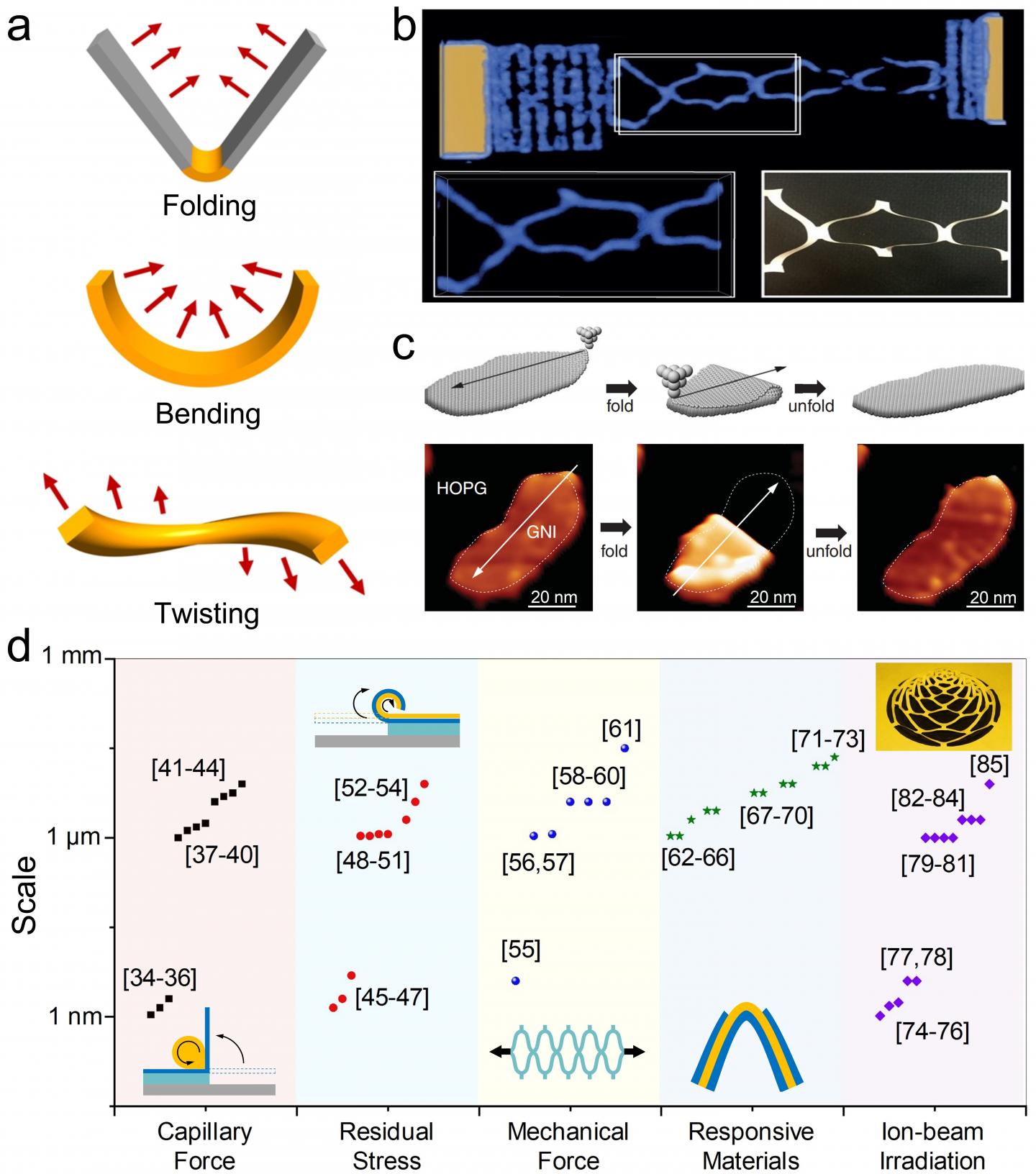
3D micro-/nanofabrication holds the key to build a large variety of micro-/nanoscale materials, structures, devices, and systems with unique properties that do not manifest in their 2D planar counterparts. Recently, scientists have explored some very different 3D fabrication strategies such as kirigami and origami that make use of the science of cutting and folding 2D materials/structures to create versatile 3D shapes. Such new methodologies enable continuous and direct 2D-to-3D transformations through folding, bending and twisting, with which the occupied space can vary “nonlinearly” by several orders of magnitude compared to the conventional 3D fabrications. More importantly, these new-concept kirigami/origami techniques provide an extra degree of freedom in creating unprecedented 3D micro-/nanogeometries beyond the imaginable designs of conventional subtractive and additive fabrication.
In a new paper published in Light: Science & Applications, Chinese scientists from Beijing Institute of Technology and South China University of Technology made a comprehensive review on some of the latest progress in kirigami/origami in micro-/nanoscale. Aiming to unfold this new regime of advanced 3D micro-/nanofabrication, they introduced and discussed various stimuli of kirigami/origami, including capillary force, residual stress, mechanical stress, responsive force and focused-ion-beam irradiation induced stress, and their working principles in the micro-/nanoscale region. The focused-ion-beam based nano-kirigami, as a prominent example coined in 2018 by the team, was highlighted particularly as an instant and direct 2D-to-3D transformation technique. In this method, the focused ion beam was employed to cut the 2D nanopatterns like “knives/scissors” and gradually “pull” the nanopatterns into complex 3D shapes like “hands”. By utilizing the topography-guided stress within the nanopatterns, versatile 3D shape transformations such as upward buckling, downward bending, complex rotation and twisting of nanostructures were precisely achieved.
As discussed in this review, the unprecedented micro-/nanoscale geometries created by kirigami/origami have brought about extensive potentials for the reshaping of 2D materials, as well as in biological, optical, and reconfigurable applications. Moreover, 3D transformations of emerging 2D materials (such as graphene, MoS2, MoS2, WSe2 and PtSe2), for example, were briefly introduced and the associated new electrical and mechanical properties were uncovered.
“Advanced kirigami/origami provides an easily accessible approach for the modulation of mechanical, electrical, magnetic and optical properties of existing materials, with remarkable flexibility, diversity, functionality, generality and reconfigurability”, they said. “These key features clearly differentiate the facile kirigami/origami from other complicated 3D nanofabrication techniques, and make this new paradigm technique unique and promising for solving many difficult problems in practical applications of micro/nano-devices.”
Furthermore, they discussed the current challenges in kirigami/origami-based 3D micro-/nanofabrication, such as the limited strategies of stimuli and reconfigurations, and the difficulties in on-chip and large-scale integration. “When these challenges are met and the advantages are fully adopted,” they envisioned, “micro-/nanoscale kirigami/origami will greatly innovate the regime of 3D micro-/nanofabrication. Unprecedented physical characteristics and extensive functional applications can be achieved in wide areas of optics, physics, biology, chemistry and engineering. These new-concept technologies, with breakthrough prototypes, could provide useful solutions for novel LIDAR/LADAR systems, high-resolution spatial light modulators, integrated optical reconfigurations, ultra-sensitive biomedical sensors, on-chip biomedical diagnosis and the emerging nano-opto-electro-mechanical systems.”
###
Media Contact
Jiafang Li
[email protected]
Related Journal Article
http://dx.