• HOME
  • NEWS
  • EXPLORE
    • CAREER
      • Companies
      • Jobs
    • EVENTS
    • iGEM
      • News
      • Team
    • PHOTOS
    • VIDEO
    • WIKI
  • BLOG
  • COMMUNITY
    • FACEBOOK
    • INSTAGRAM
    • TWITTER
Saturday, February 7, 2026
BIOENGINEER.ORG
No Result
View All Result
  • Login
  • HOME
  • NEWS
  • EXPLORE
    • CAREER
      • Companies
      • Jobs
        • Lecturer
        • PhD Studentship
        • Postdoc
        • Research Assistant
    • EVENTS
    • iGEM
      • News
      • Team
    • PHOTOS
    • VIDEO
    • WIKI
  • BLOG
  • COMMUNITY
    • FACEBOOK
    • INSTAGRAM
    • TWITTER
  • HOME
  • NEWS
  • EXPLORE
    • CAREER
      • Companies
      • Jobs
        • Lecturer
        • PhD Studentship
        • Postdoc
        • Research Assistant
    • EVENTS
    • iGEM
      • News
      • Team
    • PHOTOS
    • VIDEO
    • WIKI
  • BLOG
  • COMMUNITY
    • FACEBOOK
    • INSTAGRAM
    • TWITTER
No Result
View All Result
Bioengineer.org
No Result
View All Result
Home NEWS Science News Chemistry

High-security identification that cannot be counterfeited

Bioengineer by Bioengineer
May 26, 2020
in Chemistry
Reading Time: 2 mins read
0
IMAGE
Share on FacebookShare on TwitterShare on LinkedinShare on RedditShare on Telegram

Researchers from the University of Tsukuba create millimeter-size chips with unique color patterns that cannot be forged
IMAGE

Credit: University of Tsukuba

Tsukuba, Japan – Try whispering at one end of the Echo Wall in the Temple of Heaven in Beijing. People at the far end of the curved wall will still hear you, from 65 meters away. This is the whispering-gallery effect. Now, researchers from Japan have used the underlying principles of the whispering-gallery effect to stop counterfeiters in their tracks.

High-security identification should be exceptionally resistant to counterfeiting. Unfortunately, identity thieves eventually learn how to duplicate even highly complex patterns. The only way to permanently defeat identity thieves is to create a pattern that is impossible to duplicate.

In a study published this month in Materials Horizons, researchers from the University of Tsukuba used whispering-gallery waves to create a pattern that cannot be duplicated. In so doing, they created a new, impenetrable anti-counterfeiting system.

“Instead of using sound waves, we used light waves to follow the concave surface of micrometer-size dye particles,” explains Professor Yohei Yamamoto, senior author of the study. “This creates a complex color pattern that cannot be counterfeited.”

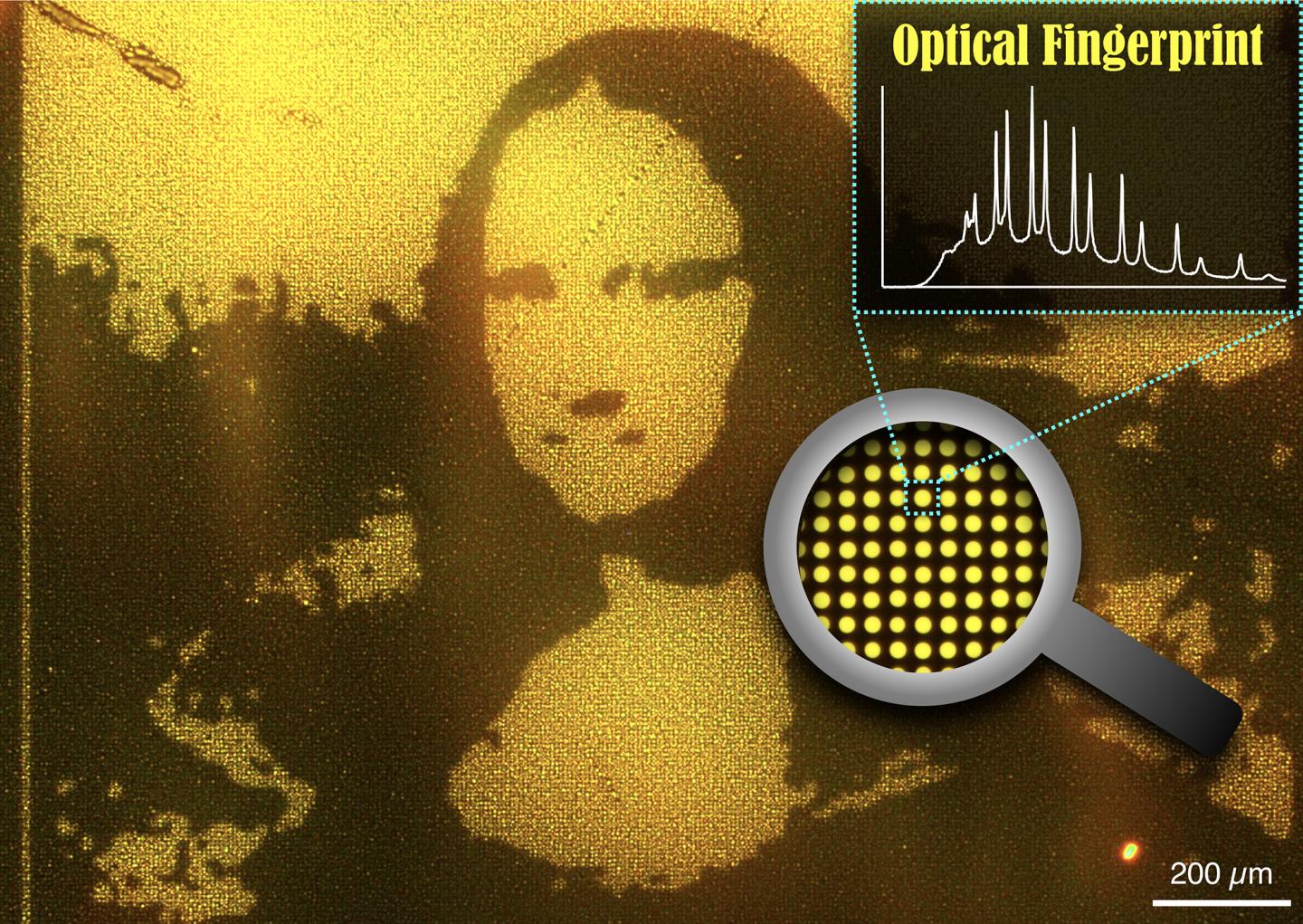
To create their millimeter-size microchips, the researchers first deposited small dye particles, where fluorescence from the particles can be turned on and off. They then selectively lit up the chip in a defined pattern; regions of bright particles, and regions of dark particles.

Each dye particle has a unique diameter and shape. Because of the principles that underpin the whispering-gallery effect–in this case, light instead of sound–the fluorescence emitted by each particle is unique. This creates a unique color pattern, a fingerprint, across the microchip that is impossible to reproduce or forge.

“We attained a pixel density of several million per square centimeter on our optimized microchips,” says Professor Yamamoto. “We have developed a high-security, two-step optical authentication system: the micropattern itself, and the underlying pixel-by-pixel fluorescence fingerprint of the microchip.”

The researchers used their technology to create a millimeter-size approximation of the Mona Lisa. This approximation contains a unique, embedded fluorescence fingerprint that cannot be duplicated.

Businesses, governments, and many other organizations require unambiguous authentication that cannot be forged. By using a microchip that is impossible to counterfeit, high-security organizations have a new option for preventing fraud, ensuring secrecy, and vouching for the integrity of data and equipment.

###

Media Contact
Naoko Yamashina
[email protected]

Related Journal Article

http://dx.doi.org/10.1039/D0MH00566E

Tags: Chemistry/Physics/Materials SciencesMaterialsOptics
Share12Tweet8Share2ShareShareShare2

Related Posts

blank

Breakthrough in Environmental Cleanup: Scientists Develop Solar-Activated Biochar for Faster Remediation

February 7, 2026
blank

Cutting Costs: Making Hydrogen Fuel Cells More Affordable

February 6, 2026

Scientists Develop Hand-Held “Levitating” Time Crystals

February 6, 2026

Observing a Key Green-Energy Catalyst Dissolve Atom by Atom

February 6, 2026
Please login to join discussion

POPULAR NEWS

  • Robotic Ureteral Reconstruction: A Novel Approach

    Robotic Ureteral Reconstruction: A Novel Approach

    82 shares
    Share 33 Tweet 21
  • Digital Privacy: Health Data Control in Incarceration

    63 shares
    Share 25 Tweet 16
  • Study Reveals Lipid Accumulation in ME/CFS Cells

    57 shares
    Share 23 Tweet 14
  • Breakthrough in RNA Research Accelerates Medical Innovations Timeline

    53 shares
    Share 21 Tweet 13

About

We bring you the latest biotechnology news from best research centers and universities around the world. Check our website.

Follow us

Recent News

Decoding Prostate Cancer Origins via snFLARE-seq, mxFRIZNGRND

Digital Health Perspectives from Baltic Sea Experts

Florida Cane Toad: Complex Spread and Selective Evolution

Subscribe to Blog via Email

Enter your email address to subscribe to this blog and receive notifications of new posts by email.

Join 73 other subscribers
  • Contact Us

Bioengineer.org © Copyright 2023 All Rights Reserved.

Welcome Back!

Login to your account below

Forgotten Password?

Retrieve your password

Please enter your username or email address to reset your password.

Log In
No Result
View All Result
  • Homepages
    • Home Page 1
    • Home Page 2
  • News
  • National
  • Business
  • Health
  • Lifestyle
  • Science

Bioengineer.org © Copyright 2023 All Rights Reserved.