• HOME
  • NEWS
  • EXPLORE
    • CAREER
      • Companies
      • Jobs
    • EVENTS
    • iGEM
      • News
      • Team
    • PHOTOS
    • VIDEO
    • WIKI
  • BLOG
  • COMMUNITY
    • FACEBOOK
    • INSTAGRAM
    • TWITTER
Monday, March 30, 2026
BIOENGINEER.ORG
No Result
View All Result
  • Login
  • HOME
  • NEWS
  • EXPLORE
    • CAREER
      • Companies
      • Jobs
        • Lecturer
        • PhD Studentship
        • Postdoc
        • Research Assistant
    • EVENTS
    • iGEM
      • News
      • Team
    • PHOTOS
    • VIDEO
    • WIKI
  • BLOG
  • COMMUNITY
    • FACEBOOK
    • INSTAGRAM
    • TWITTER
  • HOME
  • NEWS
  • EXPLORE
    • CAREER
      • Companies
      • Jobs
        • Lecturer
        • PhD Studentship
        • Postdoc
        • Research Assistant
    • EVENTS
    • iGEM
      • News
      • Team
    • PHOTOS
    • VIDEO
    • WIKI
  • BLOG
  • COMMUNITY
    • FACEBOOK
    • INSTAGRAM
    • TWITTER
No Result
View All Result
Bioengineer.org
No Result
View All Result
Home NEWS Science News Biology

Bricks made from plastic, organic waste

Bioengineer by Bioengineer
May 26, 2020
in Biology
Reading Time: 3 mins read
0
IMAGE
Share on FacebookShare on TwitterShare on LinkedinShare on RedditShare on Telegram

New binding solution targets construction uses
IMAGE

Credit: Flinders University

Revolutionary ‘green’ types of bricks and construction materials could be made from recycled PVC, waste plant fibres or sand with the help of a remarkable new kind of rubber polymer discovered by Australian scientists.

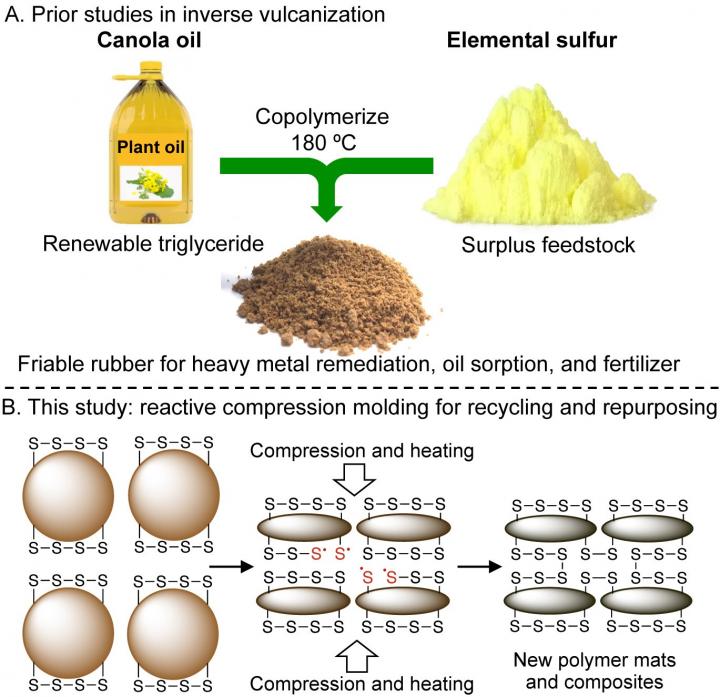
The rubber polymer, itself made from sulfur and canola oil, can be compressed and heated with fillers to create construction materials of the future, say researchers in the Young Chemist issue of Chemistry – A European Journal.

“This method could produce materials that may one day replace non-recyclable construction materials, bricks and even concrete replacement,” says Flinders University organic chemist Associate Professor Justin Chalker.

The powdered rubber can potentially be used as tubing, rubber coatings or bumpers, or compressed, heated then mixed with other fillers to form entirely new composites, including more sustainable building blocks, concrete replacement or insulation.

Cement is a finite resource and heavily polluting in its production, with concrete production estimated to contribute more than 8% of global greenhouse gases emissions, and the construction industry worldwide accounting for about 18%.

“This is also important because there are currently few methods to recycle PVC or carbon fibre,” says Associate Professor Chalker and collaborator Dr Louisa Esdaile, with support from other Flinders, Deakin University and University of Western Australia researchers.

“This new recycling method and new composites are an important step forward in making sustainable construction materials, and the rubber material can be repeatedly ground up and recycled,” says lead author Flinders PhD Nic Lundquist. “The rubber particles also can be first used to purify water and then repurposed into a rubber mat or tubing.”

Co-author and research collaborator Dr Louisa Esdaile says the important research looks at ways to repurpose and recycle materials, so that these materials are multi-use by design.

“Such technology is important in a circular economy,” says Dr Esdaile, a special contributor to this month’s Young Chemist issue of Chemistry – A European Journal (ChemEurJ).

The new manufacturing and recycling technique, labelled ‘reactive compression molding,’ applies to rubber material that can be compressed and stretched, but one that doesn’t melt. The unique chemical structure of the sulfur backbone in the novel rubber allows for multiple pieces of the rubber to bond together.

The project started two years ago in the Flinders University Chalker Laboratory as a third-year project by Ryan Shapter, with Flinders University PhD candidates Nicholas Lundquist and Alfrets Tikoalu and others contributing to the paper in this month’s special Young Chemist issue of ChemEurJ.

###

‘Reactive compression molding post-inverse vulcanization: A method to assemble, recycle, and repurpose sulfur polymers and composites’ (May 2020) by N Lundquist, A Tikoalu, M Worthington, R Shapter, S Tonkin, F Stojcevski, M Mann, C Gibson, J Gascooke, A Karton, L Henderson, L Esdaile, JM Chalker in Chemistry – A European Journal. DOI: 10.1002/chem.202001841

The Chalker Lab at Flinders University has previously developed sulfur polymers for a number of applications in mopping up environmental pollutants – from oil spills in water and mercury and heavy metals in soil.

https://doi.org/10.1002/chem.202001841

Media Contact
Dr Louisa Esdaile
[email protected]

Related Journal Article

http://dx.doi.org/10.1002/chem.202001841

Tags: BiochemistryChemistry/Physics/Materials SciencesIndustrial Engineering/ChemistryMaterialsNanotechnology/MicromachinesPollution/Remediation
Share12Tweet8Share2ShareShareShare2

Related Posts

Squirrels Scale Greater Heights to Access Superior Snacks

Squirrels Scale Greater Heights to Access Superior Snacks

March 30, 2026
New Zebrafish Study Sheds Light on Why Haploid Fish Embryos Often Fail to Fully Develop

New Zebrafish Study Sheds Light on Why Haploid Fish Embryos Often Fail to Fully Develop

March 30, 2026

Boron Neutron Capture Therapy: A Breakthrough in Cancer Treatment

March 29, 2026

Bacteria Integrate Polyfluoroalkyl Carboxylates into Membranes

March 29, 2026
Please login to join discussion

POPULAR NEWS

  • blank

    Revolutionary AI Model Enhances Precision in Detecting Food Contamination

    96 shares
    Share 38 Tweet 24
  • Imagine a Social Media Feed That Challenges Your Views Instead of Reinforcing Them

    1005 shares
    Share 397 Tweet 248
  • Promising Outcomes from First Clinical Trials of Gene Regulation in Epilepsy

    51 shares
    Share 20 Tweet 13
  • Advancements in EV Battery Technology to Surpass Climate Change-Induced Degradation

    45 shares
    Share 18 Tweet 11

About

We bring you the latest biotechnology news from best research centers and universities around the world. Check our website.

Follow us

Recent News

Prioritize Intensity Over Duration: How Harder Exercise Lowers Disease and Mortality Risks

Squirrels Scale Greater Heights to Access Superior Snacks

New Zebrafish Study Sheds Light on Why Haploid Fish Embryos Often Fail to Fully Develop

Subscribe to Blog via Email

Enter your email address to subscribe to this blog and receive notifications of new posts by email.

Join 78 other subscribers
  • Contact Us

Bioengineer.org © Copyright 2023 All Rights Reserved.

Welcome Back!

Login to your account below

Forgotten Password?

Retrieve your password

Please enter your username or email address to reset your password.

Log In
No Result
View All Result
  • Homepages
    • Home Page 1
    • Home Page 2
  • News
  • National
  • Business
  • Health
  • Lifestyle
  • Science

Bioengineer.org © Copyright 2023 All Rights Reserved.