In a study led by Miguel Ángel González Ballester, ICREA research professor with the DTIC in collaboration with Eduard Gratacós and Elisenda Eixarch, researches at the BCNatal-Barcelona Center for Maternal-Fetal and Neonatal Medicine
Credit: UPF
Twin-to-twin transfusion syndrome (TTTS) occurs in around 10-15% of pregnancies with twins that share the same placenta. Typically, this syndrome appears before 24 weeks’ gestation due to abnormal vascular communications located on the surface of the placenta. As a result, blood circulation is not balanced between the two twins, dramatically decreasing their chances of survival.
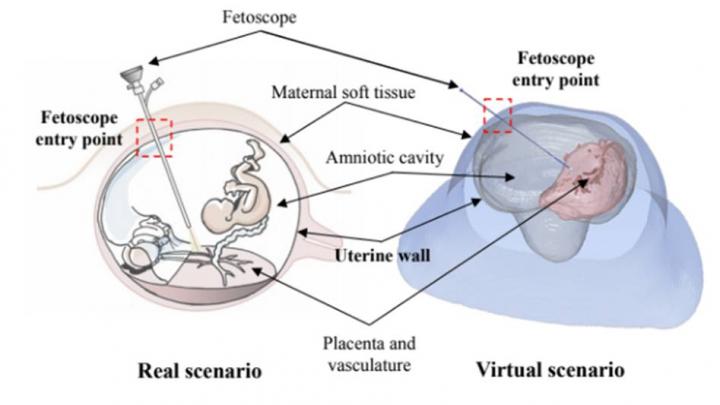
Fetoscopic laser photocoagulation is the most effective treatment for this syndrome and it consists of closing abnormal vascular connections located on the surface of the placenta to completely separate the circulation of blood to the two twins, thus preventing complications related to blood flow imbalance, such as death by cardiac overload, premature delivery and miscarriage.
The manoeuvrability of the fetoscope inserted through the uterine wall of the mother and the ability to burn all vessels that require sealing depends on the proper selection of the fetoscope entry point on the surface of the intrauterine cavity. Planning the best insertion point before the operation requires a good understanding of the patient’s anatomy, which can be achieved using a virtual representation of the mother’s uterus, via magnetic resonance imaging.
A study recently published in the advanced online edition of the journal IEEE Transactions on Medical Imaging presents the first automatic method to detect and segment the intrauterine cavity via three views (axial, sagittal and coronal) of the MRI by means of artificial intelligence and deep learning techniques.
A study conducted by Miguel Ángel González Ballester, ICREA research professor with the Department of Information and Communication Technologies (DTIC) at UPF, with Jordina Torrents-Barrena, first author of the study, Gemma Piella and Mario Ceresa, members of the UPF BCN MedTech Unit. Eduard Gratacós and Elisenda Eixarch, members of the Fetal i+D Fetal Medicine Research Center, BCNatal-Barcelona Center for Maternal-Fetal and Neonatal Medicine (Hospital Clínic and Hospital Sant Joan de Déu), IDIBAPS, are co-authors of the study and responsible for the clinics.
“The methodology presented uses neural networks based on the new paradigm of capsules to successfully capture the interdependency of the anatomy present in the MRI, particularly for unique class instances (anatomies), such as the intrauterine cavity and/or placenta”, explains Jordina Torrents-Barrena, first author of the paper.
“The method designed is based on a reinforcement learning framework that uses capsules to delimit the location of the uterus. A capsule architecture is subsequently designed to segment (or refine) the whole intrauterine cavity”, Torrents-Barrena adds. The latter network encodes the most discriminatory and robust features in the image.
The proposed method is evaluated by 13 performance measures and is also compared to 15 neural networks that have been previously published in the literature. “Our artificial intelligence method has been trained using magnetic resonance imaging from 71 pregnancies”, Torrents-Barrena affirms.
“Having a three-dimensional representation allows us to evaluate different entry points and choose the one that offers the best visibility of all placental vessels with the slightest movement”, comments Elisenda Eixarch, co-author of the study. “Undoubtedly, the application of this technology will allow us to move towards safer, more precise surgery”, she adds.
On average, the methodology presented obtains a segmentation performance of over 91% for all tests and comparisons, highlighting the potential of this approach for use in the daily clinical practice as a surgical planning method.
###
Media Contact
Nuria Perez
[email protected]
Original Source
https:/
Related Journal Article
http://dx.