Great Barrier Reef research finds the destructive starfish is eaten more often than thought
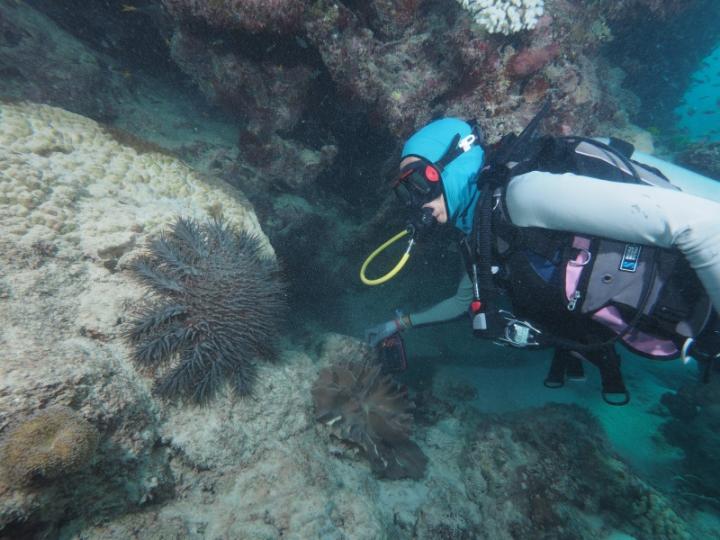
Credit: D.Westcott/CSIRO
Crown-of-thorns starfish are on the menu for many more fish species than previously suspected, an investigation using fish poo and gut goo reveals.
The finding suggests that some fish, including popular eating and aquarium species, might have a role to play in keeping the destructive pest population under control.
The native starfish (Acanthaster solaris) is responsible for widespread damage to the Great Barrier Reef. Since 1962 its population has surged to plague proportions on three occasions, each time causing the loss of large amounts of hard coral. A fourth outbreak is currently underway.
Increasing the amount of predation on starfish has long been touted as a potential solution to preventing outbreaks. However, aside from a mollusc called the Giant Triton (Charonia tritonis), identifying what eats it has been a challenging task.
Now, a team of scientists led by Dr Frederieke Kroon from the Australian Institute of Marine Science in Townsville, Australia, has applied a genetic marker unique for crown-of-thorns, developed at AIMS, to detect the presence of starfish DNA in fish poo and gut contents.
Over three years, Dr Kroon’s team used it on samples taken from 678 fish from 101 species, comprising 21 families, gathered from reefs experiencing varying levels of starfish outbreak.
“Our results strongly indicate that direct fish predation on crown-of-thorns may well be more common than is currently appreciated,” said Dr Kroon.
The study, published in the journal Scientific Reports, confirms that at least 18 coral reef fish species – including Spangled Emperor (Lethrinus nebulosus), Redthroat Emperor (Lethrinus miniatus) and Blackspotted Puffer (Arothron nigropunctatus) – consume young or adult starfish on the reef.
Among the species were nine which had not been previously reported to feed on crown-of-thorns. These include the Neon Damsel (Pomacentrus coelistis), Redspot Emperor (Lethrinus lentjan), and the Blackspot Snapper (Lutjanus fulviflama).
“Our findings might also solve a mystery – why reef areas that are closed to commercial and recreational fishing tend to have fewer starfish than areas where fishing is allowed,” said Dr Kroon.
She and colleagues from AIMS worked with researchers from CSIRO Land and Water and managers from the Great Barrier Reef Marine Park Authority to conduct the study.
“This innovative research sheds new light on the extent that coral reef fishes eat crown-of-thorns starfish,” said Mr Darren Cameron, co-author of the paper, and Director of the COTS Control Program at the Great Barrier Reef Marine Park Authority.
“A number of the fish species shown to feed on these starfish are caught by commercial and recreational fisheries, highlighting the importance of marine park zoning and effective fisheries management in controlling crown-of-thorns starfish across the Great Barrier Reef.”
###
This research was supported by funding from the Ian Potter Foundation 50th Anniversary Commemorative Grants Scheme; the Lizard Island Reef Research Foundation; and the Australian Government’s National Environmental Science Program’s Tropical Water Quality Hub.
Media Contact
Andrew Masterson
[email protected]