• HOME
  • NEWS
  • EXPLORE
    • CAREER
      • Companies
      • Jobs
    • EVENTS
    • iGEM
      • News
      • Team
    • PHOTOS
    • VIDEO
    • WIKI
  • BLOG
  • COMMUNITY
    • FACEBOOK
    • INSTAGRAM
    • TWITTER
Monday, October 5, 2026
BIOENGINEER.ORG
No Result
View All Result
  • Login
  • HOME
  • NEWS
  • EXPLORE
    • CAREER
      • Companies
      • Jobs
        • Lecturer
        • PhD Studentship
        • Postdoc
        • Research Assistant
    • EVENTS
    • iGEM
      • News
      • Team
    • PHOTOS
    • VIDEO
    • WIKI
  • BLOG
  • COMMUNITY
    • FACEBOOK
    • INSTAGRAM
    • TWITTER
No Result
View All Result
Bioengineer.org
No Result
View All Result
Home NEWS Science News

NASA analyzes developing System 90L in Straits of Florida

Bioengineer by Bioengineer
May 15, 2020
in Science News
Reading Time: 2 mins read
0
IMAGE
Share on FacebookShare on TwitterShare on LinkedinShare on RedditShare on Telegram

IMAGE

Credit: Credit: NASA/NRL

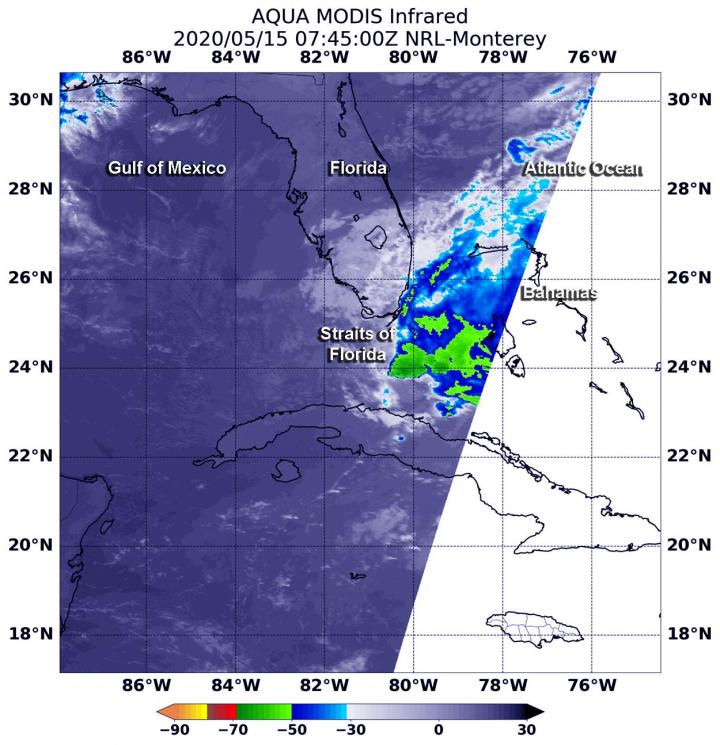
A low-pressure area designated as System 90L appears to be developing in the Straits of Florida, located between Southern Florida and Cuba. NASA’s Aqua satellite measured cloud top temperatures within the developing system and found some stronger storms.

At 8:50 a.m. EDT on May 15, NOAA’s National Hurricane Center (NHC) issued a Special Tropical Weather Outlook issued to discuss the potential for tropical or subtropical development near the northwest Bahamas.

The Outlook stated, “A trough (elongated area) of low pressure located over the Straits of Florida continues to produce disorganized shower activity and gusty winds across the Florida Keys, portions of southeast Florida, and the northwestern Bahamas. Gradual development of this system is expected, and it will likely become a tropical or subtropical storm on Saturday [May 16] when it is located near the northwestern Bahamas. Later in the weekend and early next week, the system is expected to move generally northeastward over the western Atlantic (Ocean).”

NASA’s Aqua satellite provided information to NHC forecasters. One kind of data Aqua provides is infrared light to analyze the strength of storms by providing temperature information about the system’s clouds. The strongest thunderstorms that reach high into the atmosphere have the coldest cloud top temperatures.

On May 15 at 3:45 a.m., EDT (0745 UTC) the Moderate Resolution Imaging Spectroradiometer or MODIS instrument that flies aboard NASA’s Aqua satellite gathered infrared data on 90L. Strongest thunderstorms had cloud top temperatures as cold as minus 50 degrees Fahrenheit (minus 45.5 Celsius). As cloud tops continue to cool, they stretch higher into the troposphere. NASA research has shown that when cloud top temperatures drop to minus 70 degrees Fahrenheit (minus 56.6 degrees Celsius), storms have the ability to generate heavy rain.

The NHC Outlook stated, “Regardless of development, the disturbance will continue to bring heavy rainfall to portions of the Florida Keys, southeast Florida and the Bahamas through Saturday. Tropical storm-force wind gusts are also possible across portions of the Florida Keys, southeast Florida, and the Bahamas during the next day or so. In addition, hazardous marine conditions are expected along the Florida east coast and in the Bahamas where Gale Warnings are in effect. Dangerous surf conditions and rip currents are possible along portions of the southeast U.S. coast this weekend and early next week.”

The NHC said that the formation chance through 48 hours and out through 5 days is high.

Tropical cyclones and hurricanes are the most powerful weather events on Earth. NASA’s expertise in space and scientific exploration contributes to essential services provided to the American people by other federal agencies, such as hurricane weather forecasting.

###

For updated forecasts, visit: http://www.nhc.noaa.gov.

Media Contact
Rob Gutro
[email protected]

Original Source

https://blogs.nasa.gov/hurricanes/2020/05/15/90l-atlantic-ocean/

Tags: Atmospheric ChemistryAtmospheric ScienceClimate ChangeClimate ScienceEarth ScienceMeteorologyTechnology/Engineering/Computer ScienceTemperature-Dependent PhenomenaWeather/Storms
Share12Tweet8Share2ShareShareShare2

Related Posts

Gel-Based Thin Film Gives Robots Smooth, Variable Clutching at Just 100 Volts

Gel-Based Thin Film Gives Robots Smooth, Variable Clutching at Just 100 Volts

October 5, 2026
A Simple Mathematical Tweak Unlocks BERT's Hidden Power for Chinese Word Meaning

A Simple Mathematical Tweak Unlocks BERT’s Hidden Power for Chinese Word Meaning

October 5, 2026

Tooth Root Canal Test for Telling Adults from Minors Gets Its First Spanish Trial

October 5, 2026

Dual-Teacher AI Learns to Segment Abdominal Organs From Scarce Labels and Knows When to Stop

October 5, 2026
Please login to join discussion

POPULAR NEWS

  • Alloys That Shrink Their Own Grains: New PIX Mechanism Refines Metals With Heat Alone

    Alloys That Shrink Their Own Grains: New PIX Mechanism Refines Metals With Heat Alone

    29 shares
    Share 12 Tweet 7
  • Endurance Exercise Reshapes the Liver in Males and Females Through Distinct Molecular Routes

    29 shares
    Share 12 Tweet 7
  • Single Transcription Factor PU.1 Rapidly Converts Fibroblasts into Macrophage-Lineage Cells

    29 shares
    Share 12 Tweet 7
  • New Scale Measures How Ready Nurse Educators Really Are for the AI Era

    29 shares
    Share 12 Tweet 7

About

We bring you the latest biotechnology news from best research centers and universities around the world. Check our website.

Follow us

Recent News

Alloys That Shrink Their Own Grains: New PIX Mechanism Refines Metals With Heat Alone

Endurance Exercise Reshapes the Liver in Males and Females Through Distinct Molecular Routes

Single Transcription Factor PU.1 Rapidly Converts Fibroblasts into Macrophage-Lineage Cells

Subscribe to Blog via Email

Success! An email was just sent to confirm your subscription. Please find the email now and click 'Confirm' to start subscribing.

Join 85 other subscribers
  • Contact Us

Bioengineer.org © Copyright 2023 All Rights Reserved.

Welcome Back!

Login to your account below

Forgotten Password?

Retrieve your password

Please enter your username or email address to reset your password.

Log In
No Result
View All Result
  • Homepages
    • Home Page 1
    • Home Page 2
  • News
  • National
  • Business
  • Health
  • Lifestyle
  • Science

Bioengineer.org © Copyright 2023 All Rights Reserved.