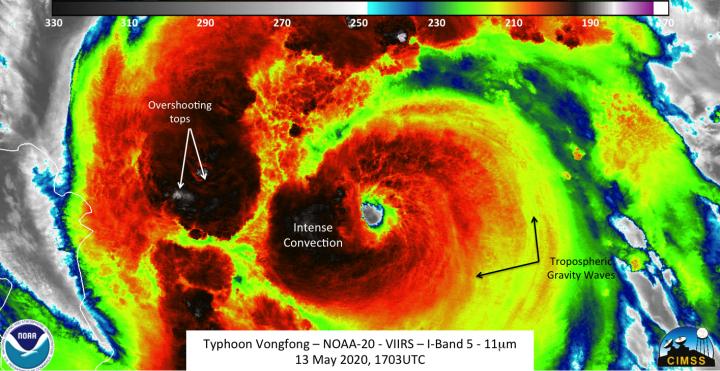
Credit: Credit: NOAA/William Straka III, Univ. of Wisconsin Madison
NASA and NOAA satellites have been providing forecasters with satellite data that showed the strength and extent of Typhoon Vongfong as it made landfall in the Philippines and continued to track through the country. Warnings were in effect throughout several areas of the Philippines on May 14.
The NOAA-20 satellite saw Typhoon Vongfong at 12:03 p.m. EDT (1703 UTC) on May 13. “The imagery showed features that one would expect from an intensifying storm, including overshooting tops and tropospheric gravity waves,” said William Straka III of the University of Wisconsin- Madison, who created the imagery using the satellite data. “In addition, a clear eye could be seen as well.”
The infrared image also showed cloud top temperatures. Coldest cloud top temperatures are indicative of strongest storms because their cloud tops are pushed high into the atmosphere by strong uplift of air. NOAA-20 showed that the colder temperatures (where the convection is located) surrounds the circulation center, a sign of a mature tropical system.
The Visible Infrared Imaging Radiometer Suite (VIIRS) instrument aboard NASA-NOAA’s Suomi NPP satellite provided a visible image of Typhoon Vongfong as it was making landfall in the east central Philippines on May 14. Vongfong made landfall in Samar. Samar is the third largest island in the Philippines, and is located in eastern Visayas region.
The VIIRS image showed bands of powerful thunderstorms north of the center and tightly around the center of circulation. Visible imagery has revealed that the eye has closed as the storm has started to weaken.
Warnings are posted throughout the Philippines on May 14. Tropical cyclone wind signal number #3 is in effect for Visayas: including Northern Samar and northern parts of eastern Samar and of Samar Luzon: Sorsogon, Albay, Masbate, Ticao Islands, Burias Islands, Catanduanes, southern parts of Camarines Sur. Tropical cyclone wind signal number 2 is also in effect for Visayas: for the northernmost part of Leyte, rest of Samar and rest of eastern Samar. Wind signal 2 is also in effect for Luzon: Camarines Norte, rest of Camarines Sur, southern parts of Quezon and Marinduque. Tropical cyclone wind signal number 1 covers Visayas and Luzon. In Visayas: Wind Signal 1 covers the rest of northern portion of Leyte, northeastern parts of Capiz and of Iloilo, and in Luzon: it covers Aurora, Bulacan, Metro Manila, Cavite, Laguna, Batangas, Rizal, rest of Quezon, Romblon, Bataan and Pampanga.
At 11 a.m. EDT (1500 UTC) on May 14, 0the Joint Typhoon Warning Center (JTWC) noted that the center of Vongfong was located near latitude 12.5 degrees north and longitude 124.5 degrees east, about 266 nautical miles east-southeast of Manila, Philippines. Vongfong was moving to the northwest and maximum sustained winds had decreased from 100 knots (115 mph/185 kph) to 85 knots (98 mph/157 kph) over the previous six hours.
The forecast from JTWC has Typhoon Vongfong weakening as it moves on a northerly track over the Visayas and Luzon regions of the Philippines, and then finally curving back into the Northwestern Pacific Ocean.
###
By Rob Gutro/ William Straka III
NASA’s Goddard Space Flight Center/University of Wisconsin Madison/SSEC/CIMSS
Media Contact
Rob Gutro
[email protected]
Original Source
https:/