• HOME
  • NEWS
  • EXPLORE
    • CAREER
      • Companies
      • Jobs
    • EVENTS
    • iGEM
      • News
      • Team
    • PHOTOS
    • VIDEO
    • WIKI
  • BLOG
  • COMMUNITY
    • FACEBOOK
    • INSTAGRAM
    • TWITTER
Saturday, February 7, 2026
BIOENGINEER.ORG
No Result
View All Result
  • Login
  • HOME
  • NEWS
  • EXPLORE
    • CAREER
      • Companies
      • Jobs
        • Lecturer
        • PhD Studentship
        • Postdoc
        • Research Assistant
    • EVENTS
    • iGEM
      • News
      • Team
    • PHOTOS
    • VIDEO
    • WIKI
  • BLOG
  • COMMUNITY
    • FACEBOOK
    • INSTAGRAM
    • TWITTER
  • HOME
  • NEWS
  • EXPLORE
    • CAREER
      • Companies
      • Jobs
        • Lecturer
        • PhD Studentship
        • Postdoc
        • Research Assistant
    • EVENTS
    • iGEM
      • News
      • Team
    • PHOTOS
    • VIDEO
    • WIKI
  • BLOG
  • COMMUNITY
    • FACEBOOK
    • INSTAGRAM
    • TWITTER
No Result
View All Result
Bioengineer.org
No Result
View All Result
Home NEWS Science News

Scientists measured electrical conductivity of pure interfacial water

Bioengineer by Bioengineer
May 7, 2020
in Science News
Reading Time: 2 mins read
0
IMAGE
Share on FacebookShare on TwitterShare on LinkedinShare on RedditShare on Telegram

IMAGE

Credit: Journal of Physical Chemistry Letters

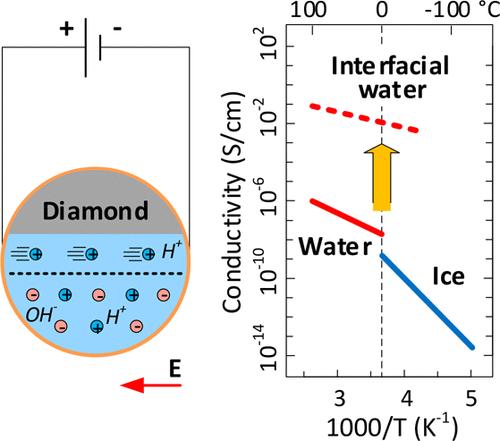
Skoltech scientists in collaboration with researchers from the University of Stuttgart, the Karlsruhe Institute of Technology and the Russian Quantum Center achieved the first systematic experimental measurements of the electrical conductivity of pure interfacial water, hence producing new results significantly extending our knowledge of interfacial water.

Interfacial water may be found everywhere around us. Biological systems, electrochemical devices, food preservation methods, climate-related processes to name a few, all depend on the properties of water near interfaces. However, direct access to the physical-chemical properties of pure interfacial water is arduous and explains why much remains to be discovered and understood.

The results obtained by the scientists from the Skoltech Center for Energy Science and Technology (CEST) in collaboration with German researchers provide new and detailed insights into complex fluids. The discovery of new electrical properties of interfacial water will clearly have impact on the future development of electrochemical systems, both for electrical power generation and storage.

“We used diamond-based ceramics with open-pore structure filled with water. By consistent reduction of the pore size from 500 nm to 5 nm, we increased the interfacial-to-bulk-water ratio up to its maximum, at which point the interfacial water showed anomalous DC conductivity, five orders of magnitude higher than that of the bulk water. Our analysis shows that this unusual conductivity is a genuine intrinsic property of the interfacial water, as the surface chemistry contribution clearly appears not to be the dominant one,” explains Vasily Artemov, Senior Research Scientist in the group of Skoltech professor Henni Ouerdane.

“The topic of interfacial water is of immense interest to a wide audience of physicists, electrochemists, climate researchers, geologists and biologists, and we anticipate that the research we report will be influential across a diverse range of scientific and technological fields, such as electrochemical energy systems, membrane technologies and nanofluidics,” said Henni Ouerdane.

###

The collaborative study was led by Dr. Vasily Artemov who joined professor Ouerdane’s research group in November 2018. Thanks to the strong support from Skoltech, professor Ouerdane and Dr. Artemov succeeded in designing and building the Dielectric Lab Setup at CEST in a record time and producing world-class results. The setup now attracts local and international students for short research stays in the framework of the Global Campus program. Research projects in physical chemistry, materials science, biology and across these disciplines are sure to benefit from the new facility. Professor Ouerdane and Dr. Artemov are set on further fostering the broadband dielectric spectroscopy research at their lab.

Media Contact
Alina Chernova
[email protected]

Related Journal Article

http://dx.doi.org/10.1021/acs.jpclett.0c00910

Tags: Chemistry/Physics/Materials SciencesEnergy/Fuel (non-petroleum)Industrial Engineering/Chemistry
Share12Tweet8Share2ShareShareShare2

Related Posts

Phage-Antibiotic Combo Beats Resistant Peritoneal Infection

February 7, 2026

Boosting Remote Healthcare: Stepped-Wedge Trial Insights

February 7, 2026

Barriers and Boosters of Seniors’ Physical Activity in Karachi

February 7, 2026

Evaluating Pediatric Emergency Care Quality in Ethiopia

February 7, 2026
Please login to join discussion

POPULAR NEWS

  • Robotic Ureteral Reconstruction: A Novel Approach

    Robotic Ureteral Reconstruction: A Novel Approach

    82 shares
    Share 33 Tweet 21
  • Digital Privacy: Health Data Control in Incarceration

    63 shares
    Share 25 Tweet 16
  • Study Reveals Lipid Accumulation in ME/CFS Cells

    57 shares
    Share 23 Tweet 14
  • Breakthrough in RNA Research Accelerates Medical Innovations Timeline

    53 shares
    Share 21 Tweet 13

About

We bring you the latest biotechnology news from best research centers and universities around the world. Check our website.

Follow us

Recent News

Phage-Antibiotic Combo Beats Resistant Peritoneal Infection

Boosting Remote Healthcare: Stepped-Wedge Trial Insights

Barriers and Boosters of Seniors’ Physical Activity in Karachi

Subscribe to Blog via Email

Enter your email address to subscribe to this blog and receive notifications of new posts by email.

Join 73 other subscribers
  • Contact Us

Bioengineer.org © Copyright 2023 All Rights Reserved.

Welcome Back!

Login to your account below

Forgotten Password?

Retrieve your password

Please enter your username or email address to reset your password.

Log In
No Result
View All Result
  • Homepages
    • Home Page 1
    • Home Page 2
  • News
  • National
  • Business
  • Health
  • Lifestyle
  • Science

Bioengineer.org © Copyright 2023 All Rights Reserved.