• HOME
  • NEWS
  • EXPLORE
    • CAREER
      • Companies
      • Jobs
    • EVENTS
    • iGEM
      • News
      • Team
    • PHOTOS
    • VIDEO
    • WIKI
  • BLOG
  • COMMUNITY
    • FACEBOOK
    • INSTAGRAM
    • TWITTER
Saturday, December 20, 2025
BIOENGINEER.ORG
No Result
View All Result
  • Login
  • HOME
  • NEWS
  • EXPLORE
    • CAREER
      • Companies
      • Jobs
        • Lecturer
        • PhD Studentship
        • Postdoc
        • Research Assistant
    • EVENTS
    • iGEM
      • News
      • Team
    • PHOTOS
    • VIDEO
    • WIKI
  • BLOG
  • COMMUNITY
    • FACEBOOK
    • INSTAGRAM
    • TWITTER
  • HOME
  • NEWS
  • EXPLORE
    • CAREER
      • Companies
      • Jobs
        • Lecturer
        • PhD Studentship
        • Postdoc
        • Research Assistant
    • EVENTS
    • iGEM
      • News
      • Team
    • PHOTOS
    • VIDEO
    • WIKI
  • BLOG
  • COMMUNITY
    • FACEBOOK
    • INSTAGRAM
    • TWITTER
No Result
View All Result
Bioengineer.org
No Result
View All Result
Home NEWS Science News Chemistry

Pure red LEDs fulfill a primary goal

Bioengineer by Bioengineer
May 6, 2020
in Chemistry
Reading Time: 2 mins read
0
IMAGE
Share on FacebookShare on TwitterShare on LinkedinShare on RedditShare on Telegram

IMAGE

Credit: © 2020 KAUST

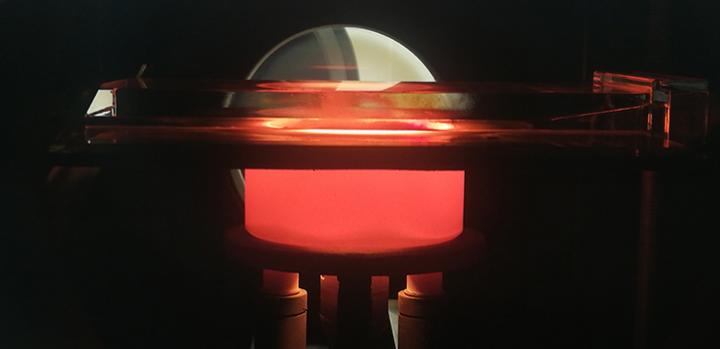
Making pure red LEDs from nitride crystals is a goal that has so far frustrated engineers. However, these LEDs are vital for building the next generation of energy-efficient micro-LED displays to follow OLED displays and for creating lighting with color tuning. Now, for the first time, a team of electrical engineers at KAUST has succeeded in making these LEDs.

“Electrical engineers can already make bright LEDs using varying materials to produce different colors. But to improve display technologies, engineers must integrate the three primary color LEDs, red, green and blue, onto one chip,” explains Daisuke Iida, an electrical engineer at KAUST. This means they need to find one material that is suitable for manufacturing all three colors. The material should be able to produce each color with high intensity, and ideally, it should have a high-power output, but use relatively little battery voltage.

The best candidates for generating all three colors are a family of compounds called nitride semiconductors. These are crystals containing nitrogen that in theory can be used to create LEDs that produce light with wavelengths between ultraviolet and infrared, which includes the entire visible spectrum. Engineers usually use gallium nitride to make blue and green LEDs, but they have struggled to make bright red LEDs with this crystal. “Red vision has been almost impossible–other groups have only really succeeded in making orange, not apple red,” says group leader, Kazuhiro Ohkawa. “Now, we have developed a crystal growth system to realize pure red LEDs.”

Replacing a large portion of the gallium with the element indium gives the desired red, but it is hard to do because indium easily evaporates from the crystal. So Iida, Ohkawa and colleagues created a reactor with extra indium vapor above the crystal’s surface, a process known as metalorganic vapor-phase deposition. This added pressure prevents the indium in the crystal from escaping. “This gives us a higher indium concentration at the surface,” says Ohkawa. “That’s our secret!”

But there was another hurdle to overcome. Indium is made of larger atoms than gallium, so when it is introduced, it creates defects in the crystal, degrading the quality of output light. The team’s trick was to also add aluminum, which has small atoms. “The introduction of the small atoms reduces the strain on the crystal, resulting in fewer crystal defects,” says Iida.

“Another advantage is that the LEDs operate at about half the voltage of its competitors,” says Ohkawa. “This will give you a longer lifetime for batteries.”

###

Media Contact
Carolyn Unck
[email protected]

Original Source

https://discovery.kaust.edu.sa/en/article/965/pure-red-leds-fulfill-a-primary-goal

Related Journal Article

http://dx.doi.org/10.35848/1882-0786/ab7168

Tags: Chemistry/Physics/Materials SciencesElectrical Engineering/ElectronicsMaterialsSuperconductors/Semiconductors
Share12Tweet8Share2ShareShareShare2

Related Posts

Cutting Electrolyte Reduction Boosts High-Energy Battery Performance

Cutting Electrolyte Reduction Boosts High-Energy Battery Performance

December 19, 2025
Microenvironment Shapes Gold-Catalysed CO2 Electroreduction

Microenvironment Shapes Gold-Catalysed CO2 Electroreduction

December 11, 2025

Photoswitchable Olefins Enable Controlled Polymerization

December 11, 2025

Cation Hydration Entropy Controls Chloride Ion Diffusion

December 10, 2025
Please login to join discussion

POPULAR NEWS

  • Nurses’ Views on Online Learning: Effects on Performance

    Nurses’ Views on Online Learning: Effects on Performance

    70 shares
    Share 28 Tweet 18
  • NSF funds machine-learning research at UNO and UNL to study energy requirements of walking in older adults

    71 shares
    Share 28 Tweet 18
  • Unraveling Levofloxacin’s Impact on Brain Function

    53 shares
    Share 21 Tweet 13
  • Exploring Audiology Accessibility in Johannesburg, South Africa

    51 shares
    Share 20 Tweet 13

About

We bring you the latest biotechnology news from best research centers and universities around the world. Check our website.

Follow us

Recent News

Hungarian Adaptation of I-CAM-Q for CAM Assessment

Anopheles arabiensis Transcriptome and Microbiota Shift Revealed

Mapping Health Risks in Atopic Eczema Patients

Subscribe to Blog via Email

Success! An email was just sent to confirm your subscription. Please find the email now and click 'Confirm' to start subscribing.

Join 70 other subscribers
  • Contact Us

Bioengineer.org © Copyright 2023 All Rights Reserved.

Welcome Back!

Login to your account below

Forgotten Password?

Retrieve your password

Please enter your username or email address to reset your password.

Log In
No Result
View All Result
  • Homepages
    • Home Page 1
    • Home Page 2
  • News
  • National
  • Business
  • Health
  • Lifestyle
  • Science

Bioengineer.org © Copyright 2023 All Rights Reserved.