Credit: Gallino/Busch
Unless you happen to be a materials scientist, which most of us after all are not, the term ‘glasses’ probably brings to mind such things as window panes, drinking glasses or spectacles. Hardly anyone will think of metals. But metallic glasses, or ‘amorphous metals’ as they are also known, are playing an increasingly important role in both scientific research and technology. When metal melts are cooled so rapidly that they solidify within a fraction of a second, they remain chaotic and disordered at the atomic level. Had they been cooled slowly, the atoms would have had time to rearrange and to form an ordered crystal lattice structure, but very rapid cooling means the atoms in the disordered liquid melt do not have sufficient time to rearrange and are essentially frozen in position. This atomic disorder imparts to these ‘non-equilibrium’ metallic glasses properties that are quite different to those of the ordered crystalline alloy that would form when the same constituents undergo more conventional slower cooling. Metallic glasses can be as strong as steel while having the elasticity of a polymer.
Most of the materials in the universe are amorphous, meaning that they are chaotic and disorganized and lack the long-range order found in crystalline solids. Even water, which in its frozen state has a regular crystal structure here on Earth, is glassy or amorphous in the wider universe, such as the water found in comets at temperatures below -150 degree Celsius. From a scientific perspective, the transition from the liquid state to the amorphous solid state is of fundamental interest.
‘What exactly is going on during vitrification is still not really well understood,’ says Isabella Gallino. Working with colleagues from Spain (Dr. Daniele Cangialosi, Dr. Xavier Monnier), France (Dr. Beatrice Ruta) and Germany (Professor Ralf Busch, also from Saarland University), Dr. Gallino has studied in unprecedented detail what is happening at the atomic level when a metastable liquid alloy vitrifies to form a solid glass.
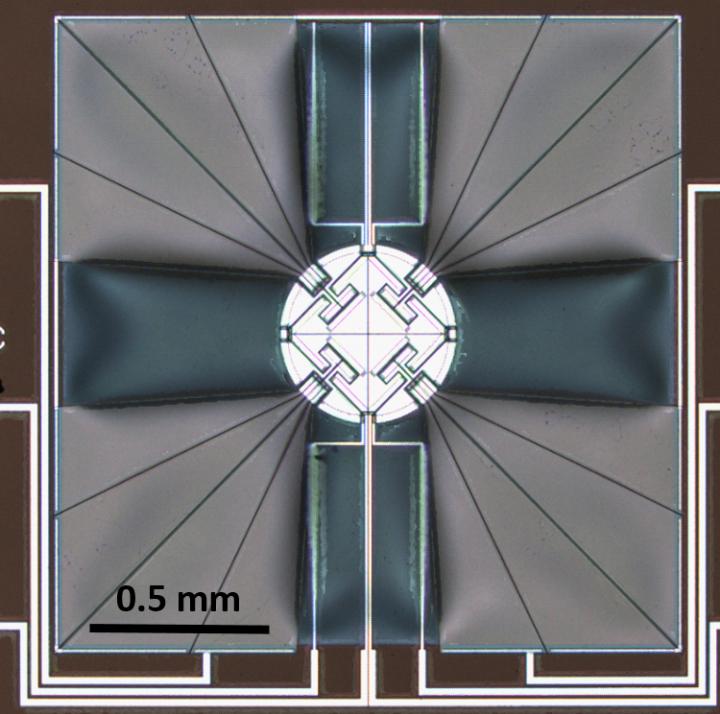
Using extremely bright and coherent x-ray beams generated at the European Synchrotron Research Facility in Grenoble, Gallino and her colleagues studied the atomic rearrangements occurring in a special gold alloy as it was cooled from around 150 °C (liquid state) to about 115 °C (frozen, glassy state). Using this technique, the research team was able to observe how the motion of the atoms decreased as the material froze. The freezing process itself was also studied using a novel flash calorimeter – a fast scanning calorimeter that allows extremely high heating and cooling rates to be achieved. Previously, no one had been able to observe what was happening in the vitrification range with this level of precision. ‘Up until now, nobody had succeeded in making these observations across such a wide range of heating and cooling rates,’ explains Isabella Gallino, who is currently working on her Habilitation, an advanced research degree that entitles the holder to teach at professorial level in Germany. Ten years ago, studies of this type were simply not feasible for technical reasons. At that time, scientists did not have the option of subjecting these materials to extremely bright synchrotron x-ray beams, nor did they have access to the fast scanning calorimeters that enable phase transitions and other transformations to be recorded at temperature rates of up to 100,000 degrees per second. Today, both of these options are available and Isabella Gallino and her colleagues have made good use of them.
In their research paper published in the respected, peer-reviewed journal Science Advances, the team showed that their results challenged a previously accepted paradigm of materials science research. ‘Up until now, conventional wisdom held that the rate at which the liquid freezes is the same as the so-called alpha-relaxation rate, i.e. the rate at which the primary mobility of the atoms decreases as the temperature is lowered,’ explains Dr. Gallino. ‘But this one-to-one correlation is not what we actually observe.’
‘That’s because the melt comprises atoms of various kinds and of very different sizes. When the large atoms, like gold, have already frozen and are essentially immobile, the smaller atoms, like silicon, can still move around and “joggle” themselves into their energetically preferred positions,’ says Isabella Gallino. Because of this collective flow of the smaller sized atoms, there is still global mobility within the material, which continues to behave like a liquid. It is only when the smaller atoms finally freeze, that the liquid fully solidifies into a glass.
This fundamental new finding by Isabella Gallino and her research colleagues has implications for the global research being conducted into amorphous metals and other glass-forming materials such as polymers and ionic liquids. Improved understanding of the vitrification process will not only facilitate the creation of new specialized materials in future, but will give us greater insight into the behaviour of existing amorphous materials.
###
X. Monnier, D. Cangialosi, B. Ruta, R. Busch, I. Gallino, Vitrification decoupling from α-relaxation in a metallic glass. Sci. Adv.6, eaay1454 (2020).
DOI: 10.1126/sciadv.aay1454, https:/
Further information:
Dr. Isabella Gallino
Tel.: +49 (0)681 302-2052
Email: [email protected]
Prof. Dr. Ralf Busch
Tel.: +49 (0)681 302-3208
Email: [email protected]
Media Contact
Dr. Isabella Gallino
[email protected]
Related Journal Article
http://dx.