• HOME
  • NEWS
  • EXPLORE
    • CAREER
      • Companies
      • Jobs
    • EVENTS
    • iGEM
      • News
      • Team
    • PHOTOS
    • VIDEO
    • WIKI
  • BLOG
  • COMMUNITY
    • FACEBOOK
    • INSTAGRAM
    • TWITTER
Saturday, February 7, 2026
BIOENGINEER.ORG
No Result
View All Result
  • Login
  • HOME
  • NEWS
  • EXPLORE
    • CAREER
      • Companies
      • Jobs
        • Lecturer
        • PhD Studentship
        • Postdoc
        • Research Assistant
    • EVENTS
    • iGEM
      • News
      • Team
    • PHOTOS
    • VIDEO
    • WIKI
  • BLOG
  • COMMUNITY
    • FACEBOOK
    • INSTAGRAM
    • TWITTER
  • HOME
  • NEWS
  • EXPLORE
    • CAREER
      • Companies
      • Jobs
        • Lecturer
        • PhD Studentship
        • Postdoc
        • Research Assistant
    • EVENTS
    • iGEM
      • News
      • Team
    • PHOTOS
    • VIDEO
    • WIKI
  • BLOG
  • COMMUNITY
    • FACEBOOK
    • INSTAGRAM
    • TWITTER
No Result
View All Result
Bioengineer.org
No Result
View All Result
Home NEWS Science News Chemistry

Spin-dependent processes in the 2D material hexagonal boron nitride

Bioengineer by Bioengineer
May 6, 2020
in Chemistry
Reading Time: 2 mins read
0
IMAGE
Share on FacebookShare on TwitterShare on LinkedinShare on RedditShare on Telegram

A paper was published in Nature Materials
IMAGE

Credit: Kazan Federal University

Quantum technology was once considered to be something very expensive and available only to the largest research centers. However, in our days it’s widely used in many applications, and one of them is magnetic resonance imaging.

“The magnetic moments associated with the nuclear spins of the protons of 1H and 13C act as sensors that are extremely sensitive to various pathologies. The ability to control and read quantum spin states lies at the basis of quantum technology,” says co-author Sergei Orlinskii, Leading Research Associate of the Rheological and Thermochemical Research Lab.

One of the promising areas here is the use of crystalline matrices with optically active spin centers, which makes it possible to convert electronic and nuclear spin states into an optical quantum. The implementation of a number of such projects in Russia, the USA, and Europe has already led to the creation of quantum cryptography devices and quantum sensors of submicron spatial resolution. 3D crystal matrices, such as diamond or silicon carbide, are used. Today, a new task for the scientific community around the world is to obtain and study systems that are fundamentally different from 3D matrices, namely, 2D crystals with vander Waals interaction.

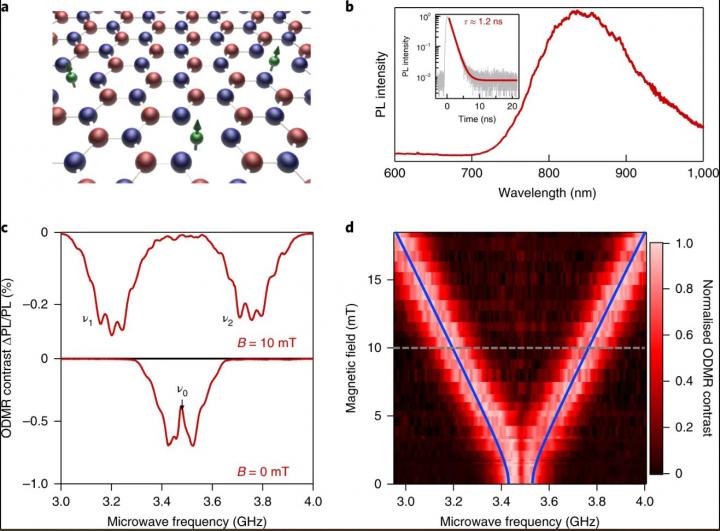
In search of a solution, scientists applied optical and microwave spectroscopy methods and demonstrated the possibility of optical polarization and reading of electronic spin color centers in boron nitride. The work was carried out jointly with German and Australian colleagues.

“At room temperatures, a coherent control of the populations of optically polarized triplet sublevels of the center was implemented and a microscopic model of this center was proposed – a boron vacancy in a negative charge state,” explains Orlinskii.

The results demonstrate that vander Waals materials can be used as a new platform for the further development of quantum technologies on the atomic scale.

###

Media Contact
Yury Nurmeev
[email protected]

Original Source

https://kpfu.ru/eng/news-eng/spin-dependent-processes-in-the-2d-material.html

Related Journal Article

http://dx.doi.org/10.1038/s41563-020-0619-6

Tags: Atomic/Molecular/Particle PhysicsChemistry/Physics/Materials SciencesElectromagneticsMaterials
Share12Tweet8Share2ShareShareShare2

Related Posts

blank

Breakthrough in Environmental Cleanup: Scientists Develop Solar-Activated Biochar for Faster Remediation

February 7, 2026
blank

Cutting Costs: Making Hydrogen Fuel Cells More Affordable

February 6, 2026

Scientists Develop Hand-Held “Levitating” Time Crystals

February 6, 2026

Observing a Key Green-Energy Catalyst Dissolve Atom by Atom

February 6, 2026
Please login to join discussion

POPULAR NEWS

  • Robotic Ureteral Reconstruction: A Novel Approach

    Robotic Ureteral Reconstruction: A Novel Approach

    82 shares
    Share 33 Tweet 21
  • Digital Privacy: Health Data Control in Incarceration

    63 shares
    Share 25 Tweet 16
  • Study Reveals Lipid Accumulation in ME/CFS Cells

    57 shares
    Share 23 Tweet 14
  • Breakthrough in RNA Research Accelerates Medical Innovations Timeline

    53 shares
    Share 21 Tweet 13

About

We bring you the latest biotechnology news from best research centers and universities around the world. Check our website.

Follow us

Recent News

Phage-Antibiotic Combo Beats Resistant Peritoneal Infection

Boosting Remote Healthcare: Stepped-Wedge Trial Insights

Barriers and Boosters of Seniors’ Physical Activity in Karachi

Subscribe to Blog via Email

Enter your email address to subscribe to this blog and receive notifications of new posts by email.

Join 73 other subscribers
  • Contact Us

Bioengineer.org © Copyright 2023 All Rights Reserved.

Welcome Back!

Login to your account below

Forgotten Password?

Retrieve your password

Please enter your username or email address to reset your password.

Log In
No Result
View All Result
  • Homepages
    • Home Page 1
    • Home Page 2
  • News
  • National
  • Business
  • Health
  • Lifestyle
  • Science

Bioengineer.org © Copyright 2023 All Rights Reserved.