• HOME
  • NEWS
  • EXPLORE
    • CAREER
      • Companies
      • Jobs
    • EVENTS
    • iGEM
      • News
      • Team
    • PHOTOS
    • VIDEO
    • WIKI
  • BLOG
  • COMMUNITY
    • FACEBOOK
    • INSTAGRAM
    • TWITTER
Sunday, August 16, 2026
BIOENGINEER.ORG
No Result
View All Result
  • Login
  • HOME
  • NEWS
  • EXPLORE
    • CAREER
      • Companies
      • Jobs
        • Lecturer
        • PhD Studentship
        • Postdoc
        • Research Assistant
    • EVENTS
    • iGEM
      • News
      • Team
    • PHOTOS
    • VIDEO
    • WIKI
  • BLOG
  • COMMUNITY
    • FACEBOOK
    • INSTAGRAM
    • TWITTER
  • HOME
  • NEWS
  • EXPLORE
    • CAREER
      • Companies
      • Jobs
        • Lecturer
        • PhD Studentship
        • Postdoc
        • Research Assistant
    • EVENTS
    • iGEM
      • News
      • Team
    • PHOTOS
    • VIDEO
    • WIKI
  • BLOG
  • COMMUNITY
    • FACEBOOK
    • INSTAGRAM
    • TWITTER
No Result
View All Result
Bioengineer.org
No Result
View All Result
Home NEWS Science News Biology

New DNA test will improve tracking of Salmonella food-poisoning outbreaks

Bioengineer by Bioengineer
April 28, 2020
in Biology
Reading Time: 3 mins read
0
IMAGE
Share on FacebookShare on TwitterShare on LinkedinShare on RedditShare on Telegram

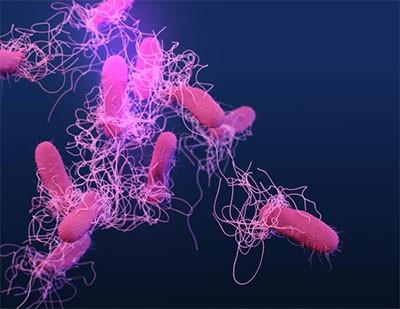
The test may rapidly and sensitively distinguish subtypes of Salmonella, reports The Journal of Molecular Diagnostics
IMAGE

Credit: Public Health Image Library, US Centers for Disease Control and Prevention, James Archer (2019).

Philadelphia, April 28, 2020 – Researchers report the development of a sensitive and specific assay to detect different serotypes of Salmonella, paving the way for rapid serotyping directly from specimens. This improvement upon current testing methods can play a critical role in quickly tracing the origin of the infection. The report appears in The Journal of Molecular Diagnostics, published by Elsevier.

Recent data from the Centers for Disease Control and Prevention (CDC) indicate that food poisoning caused by Salmonella bacteria leads to 1.35 million infections, 26,500 hospitalizations, and 420 deaths in the United States per year. During an outbreak, the speed and simplicity of a test to detect specific types of bacteria are important for public health investigators to track down the source.

“Salmonella in a clinical or food sample may be present in very small amounts and thus requires very sensitive methods to detect them. Multiple cross-displacement amplification (MCDA) is a method that can detect very small amounts of DNA rapidly and is also performed at a single constant temperature, in contrast to the cycling of temperatures required in other methods such as PCR. This makes it a good fit for a simple, rapid, and sensitive bacterial detection test. Although an MCDA test for any Salmonella already exists, it does not distinguish between different serotypes,” explained Professor Ruiting Lan, PhD, of the School of Biotechnology and Biomolecular Sciences at the University of New South Wales, Sydney, NSW, Australia.

The investigators developed an MCDA assay for each of the seven serovar (subtype)-specific targets of Salmonella. All of these assays accurately detect as few as 10 copies of DNA and can produce results in approximately eight minutes. Importantly, these assays do not require specialized detection equipment, simplifying any future application in clinical or industrial settings. By combining these seven serovar-specific assays with the existing species assay, Salmonella detection can be simplified and accelerated.

“The assays developed in this study are unique because the gene markers used were selected based on analyzing thousands of genomes. Thus, these markers future proof Salmonella serotyping in the era of culture-independent diagnostic testing,” commented Professor Lan.

Traditional methods to distinguish Salmonella serotypes involve growing the bacteria from samples and then testing them to assign them to a serovar. The MCDA test is faster because it does not require first growing the bacteria in culture. Rather, it can detect very small amounts of Salmonella DNA.

Although there are hundreds of Salmonella serovars, the authors chose the five most commonly occurring in Australia, which cause more than 85 percent of Salmonella infections in that country. However, at least two of these serovars are also the top Salmonella serovars throughout the world, therefore the researchers believe the results are applicable to other geographic regions.

Salmonella bacteria typically live in animal and human intestines and are shed through feces. Humans may become infected by ingesting contaminated water or food such as raw or undercooked meat, poultry, eggs, or egg products. Possible signs and symptoms of Salmonella poisoning include nausea, vomiting, abdominal cramps, diarrhea, fever, and headache.

###

Media Contact
Eileen Leahy
[email protected]

Related Journal Article

http://dx.doi.org/10.1016/j.jmoldx.2020.02.006

Tags: BacteriologyDiagnosticsFood/Food ScienceMedicine/HealthPublic HealthToxicology
Share12Tweet8Share2ShareShareShare2

Related Posts

Strubbelig–NHL3 Receptor Complex Helps Arabidopsis Respond to Cellulose Deficiency

Strubbelig–NHL3 Receptor Complex Helps Arabidopsis Respond to Cellulose Deficiency

August 15, 2026
Bombyx mori Satellitome Analysis Reveals Evolutionary Stability, Dispersed Chromosomal Organization, Transposon Origins

Bombyx mori Satellitome Analysis Reveals Evolutionary Stability, Dispersed Chromosomal Organization, Transposon Origins

August 15, 2026

Synthetic pyrenoid reconstruction reveals EPYC1-driven carbon concentration mechanisms and evolution

August 15, 2026

Endophytic Flavobacterium boosts root hairs and drought tolerance through ERF–CEP5 signaling

August 15, 2026
Please login to join discussion

POPULAR NEWS

  • KAIST develops semiconductor neuron that harnesses noise to selectively process signals

    29 shares
    Share 12 Tweet 7
  • Imagining natural and extra robotic thumbs together strengthens kinesthetic sensorimotor networks

    29 shares
    Share 12 Tweet 7
  • PARP1 Drives Neuropathic Pain Through GPX4-Dependent Ferroptosis in Injured Mice’s Sensory Neurons

    29 shares
    Share 12 Tweet 7
  • Strubbelig–NHL3 Receptor Complex Helps Arabidopsis Respond to Cellulose Deficiency

    29 shares
    Share 12 Tweet 7

About

We bring you the latest biotechnology news from best research centers and universities around the world. Check our website.

Follow us

Recent News

KAIST develops semiconductor neuron that harnesses noise to selectively process signals

Imagining natural and extra robotic thumbs together strengthens kinesthetic sensorimotor networks

PARP1 Drives Neuropathic Pain Through GPX4-Dependent Ferroptosis in Injured Mice’s Sensory Neurons

Subscribe to Blog via Email

Success! An email was just sent to confirm your subscription. Please find the email now and click 'Confirm' to start subscribing.

Join 85 other subscribers
  • Contact Us

Bioengineer.org © Copyright 2023 All Rights Reserved.

Welcome Back!

Login to your account below

Forgotten Password?

Retrieve your password

Please enter your username or email address to reset your password.

Log In
No Result
View All Result
  • Homepages
    • Home Page 1
    • Home Page 2
  • News
  • National
  • Business
  • Health
  • Lifestyle
  • Science

Bioengineer.org © Copyright 2023 All Rights Reserved.