


Biomedical engineers adapt simple, low-cost platform to diagnose the new coronavirus
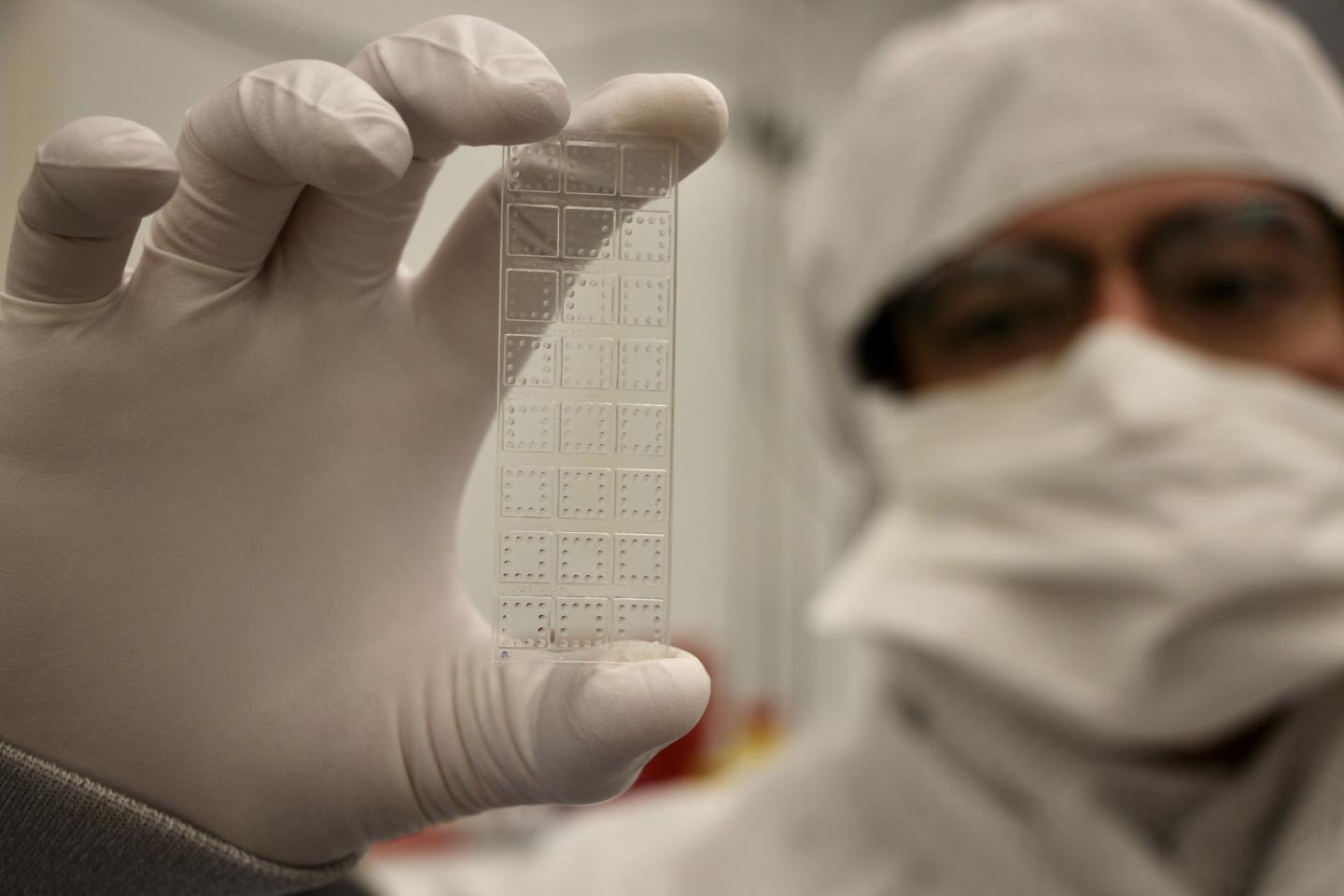
Credit: Michaela Kane, Duke University
DURHAM, N.C. — Biomedical engineers at Duke University are adapting a rapid testing platform originally designed to detect Ebola to see whether it could be of use in detecting antigens to SARS-Cov-2, the virus that causes COVID-19. The National Science Foundation has awarded them a Rapid Response Research grant to adapt the fast, simple and low-cost diagnostic tool. Inkjet-printed on a small glass slide, the D4 assay is a self-contained diagnostic test that detects low levels of antigens — the specific protein markers created by exposure to a pathogen — from a single drop of blood or from a throat- or nose-swab sample.
In previous studies, the experimental test has been shown to detect a variety of antigens and other biomarkers as accurately as the most sensitive diagnostic tests on the market, but at a much faster rate, potentially shortening the wait time for coronavirus testing from days or hours down to just 30 minutes, according to principal investigator Ashutosh Chilkoti, the Alan L. Kaganov Distinguished Professor of Biomedical Engineering at Duke.
“We’ve shown a proof-of-concept by detecting a biomarker of the SARS-Cov-2 virus (which causes COVID-19), and the next step would be to validate this with patient samples,” Chilkoti said. “Our test is designed to be truly point-of-care, and this pandemic is clearly a scenario when a portable, fast and cost-effective diagnostic would be most useful.”
The D4 assay tool has two types of antibodies printed on its surface: detection antibodies tagged with a fluorescent marker and capture antibodies, which are primed to find the antigens specific to a pathogen. When a sample is placed on the slide, the detection antibodies separate from the array and bind to the target antigen proteins in the sample. These antibody-antigen complexes then attach to the capture antibodies on the slide, which fluoresce in response to the connection. A handheld scanner is then used to look for lights indicating the presence of the antigen. Unlike other antigen diagnostic tests, the D4 assay is printed on a polymer brush coating, which prevents non-target proteins from attaching to the slide’s surface. This removes any ‘background noise’ on the chip, making it easier to detect low levels of the target proteins.
Chilkoti said that it is difficult to predict when a clinically available test might be available, as that requires FDA approval, but they hope to start testing the technology with COVID patient samples in the next few months.
In preliminary studies with other viruses, including Ebola, the D4 assay has proven about 200- to 500 times better at flagging infected people than other diagnostic tests, according to Duke Engineering doctoral student Cassio Fontes, who helped develop the platform.
The lab has not yet worked with the live SARS-Cov-2 virus that causes COVID-19, but rather with synthetic versions of the proteins it expresses.
“In preliminary tests in early March, we showed that the existing antibodies developed for SARS, another coronavirus that was identified in 2003, could effectively detect and capture synthetic versions of the COVID-19 proteins,” said Fontes. “The connection isn’t perfect, but the D4 is so sensitive that it compensates for the less-than-ideal antibody match and we’re able to get promising results.”
With the $119,000 RAPID grant from NSF (2029361) the team will further optimize and validate their platform with the goal of testing in patients in the next few months in collaboration with Chris Woods, a clinical investigator and Professor of Global Health and Medicine and Chief of the Infectious Diseases Division at the VA Medical Center.
“Challenging times also create opportunities,” Chilkoti said. “Given that this is a huge societal and public health challenge, those of us who create new technologies have a responsibility to act, and we’re grateful that the support from the National Science Foundation allows us address this challenge head-on.”
###
Media Contact
Michaela Kane
[email protected]
Original Source
https:/


