Credit: Mahesh Narayan.
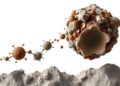
EL PASO, Texas – Researchers in The University of Texas at El Paso’s Department of Chemistry and Biochemistry have developed a nanohybrid vehicle that can be used to optimally deliver drugs into the human body.
The research was published in April 2020 in ACS Applied Materials & Interfaces. Leading the study are Mahesh Narayan, Ph.D., professor, and Sreeprasad Sreenivasan, Ph.D., assistant professor, both from the Department of Chemistry and Biochemistry and the Border Biomedical Research Center (BBRC) in UTEP’s College of Science.
Drug candidates that show promise against a particular disease often are toxic to other cell types. One such drug is the polyphenol ellagic acid (EA). This antioxidant, derived from nature, demonstrates the potential to mitigate pathologies including Parkinson’s and Alzheimer’s diseases. To selectively use EA in the brain against neurodegenerative disorders requires that its cytotoxic potential be reduced and only its anti-oxidant potential be exploited. Narayan, Sreenivasan and colleagues created a nanohybrid vehicle to circumvent this problem.
“We are very excited about the new drug delivery materials developed by Drs. Narayan and Sreenivasan,” said Robert Kirken, Ph.D., dean of UTEP’s College of Science. “This platform allows for molecules to be impregnated into the material so that the drug can more specifically target the tumor or other tissue site, thus increasing the beneficial effects of the drug while reducing its negative side effects.”
The researchers discovered that encapsulating EA in chitosan, a sugar, reduces its inherent cytotoxicity while enhancing its anti-oxidant properties. The chitosan shell, which makes up the hard outer skeleton of shellfish, also permits EA delivery via a rapid burst phase and a relatively slow phase. This further enhances the drug delivery because the nanohybrid vehicle is uniquely suited for drug release over extended time periods.
“This work creates a new type of bio-friendly drug-delivery vehicle made of recyclable materials,” Narayan said. “The other special feature of this vehicle is that it can deliver the drug via two mechanisms: one rapid and the other a slow-release.”
Other project collaborators include UTEP doctoral student Jyoti Ahlawat, who led the research project under the supervision of her mentors; Eva Deemer, Ph.D., of UTEP’s Department of Materials Science and Engineering; and Rabin Neupane, a graduate student in the department of industrial pharmacy at the University of Toledo.
Narayan’s laboratory focuses on mitigating oxidative stress induced by neurotoxins as a means to prevent neurodegenerative disorders such as Parkinson’s disease and Alzheimer’s disease. Sreenivasan’s lab works to bridge and interface chemistry, materials physics, and biological sciences to develop uniquely designed quantum structures and devices.
###
To learn more about this research, visit: https:/
The University of Texas at El Paso enrolls more than 25,000 students in 166 bachelor’s, master’s and doctoral programs in 10 colleges and schools. With $108 million in total annual research expenditures, UTEP is ranked in the top 5% of research institutions nationally and fourth in Texas for federal research expenditures at public universities, after UT Austin, Texas A&M and the University of Houston. UTEP is one of the largest and most successful Hispanic-serving institutions in the country, with a student body that is over 80% Hispanic.
Media Contact
Victor H. Arreola
[email protected]
Related Journal Article
http://dx.