• HOME
  • NEWS
  • EXPLORE
    • CAREER
      • Companies
      • Jobs
    • EVENTS
    • iGEM
      • News
      • Team
    • PHOTOS
    • VIDEO
    • WIKI
  • BLOG
  • COMMUNITY
    • FACEBOOK
    • INSTAGRAM
    • TWITTER
Saturday, February 7, 2026
BIOENGINEER.ORG
No Result
View All Result
  • Login
  • HOME
  • NEWS
  • EXPLORE
    • CAREER
      • Companies
      • Jobs
        • Lecturer
        • PhD Studentship
        • Postdoc
        • Research Assistant
    • EVENTS
    • iGEM
      • News
      • Team
    • PHOTOS
    • VIDEO
    • WIKI
  • BLOG
  • COMMUNITY
    • FACEBOOK
    • INSTAGRAM
    • TWITTER
  • HOME
  • NEWS
  • EXPLORE
    • CAREER
      • Companies
      • Jobs
        • Lecturer
        • PhD Studentship
        • Postdoc
        • Research Assistant
    • EVENTS
    • iGEM
      • News
      • Team
    • PHOTOS
    • VIDEO
    • WIKI
  • BLOG
  • COMMUNITY
    • FACEBOOK
    • INSTAGRAM
    • TWITTER
No Result
View All Result
Bioengineer.org
No Result
View All Result
Home NEWS Science News

Caribbean coral reef decline began in 1950s and 1960s from local human activities

Bioengineer by Bioengineer
April 22, 2020
in Science News
Reading Time: 2 mins read
0
IMAGE
Share on FacebookShare on TwitterShare on LinkedinShare on RedditShare on Telegram

IMAGE

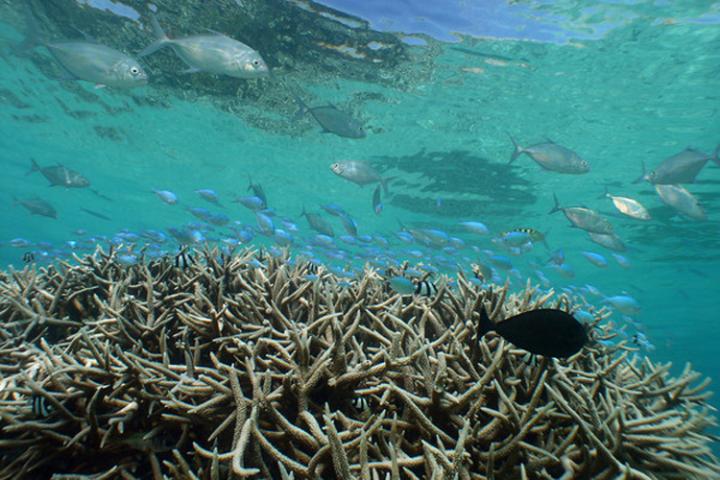
Credit: NOAA

Not long ago, the azure waters of the Caribbean contained healthy and pristine coral reef environments dominated by the reef-building corals that provide home to one-third of the biodiversity in the region.

But the Caribbean reefs of today pale in comparison to those that existed even just a generation ago. Since researchers began intensively studying these reefs in the 1970s, about one half of Caribbean corals have died. The iconic elkhorn and staghorn corals that once dominated Caribbean reefs have been hardest hit, with only 20% of their populations remaining today.

Although researchers believe climate change, fishing and pollution are to blame, the lack of baseline data prior to the 1970s has made it hard to determine the precise reasons for these coral die offs. ASU researcher Katie Cramer wanted to document when corals first began dying to better understand the root causes of coral loss.

Now, in a new paper in Science Advances, Cramer has combined fossil data, historical records, and underwater survey data to reconstruct the abundance of staghorn and elkhorn corals over the past 125,000 years. She finds that these corals first began declining in the 1950s and 1960s, earlier than previously thought. This timing is decades before climate change impacts, indicating that local human impacts like fishing and land-clearing set the stage for the widespread coral declines that are now accelerating in response to warming oceans.

“I am interested in going back to the scene of the crime when humans first began to significantly impact coral reefs centuries ago, to understand when, why and how much reefs have been altered by humans,” said Katie Cramer, an assistant research professor at the Julie Ann Wrigley Global Institute of Sustainability at Arizona State University and an Ocean Science Fellow at the Center for Oceans at Conservation International.

The earlier, local roots of declines of elkhorn and staghorn corals in the 1950s and 1960s highlight the urgency of mitigating local human impacts on reefs to allow these corals to recover. “In an era where coral reefs are being hit with multiple human stressors at the same time, we need to resolve why and how much coral reefs have changed over human history to inform our responses to the current reef crisis.”

“Recent studies are showing that reefs are better able to cope with climate change impacts when they are not also stressed from overfishing and land-based runoff. So let’s get a handle on these tractable problems now to give reefs a better chance of weathering the current climate crisis,” said Cramer.

###

Media Contact
Joseph Caspermeyer
[email protected]

Original Source

https://asunow.asu.edu/20200422-discoveries-caribbean-coral-reef-decline-began-1950s-and-1960s-local-human-activities

Tags: Atmospheric ScienceBiologyClimate ScienceEarth ScienceFisheries/AquacultureMarine/Freshwater BiologyTechnology/Engineering/Computer Science
Share12Tweet8Share2ShareShareShare2

Related Posts

Evaluating Pediatric Emergency Care Quality in Ethiopia

February 7, 2026

TPMT Expression Predictions Linked to Azathioprine Side Effects

February 7, 2026

Improving Dementia Care with Enhanced Activity Kits

February 7, 2026

Decoding Prostate Cancer Origins via snFLARE-seq, mxFRIZNGRND

February 7, 2026
Please login to join discussion

POPULAR NEWS

  • Robotic Ureteral Reconstruction: A Novel Approach

    Robotic Ureteral Reconstruction: A Novel Approach

    82 shares
    Share 33 Tweet 21
  • Digital Privacy: Health Data Control in Incarceration

    63 shares
    Share 25 Tweet 16
  • Study Reveals Lipid Accumulation in ME/CFS Cells

    57 shares
    Share 23 Tweet 14
  • Breakthrough in RNA Research Accelerates Medical Innovations Timeline

    53 shares
    Share 21 Tweet 13

About

We bring you the latest biotechnology news from best research centers and universities around the world. Check our website.

Follow us

Recent News

Evaluating Pediatric Emergency Care Quality in Ethiopia

TPMT Expression Predictions Linked to Azathioprine Side Effects

Improving Dementia Care with Enhanced Activity Kits

Subscribe to Blog via Email

Success! An email was just sent to confirm your subscription. Please find the email now and click 'Confirm' to start subscribing.

Join 73 other subscribers
  • Contact Us

Bioengineer.org © Copyright 2023 All Rights Reserved.

Welcome Back!

Login to your account below

Forgotten Password?

Retrieve your password

Please enter your username or email address to reset your password.

Log In
No Result
View All Result
  • Homepages
    • Home Page 1
    • Home Page 2
  • News
  • National
  • Business
  • Health
  • Lifestyle
  • Science

Bioengineer.org © Copyright 2023 All Rights Reserved.