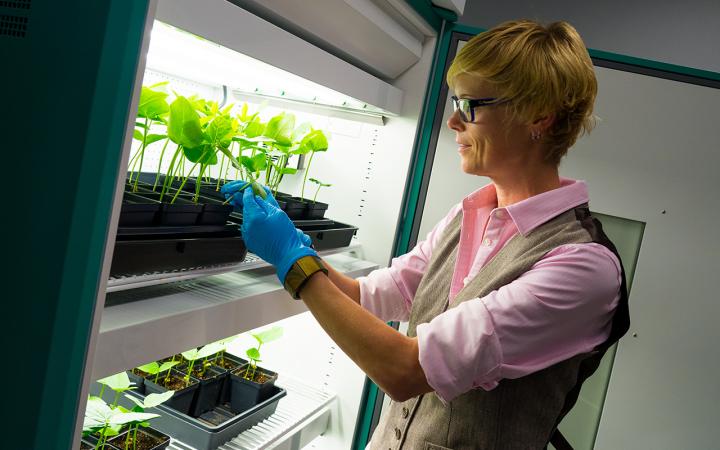
Credit: David Baillot, UC San Diego Jacobs School of Engineering
Nanoengineers at the University of California San Diego are working on a COVID-19 vaccine using an unconventional candidate: a plant virus.
The team’s goal is to use plants to create a stable, easy to manufacture vaccine that can be shipped around the globe. It will be packaged in slow-release microneedle patches that patients can wear on the arm to painlessly self-administer the vaccine in a single dose.
The project, led by UC San Diego nanoengineering professors Nicole Steinmetz and Jon Pokorski, received a Rapid Response Research (RAPID) grant from the National Science Foundation. The grant funds research proposals that have the potential to immediately address urgent challenges, such as the novel coronavirus pandemic.
“To really make an impact, we are making a vaccine that’s stable at room temperature and above so it can be shipped–without refrigeration–throughout the world and be distributed to resource-poor areas,” said Steinmetz, who is the director of the Center for NanoImmunoEngineering at UC San Diego.
The Steinmetz lab will work on vaccine development, while the Pokorski lab will work on vaccine delivery devices in the form of slow-release microneedle patches that are inexpensive and also easy to manufacture and ship worldwide.
“People can just self-apply these patches, so no need for doctor’s visits. Our goal is to reduce the barriers to vaccination around the world,” said Pokorski, a faculty member of the Center for NanoImmunoEngineering.
To create the vaccine, the team is using a plant virus that infects legumes and engineering it to look like the novel Coronavirus (SARS-CoV-2). Molecular signatures called peptides that are specific to SARS-CoV-2 will be woven onto the surface of the plant virus so it can stimulate an immune response.
The beauty of this approach is that the plant virus is non-infectious in humans, said Steinmetz, whose lab specializes in engineering plant viruses to treat plant and human health. Also, plant viruses are easy to produce in large scales because they can be grown on plants via a technique called molecular farming.
And since plant viruses are extremely stable up to high temperatures, the team’s vaccine is compatible with the methods that will be used to fabricate the microneedle patches.
The methods, called melt extrusion and injection molding, are polymer processing techniques that are used to mass-produce plastic products like Legos and disposable cutlery. They involve melting polymer materials at 100 degrees Celsius. This is too hot for most biological materials, but not for the plant virus-based vaccine, making it easy to manufacture into vaccine patches.
Pokorski’s lab will customize the methods so they can be first scaled down to do quick, inexpensive pilot studies on the vaccine patches. “These methods are usually performed at kilogram scales, and trying to make that much vaccine to do a pilot study would be incredibly expensive,” Pokorski said. “Once we find something that works, we could easily scale it up because these methods are widely used in manufacturing.”
“By synergistically combining our labs’ areas of expertise in plant virus-based vaccine design and biomedical device manufacturing, we hope to really move this research forward to rapidly generate a scalable solution for the current pandemic,” Steinmetz said.
###
Media Contact
Katherine Connor
[email protected]
Original Source
http://jacobsschool.