• HOME
  • NEWS
  • EXPLORE
    • CAREER
      • Companies
      • Jobs
    • EVENTS
    • iGEM
      • News
      • Team
    • PHOTOS
    • VIDEO
    • WIKI
  • BLOG
  • COMMUNITY
    • FACEBOOK
    • INSTAGRAM
    • TWITTER
Saturday, February 7, 2026
BIOENGINEER.ORG
No Result
View All Result
  • Login
  • HOME
  • NEWS
  • EXPLORE
    • CAREER
      • Companies
      • Jobs
        • Lecturer
        • PhD Studentship
        • Postdoc
        • Research Assistant
    • EVENTS
    • iGEM
      • News
      • Team
    • PHOTOS
    • VIDEO
    • WIKI
  • BLOG
  • COMMUNITY
    • FACEBOOK
    • INSTAGRAM
    • TWITTER
  • HOME
  • NEWS
  • EXPLORE
    • CAREER
      • Companies
      • Jobs
        • Lecturer
        • PhD Studentship
        • Postdoc
        • Research Assistant
    • EVENTS
    • iGEM
      • News
      • Team
    • PHOTOS
    • VIDEO
    • WIKI
  • BLOG
  • COMMUNITY
    • FACEBOOK
    • INSTAGRAM
    • TWITTER
No Result
View All Result
Bioengineer.org
No Result
View All Result
Home NEWS Science News Biology

Aquaculture at the crossroads of global warming and antimicrobial resistance

Bioengineer by Bioengineer
April 20, 2020
in Biology
Reading Time: 3 mins read
0
IMAGE
Share on FacebookShare on TwitterShare on LinkedinShare on RedditShare on Telegram

IMAGE

Credit: © Miriam Reverter et al., Nature Communications.

Aquaculture – rearing aquatic organisms such as fish and shellfish – plays a vital role in food security in many countries (it supplies more than half of the aquatic animals consumed by humans worldwide). It is particularly important for developing countries, for instance in Asia, which accounts for 90% of global output.

Fish farmers use large quantities of antimicrobials to treat or prevent disease on their farms. However, when used inappropriately, antimicrobials are ineffective and foster the development of resistant bacteria.

An index to assess the risks of antimicrobial resistance in aquaculture

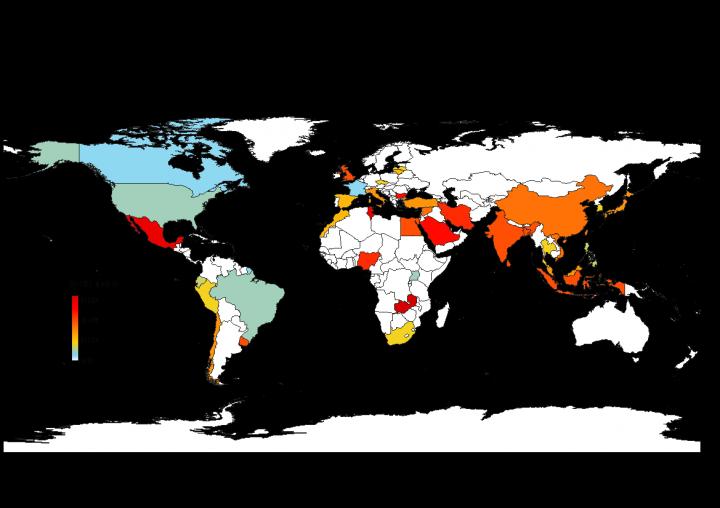
Researchers from IRD and CIRAD belonging to the Institute of Evolution Sciences of Montpellier’s Fish Diversity and Aquaculture team (DIVA, UMR ISEM) examined data from more than 400 scientific articles referring to over 10 000 bacteria of aquacultural origin from 40 countries. That meta-analysis allowed them to study the effect of temperature on the mortality rate of aquatic animals infected with pathogenic bacteria commonly found in aquaculture. They then conducted a systematic review on the abundance of resistant bacteria found on fish farms and calculated the Multi-Antibiotic Resistance (MAR) index for 40 countries.

Global warming is partly responsible

“Our results show that global warming promotes the development of pathogenic bacteria, hence disease development on fish farms”, Rodolphe Gozlan, an IRD specialist in biodiversity-health relations, explains.

Aquatic bacteria are in effect temperature-sensitive. “Global warming will therefore push up mortality rates on fish farms, which is likely to mean increased antibiotic use”, says Miriam Reverter, a post-doctoral student at IRD, and as the study showed, antimicrobial resistance is already a reality in several countries among those that are highly vulnerable to climate change.

A threat to animal and human health

The study’s authors raise the alarm about the consequences of inappropriate antibiotic use, for both the sustainability of aquaculture and human health. “Resistant bacteria in aquaculture can either spread or transmit their resistance genes to non-resistant bacteria that infect humans, thus causing diseases that are difficult to treat in both animals and humans”, Samira Sarter, a microbiologist with CIRAD, explains.

These health risks linked to antibiotic use are not restricted to aquaculture. They also apply to terrestrial farms. “Some 60% of the infectious diseases that currently affect humans are of animal origin. If a resistant bacterium or its genes were to be transmitted to humans, and existing antibiotics were ineffective, we could face a steep rise in mortality rates as a result of antimicrobial resistance.”

Finding alternative to antibiotics

“We urgently need to help producers in the global South find alternatives to treat and prevent disease on fish farms. This means encouraging research that makes use of the One Health or EcoHealth approaches, i.e. that is multi-disciplinary and multi-sector”, Rodolphe Gozlan stresses. Work has shown that certain plants are highly effective for boosting disease immunity in fish. Their use on fish farms could help reduce antibiotic use. Alongside this, researchers are also working to develop more resilient aquaculture systems based on the principles of agroecology, in the aim of reducing disease rates.

###

Media Contact
Rodolphe Gozlan
[email protected]

Original Source

https://en.ird.fr/aquaculture-crossroads-global-warming-and-antimicrobial-resistance

Related Journal Article

http://dx.doi.org/10.1038/s41467-020-15735-6

Tags: AgricultureBiodiversityClimate ChangeFisheries/AquacultureFood/Food ScienceMarine/Freshwater BiologyTemperature-Dependent Phenomena
Share12Tweet8Share2ShareShareShare2

Related Posts

Florida Cane Toad: Complex Spread and Selective Evolution

Florida Cane Toad: Complex Spread and Selective Evolution

February 7, 2026
New Study Uncovers Mechanism Behind Burn Pit Particulate Matter–Induced Lung Inflammation

New Study Uncovers Mechanism Behind Burn Pit Particulate Matter–Induced Lung Inflammation

February 6, 2026

DeepBlastoid: Advancing Automated and Efficient Evaluation of Human Blastoids with Deep Learning

February 6, 2026

Navigating the Gut: The Role of Formic Acid in the Microbiome

February 6, 2026
Please login to join discussion

POPULAR NEWS

  • Robotic Ureteral Reconstruction: A Novel Approach

    Robotic Ureteral Reconstruction: A Novel Approach

    82 shares
    Share 33 Tweet 21
  • Digital Privacy: Health Data Control in Incarceration

    63 shares
    Share 25 Tweet 16
  • Study Reveals Lipid Accumulation in ME/CFS Cells

    57 shares
    Share 23 Tweet 14
  • Breakthrough in RNA Research Accelerates Medical Innovations Timeline

    53 shares
    Share 21 Tweet 13

About

We bring you the latest biotechnology news from best research centers and universities around the world. Check our website.

Follow us

Recent News

Florida Cane Toad: Complex Spread and Selective Evolution

Exploring Decision-Making in Dementia Caregivers’ Mobility

Succinate Receptor 1 Limits Blood Cell Formation, Leukemia

Subscribe to Blog via Email

Enter your email address to subscribe to this blog and receive notifications of new posts by email.

Join 73 other subscribers
  • Contact Us

Bioengineer.org © Copyright 2023 All Rights Reserved.

Welcome Back!

Login to your account below

Forgotten Password?

Retrieve your password

Please enter your username or email address to reset your password.

Log In
No Result
View All Result
  • Homepages
    • Home Page 1
    • Home Page 2
  • News
  • National
  • Business
  • Health
  • Lifestyle
  • Science

Bioengineer.org © Copyright 2023 All Rights Reserved.