• HOME
  • NEWS
  • EXPLORE
    • CAREER
      • Companies
      • Jobs
    • EVENTS
    • iGEM
      • News
      • Team
    • PHOTOS
    • VIDEO
    • WIKI
  • BLOG
  • COMMUNITY
    • FACEBOOK
    • INSTAGRAM
    • TWITTER
Tuesday, July 7, 2026
BIOENGINEER.ORG
No Result
View All Result
  • Login
  • HOME
  • NEWS
  • EXPLORE
    • CAREER
      • Companies
      • Jobs
        • Lecturer
        • PhD Studentship
        • Postdoc
        • Research Assistant
    • EVENTS
    • iGEM
      • News
      • Team
    • PHOTOS
    • VIDEO
    • WIKI
  • BLOG
  • COMMUNITY
    • FACEBOOK
    • INSTAGRAM
    • TWITTER
  • HOME
  • NEWS
  • EXPLORE
    • CAREER
      • Companies
      • Jobs
        • Lecturer
        • PhD Studentship
        • Postdoc
        • Research Assistant
    • EVENTS
    • iGEM
      • News
      • Team
    • PHOTOS
    • VIDEO
    • WIKI
  • BLOG
  • COMMUNITY
    • FACEBOOK
    • INSTAGRAM
    • TWITTER
No Result
View All Result
Bioengineer.org
No Result
View All Result
Home NEWS Science News Biology

New isomer separation method a boon for research on protein oxidation

Bioengineer by Bioengineer
April 9, 2020
in Biology
Reading Time: 2 mins read
0
IMAGE
Share on FacebookShare on TwitterShare on LinkedinShare on RedditShare on Telegram

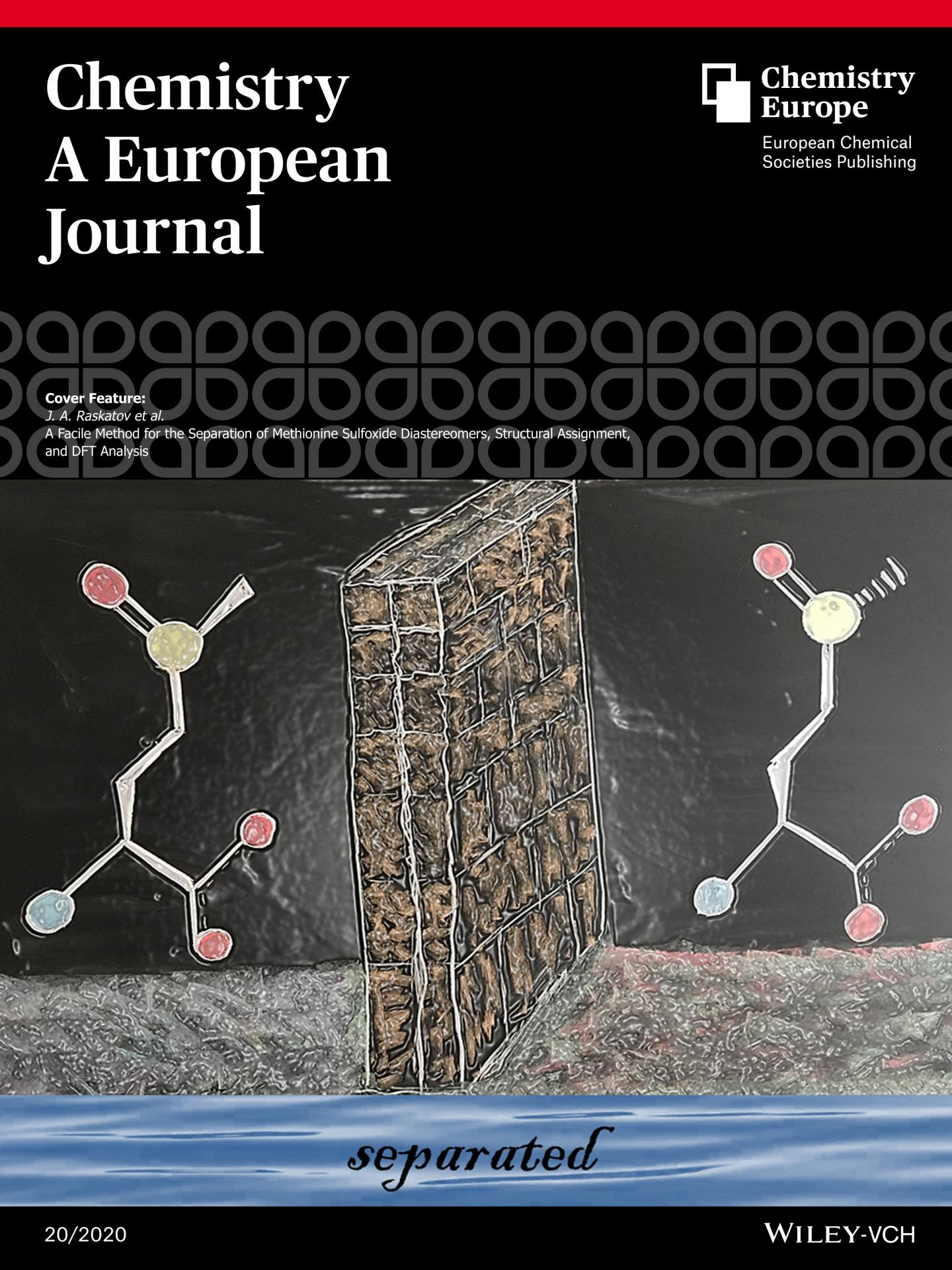
UCSC chemists have developed an easy way to separate the stereoisomers of an oxidized amino acid that has important functions in protein biology
IMAGE

Credit: Cover art by J. Raskatov

Proteins are made up of long chains of amino acids, and most proteins have one or more of the sulfur-containing amino acid methionine. Oxidation of the sulfur atom in methionine is an important biomolecular reaction that can have a wide range of biological consequences depending on the context and the protein involved.

Interestingly, the sulfur oxidation of methionine can give rise to two different versions of the oxidized molecule (methionine sulfoxide) differing only in the 3-dimensional spatial arrangement of its atoms. The two versions are called stereoisomers (or, more precisely, diastereomers, which are stereoisomers that are not mirror images). Researchers studying the biological effects of sulfur oxidation would like to be able to separate the two stereoisomers, but this has been extremely difficult to do.

Now, chemists at UC Santa Cruz have reported a new method for separation of methionine sulfoxide diastereomers that opens up new opportunities for studying their roles in biological processes. In a paper published April 6 in Chemistry, A European Journal, they reported obtaining both stereoisomers in purities exceeding 99%.

“The field of methionine oxidation has been hampered for decades by a lack of robust access to these reagents, and we believe this will be a tremendous boost,” said first author Jevgenij Raskatov, assistant professor of chemistry and biochemistry at UC Santa Cruz.

Raskatov’s lab collaborated with researchers at the California Institute of Technology on the paper, which was featured on the cover of the journal. Raskatov said he has already heard from other researchers in the field who are interested in the new method.

Raskatov’s team used an advanced chromatography technique called supercritical fluid chromatography to purify the methionine sulfoxide stereoisomers. Supercritical fluids have the properties of both liquids and gases, which can be very useful in chromatography. The researchers also analyzed the structures of the purified stereoisomers using x-ray crystallography and confirmed their remarkable stereochemical stability.

In addition to Raskatov, the coauthors of the paper include Scott Virgil and Lawrence Henling at Caltech and Hsiau-Wei Lee, Ka Chan, Ariel Kuhn, and Alejandro Foley at UC Santa Cruz.

###

Media Contact
Tim Stephens
[email protected]

Related Journal Article

http://dx.doi.org/10.1002/chem.201904848

Tags: BiochemistryChemistry/Physics/Materials Sciences
Share12Tweet8Share2ShareShareShare2

Related Posts

Here are a few rewritten headlines for a science magazine post, each with a slightly different tone: Intriguing & poetic: How do organs sculpt themselves? Sea stars hold the secret Direct & research-focused: Sea stars reveal the hidden rules of organ formation Metaphorical & inviting: Tiny architects beneath the waves: What sea stars teach us about building organs Short & punchy: Star-shaped clues to how our organs take shape Question-led: Could a sea star show us how organs form? Elegant & feature-style: The body’s blueprint, glimpsed in a sea star’s arm

July 6, 2026
Bacteria evolve faster with unconventional gene copies — Biology

Bacteria evolve faster with unconventional gene copies

July 6, 2026

Neighbours rewire soil feedback via root microbiome shifts

July 6, 2026

Evolution-Inspired Biosensors Revolutionize Lipid Tracking in Real Time

July 2, 2026
Please login to join discussion

POPULAR NEWS

  • Detection of EDCs in Breast Milk and Infant Urine Up to Six Months Highlights Early Exposure Risks

    77 shares
    Share 31 Tweet 19
  • New Drug Candidate Developed at McMaster Shows Potential for Treating Brain Cancer

    58 shares
    Share 23 Tweet 15
  • Saying Goodbye to PGY-6: Pediatric Fellowship Realities

    103 shares
    Share 41 Tweet 26
  • KTU Researchers Explore Ultrasound’s Role in Enhancing Blood Flow Beyond Diagnostics

    53 shares
    Share 21 Tweet 13

About

We bring you the latest biotechnology news from best research centers and universities around the world. Check our website.

Follow us

Recent News

Flame retardant BDE-209 targets molecularly linked to ulcerative colitis

Ultra-high frequency particle impacts mimic rockbursts to shatter hard rock

Kidney transplant outcomes in older adults studied by German researchers

Subscribe to Blog via Email

Success! An email was just sent to confirm your subscription. Please find the email now and click 'Confirm' to start subscribing.

Join 83 other subscribers
  • Contact Us

Bioengineer.org © Copyright 2023 All Rights Reserved.

Welcome Back!

Login to your account below

Forgotten Password?

Retrieve your password

Please enter your username or email address to reset your password.

Log In
No Result
View All Result
  • Homepages
    • Home Page 1
    • Home Page 2
  • News
  • National
  • Business
  • Health
  • Lifestyle
  • Science

Bioengineer.org © Copyright 2023 All Rights Reserved.