• HOME
  • NEWS
  • EXPLORE
    • CAREER
      • Companies
      • Jobs
    • EVENTS
    • iGEM
      • News
      • Team
    • PHOTOS
    • VIDEO
    • WIKI
  • BLOG
  • COMMUNITY
    • FACEBOOK
    • INSTAGRAM
    • TWITTER
Tuesday, December 23, 2025
BIOENGINEER.ORG
No Result
View All Result
  • Login
  • HOME
  • NEWS
  • EXPLORE
    • CAREER
      • Companies
      • Jobs
        • Lecturer
        • PhD Studentship
        • Postdoc
        • Research Assistant
    • EVENTS
    • iGEM
      • News
      • Team
    • PHOTOS
    • VIDEO
    • WIKI
  • BLOG
  • COMMUNITY
    • FACEBOOK
    • INSTAGRAM
    • TWITTER
  • HOME
  • NEWS
  • EXPLORE
    • CAREER
      • Companies
      • Jobs
        • Lecturer
        • PhD Studentship
        • Postdoc
        • Research Assistant
    • EVENTS
    • iGEM
      • News
      • Team
    • PHOTOS
    • VIDEO
    • WIKI
  • BLOG
  • COMMUNITY
    • FACEBOOK
    • INSTAGRAM
    • TWITTER
No Result
View All Result
Bioengineer.org
No Result
View All Result
Home NEWS Science News Chemistry

Tracking Southern Hemisphere black carbon to Antarctic snow

Bioengineer by Bioengineer
April 8, 2020
in Chemistry
Reading Time: 2 mins read
0
IMAGE
Share on FacebookShare on TwitterShare on LinkedinShare on RedditShare on Telegram

IMAGE

Credit: Luciano Marquetto

Black carbon (BC) measurements in Antarctica are still scarce, but necessary to understand the particle’s effect in our climate, says Luciano Marquetto, a Ph.D. student from the Polar and Climatic Center, Federal University of Rio Grande do Sul, Brazil.

“Black carbon, or BC, commonly known as soot, is a particle originated from the incomplete combustion of fossil fuels and biomass burning that warms the atmosphere. When deposited in snow and ice, BC increases surface radiation absorption and can cause melt,” explains Mr. Marquetto. “Some scientists say that BC is second only to CO2 in its warming effects on the climate, and studies have shown that BC concentrations have risen since the industrial revolution in several places of the world, including Greenland, the Himalayas, the Alps and even Antarctica.”

But studying BC in Antarctica is logistically challenging, and only in the last decade the topic has gained more attention. “Antarctica is a vast continent, and there are regions with no BC data yet. As climatic and atmospheric models rely on field data, studying BC concentrations in Antarctic snow is essential to improve these models”, adds Mr. Marquetto.

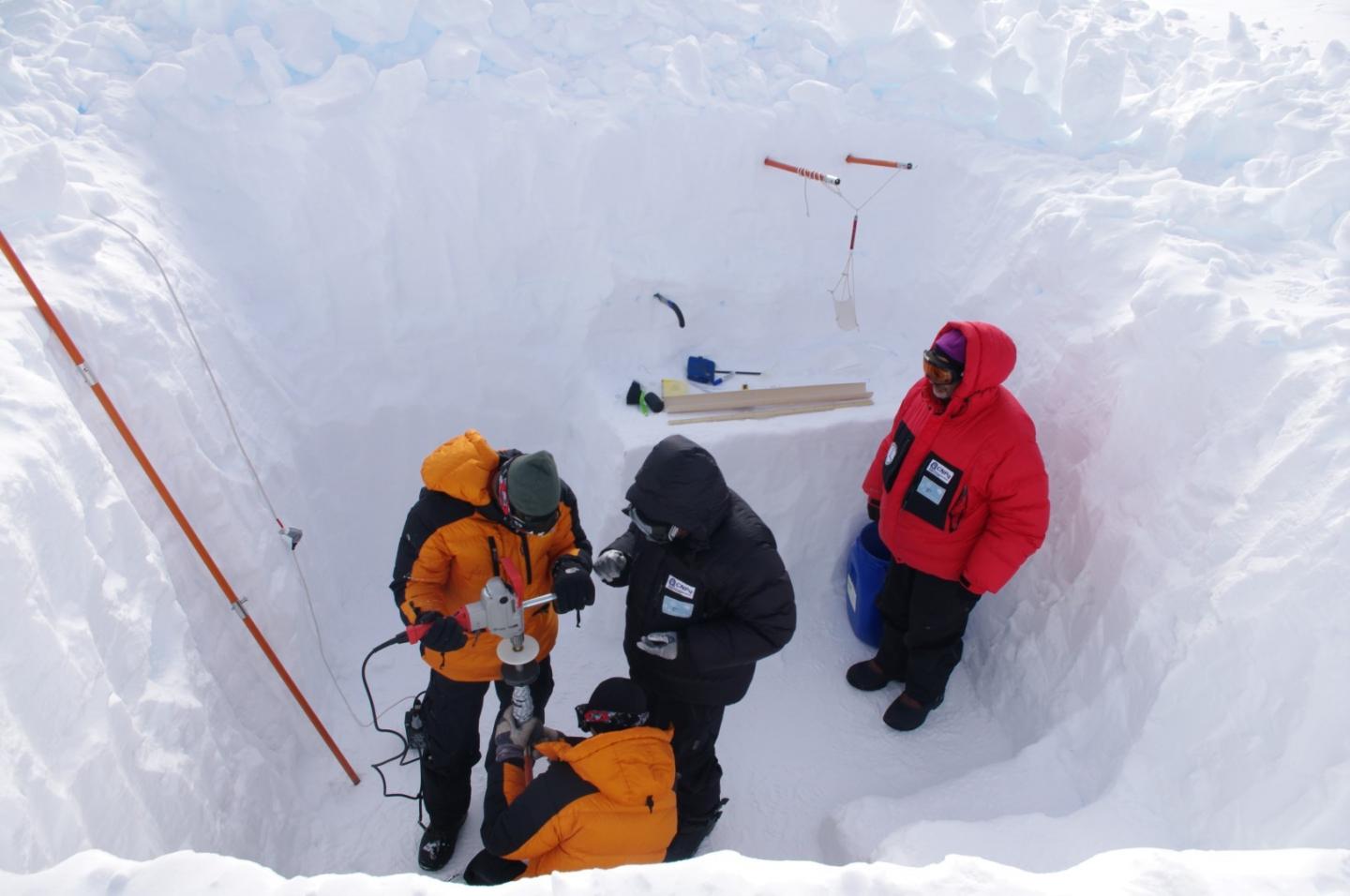
Mr. Marquetto was part of a team of Brazilian researchers led by Dr. Jefferson Cardia Simões (Polar and Climatic Center) who carried out a traverse in West Antarctica in the 2014/2015 austral summer. They travelled more than 1400 km, collecting several shallow snow cores and samples along the way to investigate the snow chemistry (and consequently the atmospheric chemistry) in the last 50 years or so. One of these shallow cores was analyzed for BC in cooperation with Dr. Susan Kaspari (Central Washington University, USA).

“We observed very low BC concentrations in snow, lower than in other works in the continent. Due to that, in the article published in Advances in Atmospheric Sciences we decided to focus on instrumental and methodological questions raised during the research that needed to be answered before going deeper into the environmental interpretation”, Mr. Marquetto says.

“However, our ultimate goal is to better understand BC seasonal variability and overall concentrations to see what impact the particle has in Antarctic snow, as well as try to identify BC geographical sources. We are also interested in the BC size distribution in snow, as particle size affects the amount of solar radiation BC can absorb. Impacts in the atmosphere and in the cryosphere are possibly being under or overestimated due to simplified representations of BC particle size in climatic models”, believes Mr. Marquetto.

“As for sectorial sources, we know biomass burning represents around 80% of all BC emitted to the atmosphere in the Southern Hemisphere, which means that the fires happening in Australia, New Zealand and South America ultimately leave a mark in Antarctic snow.”

###

Media Contact
Ms. LIN Zheng
[email protected]

Related Journal Article

http://dx.doi.org/10.1007/s00376-019-9124-8

Tags: Atmospheric ScienceChemistry/Physics/Materials SciencesEarth Science
Share12Tweet8Share2ShareShareShare2

Related Posts

Cutting Electrolyte Reduction Boosts High-Energy Battery Performance

Cutting Electrolyte Reduction Boosts High-Energy Battery Performance

December 19, 2025
Microenvironment Shapes Gold-Catalysed CO2 Electroreduction

Microenvironment Shapes Gold-Catalysed CO2 Electroreduction

December 11, 2025

Photoswitchable Olefins Enable Controlled Polymerization

December 11, 2025

Cation Hydration Entropy Controls Chloride Ion Diffusion

December 10, 2025
Please login to join discussion

POPULAR NEWS

  • Nurses’ Views on Online Learning: Effects on Performance

    Nurses’ Views on Online Learning: Effects on Performance

    70 shares
    Share 28 Tweet 18
  • NSF funds machine-learning research at UNO and UNL to study energy requirements of walking in older adults

    71 shares
    Share 28 Tweet 18
  • Unraveling Levofloxacin’s Impact on Brain Function

    54 shares
    Share 22 Tweet 14
  • Exploring Audiology Accessibility in Johannesburg, South Africa

    51 shares
    Share 20 Tweet 13

About

We bring you the latest biotechnology news from best research centers and universities around the world. Check our website.

Follow us

Recent News

Understanding Disease Risk in Older Non-Communicable Patients

Assessing Resilience and Evolution of Yellow River Water Resources

Brahmi Boosts Dendritic Cells to Combat NSCLC

Subscribe to Blog via Email

Enter your email address to subscribe to this blog and receive notifications of new posts by email.

Join 70 other subscribers
  • Contact Us

Bioengineer.org © Copyright 2023 All Rights Reserved.

Welcome Back!

Login to your account below

Forgotten Password?

Retrieve your password

Please enter your username or email address to reset your password.

Log In
No Result
View All Result
  • Homepages
    • Home Page 1
    • Home Page 2
  • News
  • National
  • Business
  • Health
  • Lifestyle
  • Science

Bioengineer.org © Copyright 2023 All Rights Reserved.