• HOME
  • NEWS
  • EXPLORE
    • CAREER
      • Companies
      • Jobs
    • EVENTS
    • iGEM
      • News
      • Team
    • PHOTOS
    • VIDEO
    • WIKI
  • BLOG
  • COMMUNITY
    • FACEBOOK
    • INSTAGRAM
    • TWITTER
Saturday, February 7, 2026
BIOENGINEER.ORG
No Result
View All Result
  • Login
  • HOME
  • NEWS
  • EXPLORE
    • CAREER
      • Companies
      • Jobs
        • Lecturer
        • PhD Studentship
        • Postdoc
        • Research Assistant
    • EVENTS
    • iGEM
      • News
      • Team
    • PHOTOS
    • VIDEO
    • WIKI
  • BLOG
  • COMMUNITY
    • FACEBOOK
    • INSTAGRAM
    • TWITTER
  • HOME
  • NEWS
  • EXPLORE
    • CAREER
      • Companies
      • Jobs
        • Lecturer
        • PhD Studentship
        • Postdoc
        • Research Assistant
    • EVENTS
    • iGEM
      • News
      • Team
    • PHOTOS
    • VIDEO
    • WIKI
  • BLOG
  • COMMUNITY
    • FACEBOOK
    • INSTAGRAM
    • TWITTER
No Result
View All Result
Bioengineer.org
No Result
View All Result
Home NEWS Science News Biology

Wild tomato resistance to bacterial canker has implications for commercial tomato industry

Bioengineer by Bioengineer
April 7, 2020
in Biology
Reading Time: 2 mins read
0
IMAGE
Share on FacebookShare on TwitterShare on LinkedinShare on RedditShare on Telegram

IMAGE

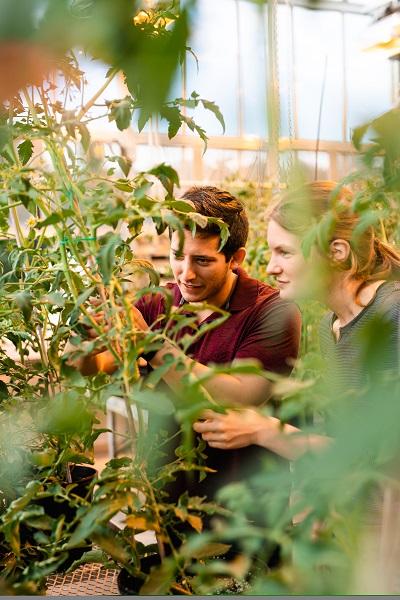
Credit: F. Christopher Peritore-Galve

Bacterial canker of tomato is a disease that leads to wilt, cankers, and eventually death. The disease was first discovered in Grand Rapids, Michigan, in 1909, but annual outbreaks now affect tomato production areas worldwide. For some farmers, bacterial canker can be devastating and spoil an entire season’s planting.

Bacterial canker is caused by the pathogen Clavibacter michiganensis, which infects commercially bred tomatoes by colonizing the xylem, a series of tubes that transports water and minerals throughout the plant. There are no commercially available tomatoes resistant to bacterial canker and management options are limited. However, breeders have known that wild tomato species are less susceptible to bacterial canker, but this knowledge is limited.

Scientists at the School of Integrative Plant Science at Cornell University were interested in understanding how C. michiganensis colonized the xylem in wild tomato and comparing to colonization of cultivated tomatoes. They found a significant difference, according to the paper published in Phytopathology.

F. Christopher Peritore-Galve, lead author of this paper, explains: “Interestingly, the pathogen colonizes to high densities close to the inoculation site in wild tomatoes, but it is found in much lower densities 5 and 10 centimeters above that site, meaning that the bacteria are unable to spread through the xylem as well as in cultivated tomato xylem.”

Additional research showed that the pathogen was restricted to the protoxylem vessels in vascular bundles of wild tomato.

“Protoxylem are early formed xylem vessels that are smaller in diameter that enable water transport during early, rapid plant growth,” said Peritore-Galve. “We currently do not know why C. michiganensis preferentially colonizes these vessels, but that will be an avenue of future research.”

Understanding what makes wild tomatoes able to tolerate this pathogen may help with future breeding efforts. For more information about this study, read “Characterizing Colonization Patterns of Clavibacter michiganensis During Infection of Tolerant Wild Solanum Species.”

###

Media Contact
Ashley Bergman Carlin
[email protected]

Related Journal Article

http://dx.doi.org/10.1094/PHYTO-09-19-0329-R

Tags: Agricultural Production/EconomicsAgricultureBacteriologyEcology/EnvironmentFood/Food ScienceGeneticsPlant Sciences
Share12Tweet8Share2ShareShareShare2

Related Posts

Florida Cane Toad: Complex Spread and Selective Evolution

Florida Cane Toad: Complex Spread and Selective Evolution

February 7, 2026
New Study Uncovers Mechanism Behind Burn Pit Particulate Matter–Induced Lung Inflammation

New Study Uncovers Mechanism Behind Burn Pit Particulate Matter–Induced Lung Inflammation

February 6, 2026

DeepBlastoid: Advancing Automated and Efficient Evaluation of Human Blastoids with Deep Learning

February 6, 2026

Navigating the Gut: The Role of Formic Acid in the Microbiome

February 6, 2026
Please login to join discussion

POPULAR NEWS

  • Robotic Ureteral Reconstruction: A Novel Approach

    Robotic Ureteral Reconstruction: A Novel Approach

    82 shares
    Share 33 Tweet 21
  • Digital Privacy: Health Data Control in Incarceration

    63 shares
    Share 25 Tweet 16
  • Study Reveals Lipid Accumulation in ME/CFS Cells

    57 shares
    Share 23 Tweet 14
  • Breakthrough in RNA Research Accelerates Medical Innovations Timeline

    53 shares
    Share 21 Tweet 13

About

We bring you the latest biotechnology news from best research centers and universities around the world. Check our website.

Follow us

Recent News

Evaluating Pediatric Emergency Care Quality in Ethiopia

TPMT Expression Predictions Linked to Azathioprine Side Effects

Improving Dementia Care with Enhanced Activity Kits

Subscribe to Blog via Email

Enter your email address to subscribe to this blog and receive notifications of new posts by email.

Join 73 other subscribers
  • Contact Us

Bioengineer.org © Copyright 2023 All Rights Reserved.

Welcome Back!

Login to your account below

Forgotten Password?

Retrieve your password

Please enter your username or email address to reset your password.

Log In
No Result
View All Result
  • Homepages
    • Home Page 1
    • Home Page 2
  • News
  • National
  • Business
  • Health
  • Lifestyle
  • Science

Bioengineer.org © Copyright 2023 All Rights Reserved.