• HOME
  • NEWS
  • EXPLORE
    • CAREER
      • Companies
      • Jobs
    • EVENTS
    • iGEM
      • News
      • Team
    • PHOTOS
    • VIDEO
    • WIKI
  • BLOG
  • COMMUNITY
    • FACEBOOK
    • INSTAGRAM
    • TWITTER
Saturday, February 7, 2026
BIOENGINEER.ORG
No Result
View All Result
  • Login
  • HOME
  • NEWS
  • EXPLORE
    • CAREER
      • Companies
      • Jobs
        • Lecturer
        • PhD Studentship
        • Postdoc
        • Research Assistant
    • EVENTS
    • iGEM
      • News
      • Team
    • PHOTOS
    • VIDEO
    • WIKI
  • BLOG
  • COMMUNITY
    • FACEBOOK
    • INSTAGRAM
    • TWITTER
  • HOME
  • NEWS
  • EXPLORE
    • CAREER
      • Companies
      • Jobs
        • Lecturer
        • PhD Studentship
        • Postdoc
        • Research Assistant
    • EVENTS
    • iGEM
      • News
      • Team
    • PHOTOS
    • VIDEO
    • WIKI
  • BLOG
  • COMMUNITY
    • FACEBOOK
    • INSTAGRAM
    • TWITTER
No Result
View All Result
Bioengineer.org
No Result
View All Result
Home NEWS Science News Chemistry

Magnetoacoustic waves: Towards a new paradigm of on-chip communication

Bioengineer by Bioengineer
April 6, 2020
in Chemistry
Reading Time: 2 mins read
0
IMAGE
Share on FacebookShare on TwitterShare on LinkedinShare on RedditShare on Telegram

IMAGE

Credit: B. Casals et al.

Researchers have observed directly and for the first time magnetoacoustic waves (sound-driven spin waves), which are considered as potential information carriers for novel computation schemes. These waves have been generated and observed on hybrid magnetic/piezoelectric devices. The experiments were designed by a collaboration between the University of Barcelona (UB), the Institute of Materials Science of Barcelona (ICMAB-CSIC) and the ALBA Synchrotron. The results show that magnetoacoustic waves can travel over long distances -up to centimeters- and have larger amplitudes than expected.

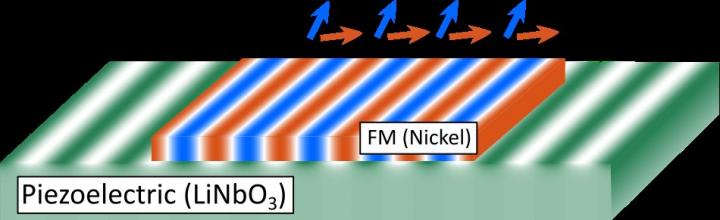
The observation of the magnetization waves was performed in a Nickel ferromagnetic thin film, which was excited by a deformation wave (called surface acoustic wave, SAW) originated in a piezoelectric substrate layer below the Nickel film. Although clear interaction between acoustic waves and magnetization dynamics has been reported in several systems, thus far, no direct observation of the underlying magnetic excitations existed, providing a quantification of both time and space.

Now researchers have published in Physical Review Letters their findings: “We designed an experiment ad hoc to image and quantify the magnetization dynamics generated by surface acoustic waves (SAW). The results clearly show that magnetization waves exist at distinct frequencies and wavelengths and that it is possible to create wave interferences” explains Ferran Macià, leader of the project at the UB and ICMAB.

The experiments show interference patterns of magnetization waves and provides new avenues for manipulation of these waves at room temperature “Our magnetization waves are coupled to the acoustic waves and thus, can travel long distances and have larger amplitudes than spin waves” explains Michael Foerster, beamline scientist of CIRCE-PEEM at ALBA. Such large-amplitude, long-distance waves could be well-suited for carrying information, processing data, or driving small motors.

The generation of magnetization dynamics through acoustic waves has attracted interest because it has some advantages over magnetic field induced excitations, such as more energy efficiency, larger spatial extension, or match of wavelengths.

The experiments were performed using the PEEM (Photoemission Electron Microscopy) at the CIRCE beamline at the ALBA Synchrotron to image the magnetization waves, which were synchronized with the synchrotron light pulses. “As wave are dynamic objects, they were imaged with stroboscopic snapshots thanks to this synchronization. The X-ray magnetic circular dichroism (XMCD) effect was used to obtain magnetic contrast in the images” explains Macià.

###

The study, in collaboration with the Paul-Drude-Institut in Berlin, was in the framework of a Frontier Interdisciplinary Project (FIP) of the ICMAB Severo Ochoa grant. The FIPs are aimed to develop high-risk exploratory projects of interdisciplinary character to generate cutting-edge research in the application areas of energy, electronics or health.

Media Contact
Bibiana Bonmatí
[email protected]

Original Source

https://www.ub.edu/web/ub/ca/menu_eines/noticies/2020/03/060.html

Related Journal Article

http://dx.doi.org/10.1103/PhysRevLett.124.137202

Tags: Chemistry/Physics/Materials SciencesElectromagneticsMaterials
Share12Tweet8Share2ShareShareShare2

Related Posts

blank

Breakthrough in Environmental Cleanup: Scientists Develop Solar-Activated Biochar for Faster Remediation

February 7, 2026
blank

Cutting Costs: Making Hydrogen Fuel Cells More Affordable

February 6, 2026

Scientists Develop Hand-Held “Levitating” Time Crystals

February 6, 2026

Observing a Key Green-Energy Catalyst Dissolve Atom by Atom

February 6, 2026
Please login to join discussion

POPULAR NEWS

  • Robotic Ureteral Reconstruction: A Novel Approach

    Robotic Ureteral Reconstruction: A Novel Approach

    82 shares
    Share 33 Tweet 21
  • Digital Privacy: Health Data Control in Incarceration

    63 shares
    Share 25 Tweet 16
  • Study Reveals Lipid Accumulation in ME/CFS Cells

    57 shares
    Share 23 Tweet 14
  • Breakthrough in RNA Research Accelerates Medical Innovations Timeline

    53 shares
    Share 21 Tweet 13

About

We bring you the latest biotechnology news from best research centers and universities around the world. Check our website.

Follow us

Recent News

Evaluating Pediatric Emergency Care Quality in Ethiopia

TPMT Expression Predictions Linked to Azathioprine Side Effects

Improving Dementia Care with Enhanced Activity Kits

Subscribe to Blog via Email

Success! An email was just sent to confirm your subscription. Please find the email now and click 'Confirm' to start subscribing.

Join 73 other subscribers
  • Contact Us

Bioengineer.org © Copyright 2023 All Rights Reserved.

Welcome Back!

Login to your account below

Forgotten Password?

Retrieve your password

Please enter your username or email address to reset your password.

Log In
No Result
View All Result
  • Homepages
    • Home Page 1
    • Home Page 2
  • News
  • National
  • Business
  • Health
  • Lifestyle
  • Science

Bioengineer.org © Copyright 2023 All Rights Reserved.