• HOME
  • NEWS
  • EXPLORE
    • CAREER
      • Companies
      • Jobs
    • EVENTS
    • iGEM
      • News
      • Team
    • PHOTOS
    • VIDEO
    • WIKI
  • BLOG
  • COMMUNITY
    • FACEBOOK
    • INSTAGRAM
    • TWITTER
Tuesday, July 7, 2026
BIOENGINEER.ORG
No Result
View All Result
  • Login
  • HOME
  • NEWS
  • EXPLORE
    • CAREER
      • Companies
      • Jobs
        • Lecturer
        • PhD Studentship
        • Postdoc
        • Research Assistant
    • EVENTS
    • iGEM
      • News
      • Team
    • PHOTOS
    • VIDEO
    • WIKI
  • BLOG
  • COMMUNITY
    • FACEBOOK
    • INSTAGRAM
    • TWITTER
  • HOME
  • NEWS
  • EXPLORE
    • CAREER
      • Companies
      • Jobs
        • Lecturer
        • PhD Studentship
        • Postdoc
        • Research Assistant
    • EVENTS
    • iGEM
      • News
      • Team
    • PHOTOS
    • VIDEO
    • WIKI
  • BLOG
  • COMMUNITY
    • FACEBOOK
    • INSTAGRAM
    • TWITTER
No Result
View All Result
Bioengineer.org
No Result
View All Result
Home NEWS Science News Health

Tissue dynamics provide clues to human disease

Bioengineer by Bioengineer
April 3, 2020
in Health
Reading Time: 3 mins read
0
IMAGE
Share on FacebookShare on TwitterShare on LinkedinShare on RedditShare on Telegram

EMBL scientists examine the molecular causes of a rare hereditary disease of the spine and ribs
IMAGE

Credit: Ebisuya group/EMBL

Segmentation clock

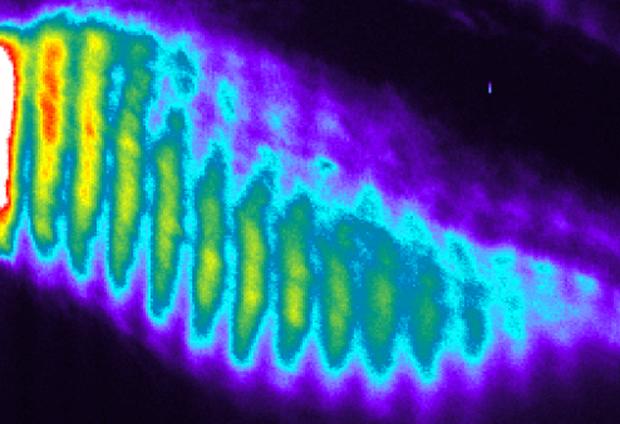
Our vertebral column is a highly repetitive structure – 33 vertebrae from top to bottom. This arrangement is created in the embryo by the sequential formation of a long row of structures called somites (see image), which later give rise to the vertebrae and ribs. This periodic pattern of somites is created by a group of genes known as the segmentation clock. Molecular interactions within the cell cause the expression of these genes to oscillate, with gene activity rising and falling in a regular pattern over time (see movie below). For each oscillation, another somite is formed. Errors in this segmentation clock can cause hereditary disorders of the vertebrae, such as the rare condition spondylocostal dysostosis (SCD).

The dynamics of the human segmentation clock and related diseases cannot be studied directly in human embryos, so EMBL Research Scientist Mitsuhiro Matsuda and collaborators tried to create a system for studying this process in the lab. They created cell lines that each lacked a gene thought to be the causative mutation of SCD – which can be caused by any of several genes – in different patients. They cultured these cells to create simplified versions of an embryo that show many of the same characteristics. While cells lacking a gene called HES7 failed to show oscillations, cells lacking the genes DLL3 and LFNG surprisingly showed intact oscillations. However, despite oscillations occurring in these cell lines at the single-cell level, they did not properly coordinate across the tissue to form synchronised collective oscillations or travelling waves of gene activity.

Further tests

These experiments demonstrated that the culture system the scientists has created could reveal SCD mutations that had been engineered into otherwise healthy cells. But what about testing patients’ cells directly? They established a new cell line from a patient with a mutation in DLL3, and tested it in vitro. As expected, this cell line failed to show travelling waves. To provide the strongest evidence that the DLL3 mutation was the cause, the researchers used the gene editing tool CRISPR-Cas9 to correct the patient’s mutation. This restored the normal synchronisation of the segmentation clock in the in vitro tissue, proving that this specific mutation was responsible.

“The segmentation clock, the mechanism underlying the periodic structures of the vertebral column, has been recapitulated in vitro. We also succeeded in evaluating two important properties of the segmentation clock separately: oscillation and synchronisation,” says EMBL group leader Miki Ebisuya. “HES7, DLL3, and LFNG were already known as causative genes of SCD. But, for many SCD patients, the causative genes are still unknown. Our next goal is to identify a novel causative gene of SCD by using our newly established in vitro model.”

###

Media Contact
Mathias Jäger
[email protected]

Original Source

https://www.embl.org/news/science/tissue-dynamics-provide-clues-to-human-disease

Related Journal Article

http://dx.doi.org/10.1038/s41586-020-2144-9

Tags: BiologyCell BiologyMedicine/HealthMolecular Biology
Share12Tweet8Share2ShareShareShare2

Related Posts

Flame retardant BDE-209 targets molecularly linked to ulcerative colitis

July 6, 2026

Kidney transplant outcomes in older adults studied by German researchers

July 6, 2026

Salmonella protein SopB curbs early inflammation to slow disease progression

July 6, 2026

Multi-metal cooperation drives lung cancer chemoresistance, reversed by MiADMSA

July 6, 2026
Please login to join discussion

POPULAR NEWS

  • Detection of EDCs in Breast Milk and Infant Urine Up to Six Months Highlights Early Exposure Risks

    77 shares
    Share 31 Tweet 19
  • New Drug Candidate Developed at McMaster Shows Potential for Treating Brain Cancer

    58 shares
    Share 23 Tweet 15
  • Saying Goodbye to PGY-6: Pediatric Fellowship Realities

    103 shares
    Share 41 Tweet 26
  • KTU Researchers Explore Ultrasound’s Role in Enhancing Blood Flow Beyond Diagnostics

    53 shares
    Share 21 Tweet 13

About

We bring you the latest biotechnology news from best research centers and universities around the world. Check our website.

Follow us

Recent News

Flame retardant BDE-209 targets molecularly linked to ulcerative colitis

Ultra-high frequency particle impacts mimic rockbursts to shatter hard rock

Kidney transplant outcomes in older adults studied by German researchers

Subscribe to Blog via Email

Enter your email address to subscribe to this blog and receive notifications of new posts by email.

Join 83 other subscribers
  • Contact Us

Bioengineer.org © Copyright 2023 All Rights Reserved.

Welcome Back!

Login to your account below

Forgotten Password?

Retrieve your password

Please enter your username or email address to reset your password.

Log In
No Result
View All Result
  • Homepages
    • Home Page 1
    • Home Page 2
  • News
  • National
  • Business
  • Health
  • Lifestyle
  • Science

Bioengineer.org © Copyright 2023 All Rights Reserved.