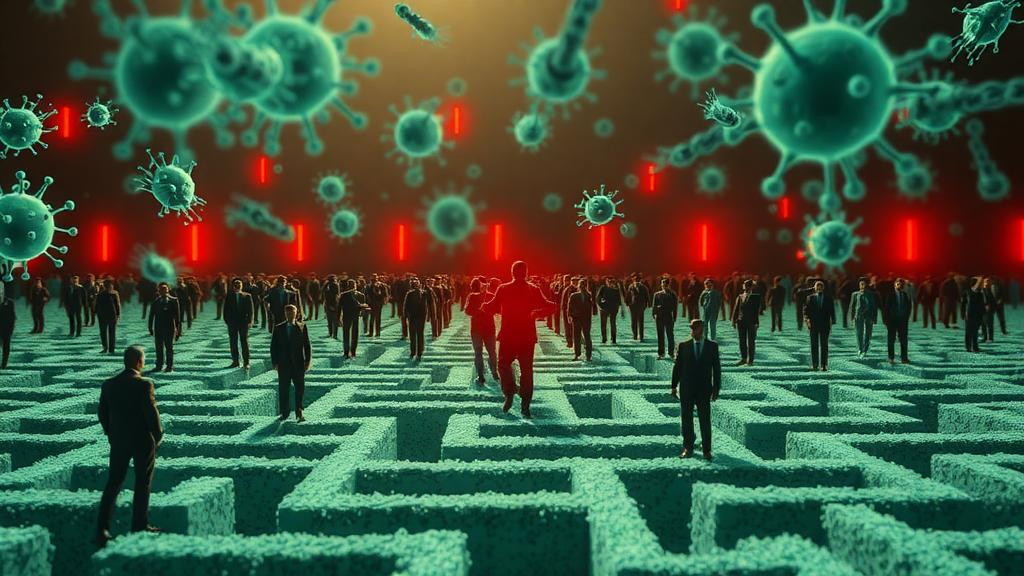
From flocks of starlings wheeling across an evening sky to the crush of commuters on a packed train platform, collective movement is one of the most familiar phenomena in the living world. Moving as a group can offer safety and efficiency, but it carries a hidden cost: congestion. A flock that stays perfectly coordinated may never split off to explore a new feeding ground, and a crowd that flows smoothly in one direction can jam catastrophically when it meets an obstacle. How individuals balance the benefits of coordinated motion with the need to break away and explore on their own is a central question that spans biology, physics, and engineering. Now, researchers at EPFL report that even bacteria, among the simplest of collective movers, have evolved an elegant solution to this dilemma, and it relies on something surprisingly familiar: a good bump on the shoulder.
The study, published in Nature Microbiology by Alexandre Persat’s Microbial Mechanics Lab in collaboration with Sangwoo Kim’s Mechanics of Soft and Biological Matter Laboratory, both at EPFL, reveals that the opportunistic pathogen Pseudomonas aeruginosa actively senses when it collides with neighboring cells and responds by reversing its direction of travel within seconds. This touch-based feedback loop allows the bacterial population to do something remarkable: stay highly organized where organization matters, such as at the advancing edge of a growing colony, while deliberately dissolving that order in crowded regions where it would otherwise trap individual cells. According to the authors, this shows that collective order in bacterial groups is not merely a passive consequence of physics but an actively regulated state that the cells themselves control.
The problem the bacteria face is one that anyone who has ever been stuck in a dense crowd will recognize. P. aeruginosa moves across surfaces using a form of motility that depends on physical contact with the substrate, and in dense communities the cells frequently line up and stream together in coordinated groups. These physical interactions between neighboring cells create alignment, and alignment creates order. But order has a downside. Individual cells embedded within a coordinated stream can become trapped inside the group, unable to turn away and strike out into new territory. For a bacterium, that inability to disperse is a serious handicap: it prevents the cell from finding fresh nutrients, and it hinders escape from crowded, structurally complex environments such as soil pores or the tissues of a host during infection.
Laure Le Blanc, the paper’s first author, explains the mechanism in simple terms. As the bacteria move across surfaces, they sense when they bump into neighbors, and in response they reverse direction within seconds. That rapid reversal is the key. Each collision acts as a piece of sensory information, telling the cell that its local environment is congested and that continuing straight ahead would be counterproductive. By reversing, the cell injects disorder into the collective motion, loosening the alignment that physical contact tends to create. Where collisions are rare, for example at the open frontier of a colony, the cells align strongly and move together toward unexplored space. Where collisions are frequent, the reversals accumulate and the group remains disordered and mobile. The population effectively uses touch to tune its own degree of collective organization from moment to moment.
To disentangle how individual collisions translate into group-level behavior, the team combined three complementary approaches: live microscopy to watch the bacteria in action, single-cell tracking to follow the trajectories of individual cells, and computer simulations to test how collision-driven reversals shape population dynamics. Crucially, they compared wild-type bacteria, which possess the full sensory machinery, with mutant strains that lack it. This side-by-side comparison allowed the researchers to isolate the specific contribution of collision sensing, rather than inferring it indirectly from the behavior of intact populations alone. By tracking individuals and analyzing overall group movement simultaneously, they could observe in real time how a microscopic bump between two cells rippled outward to reshape the behavior of the entire community.
The contrast between the two strains was striking. The researchers worked with a mutant lacking a gene critical for the bacterium’s normal motility pattern; the mutant always moves forward, even after colliding with other cells or with boundaries. When traveling alone, the mutants actually performed well, covering greater distances than their wild-type counterparts, since relentless forward motion pays off in empty space. But when moving together, the advantage evaporated. Without the ability to respond to collisions, the cells quickly became trapped in dense clusters, jamming against one another much like a crowd pressing into a blocked exit. The wild-type cells, by contrast, used each bump as information, reversing in crowded areas to keep the group fluid and exploratory, while maintaining tight alignment at the colony edge where open space invited coordinated advance.
The most dramatic demonstration came from an experiment that sounds almost whimsical: the researchers built micro-mazes, tiny obstacle-filled labyrinths, and released the two strains inside to see how they would navigate the confined, structured environment. The results were decisive. Only one percent of the collision-blind mutant bacteria managed to reach the maze exit within four hours. The wild-type cells, equipped with their touch-based navigation system, explored an average of ninety-two percent of the maze, and twenty percent of the cells eventually found the exit. In other words, the ability to feel a collision and reverse course transformed a population of microscopic wanderers into efficient problem-solvers capable of threading their way through a physical puzzle that stumped the mutants almost completely.
At the mechanistic level, the findings reframe what bacterial collectives are doing on surfaces. The classical picture treats alignment and streaming in dense bacterial groups as emergent physics, the inevitable result of cells pushing against one another as they crawl. The new work shows that P. aeruginosa actively modulates that physics, converting mechanical interactions into sensory input that feeds back onto individual behavior and, from there, onto the architecture of the whole population. The cells are, in effect, performing a computation: the frequency of collisions in their immediate surroundings encodes the local density of the crowd, and the reversal response reads that signal out as a behavioral decision. This allows the same population to display two very different collective states, ordered at the frontier and disordered in the interior, without any central coordination or chemical signaling between distant cells.
The implications extend well beyond basic microbiology. P. aeruginosa is a notorious opportunistic pathogen, and the researchers suggest that this collision-sensing mechanism may help the bacterium spread through host tissues and contribute to biofilm formation during human infections. Understanding how the cells regulate their collective organization could therefore inform new strategies for interfering with bacterial dispersal and biofilm development, both of which are major challenges in clinical settings where antibiotic-resistant infections are a growing concern. The discovery also carries a lesson for engineers. Robot swarms deployed in crowded or unknown environments face exactly the same trade-off between cohesion and exploration that bacteria face, and they often get stuck for precisely the reasons the mutant cells do. A simple rule, reverse when you bump into something, turns out to be a remarkably effective decentralized algorithm for keeping a swarm mobile, and it requires no central controller, no map, and no communication beyond the moment of contact itself.
What makes the study especially compelling is the way it connects scales. A single molecular event, a cell brushing against a neighbor, triggers a reversal within seconds; thousands of such events sculpt the shape and exploratory capacity of an entire colony; and in a maze, that collective behavior determines whether the population escapes or perishes. Persat’s framing of the question, drawn from fish schools, bird flocks, and human crowds, finds its answer in one of the simplest organisms on Earth: individuals in a group can balance coordination with exploration by using their own bodies as sensors. For bacteria, the crowded environment is not an obstacle to navigation but the very source of the information needed to navigate it. The bump in the crowd, it turns out, is the message.
Subject of Research: Mechanosensing of cell-cell collisions regulating collective navigation in Pseudomonas aeruginosa
Article Title: Bacteria use collisions to navigate crowded environments
Article References: Bacteria use collisions to navigate crowded environments. (n.d.). Original publication
Image Credits: AI Generated
DOI: Not provided
Keywords: Pseudomonas aeruginosa, bacteria, mechanosensing, collective behavior, cell-cell collisions, twitching motility, biofilms, micro-mazes, EPFL, Nature Microbiology, robot swarms, bacterial navigation
News Source: Morgan Morrow. (October 6, 2026). Bacteria Turn Bumps Into Signals to Escape Crowds and Conquer Mazes. Scienmag.