Imidazoline receptors I2: Looking for new therapeutic targets
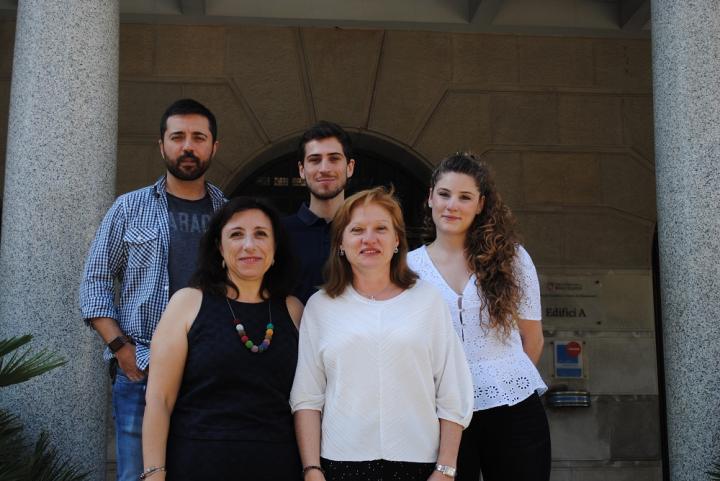
Credit: UNIVERSITY OF BARCELONA
An article published in the Journal of Medicinal Chemistry shows a new family of molecules with high affinity to join imidazoline receptors, which are altered in the brain of those patients with neurodegenerative diseases such as Alzheimer’s, Parkinson’s and Huntington’s. According to the preclinical study, the merge of these specific ligands to I2 receptors improves cognitive skills and some biomarkers which are indicators of brain neurodegenerative processes in murine models.
The new study is coordinated by the lecturer M. Carmen Escolano, from the Faculty of Pharmacy and Food Sciences of the University of Barcelona, and counts on the participation of Mercè Pallàs (UBNeuro), Javier Luque (IBUB-IQTCUB) and Pilar Pérez-Lozano (Unit of Pharmaceutic Technology), among other researchers from the same Faculty.
Other collaborators in this research were Julia García-Fuster and Jesús A. García-Fuster (UIB), Belén Pérez (UAB), Elies Molins (Institute of Materials Sciences of Barcelona, ICMAB-CSIC), Luis F. Callado (UPV), and other experts from the University of Santiago de Compostela, the University of Belgrade (Serbia) and Leuven University (Belgium).
Imidazoline receptors I2: looking for new therapeutic targets
Imidazoline receptors I2 are found in several bodies. Selective ligands from these receptors showed they participate in several physiological processes (analgesia, inflammation, human brain disorders, etc.). These are distributed in the brain and in the case of patients with neurodegenerative processes, or with glioma or mental disorders, these are altered. This is why they can be presented as potential pharmacological targets in the fight against neurodegenerative diseases.
Despite their decisive role in cell physiology, the structure of the receptors in this family has not been described yet in order to make its pharmacological characterization.
“We need new therapeutic targets to cope with therapy for diseases which are currently an uncovered in medicine. The discovery of a receptor or a maker can lead to the unfolding of therapeutic technology and become an important process”, notes the lecturer M. Carmen Escolano.
New ligands with high affinity for imidazoline I2 receptors
The new article presents a new molecule structural family (Bicyclic α?Iminophosphonates) with high affinity and selectivity regarding imidazoline I2 receptors. These molecules with an innovative profile are not structurally related to any of the standard ligands used for the pharmacological characterization of these receptors, and open new structural possibilities beyond those offered by the classic ligands.
With an only phase of diastereoselective synthesis, the team created a series of membres of the ligand family of the imidazoline I2 receptors, with several compunds to help shape the structure-activity relation and determine the structural features to get the best ligand-receptor affinity.
Specifically, the synthetized molecules have a phosphonic ester -original functional group- integrated in a α?Iminophosphonate system which is not exploited as a functional group of interest in the field of medical chemistry.
With an innovative perspective, affinity studies of the new study have been carried out with competition binding techniques of radioactive ligands in human brain samples. Other comparative studies of affinity in different animal species (humans, rats, mica) have been conducted with the new compounds and the ligands considered as standard according to scientific literature.
Cognitive improvement in neurodegeneration biomarkers and behaviour
In previous studies, the research team had described for the first time the cognitive improvement of a murine model of neurodegeneration (Neurotherapeutics, 2019), produced by new ligands I2, synthetized by these experts (ACD Chemical Neurosciences, 2017).
The new study states that the specific union between a representative molecule of the new family of ligands and the imidazoline I2 receptors produces an improvement of protein markers related to neuroprotector processes in the treated animal models. Also, there is a cognitive improvement in behaviour studies and in parameters associated with neuroinflammation and oxidative stress in the model 5xFAD (murine model with family Alzheimer’s).
A multidisciplinary project with a patent in neurosciences
This multidiscipline line of work, unfolded in the frame of a CaixaImpulse project, led to the patent WO 2019/121853, projected in different scenarios with the support from Bosch i Gimpera Foundation (FBG).
With these references, the experts continue with their research to describe pharmaco-technical processes that take place after the administration of the representative ligand in model animals to define the participating metabolites and shape the most accurate therapeutic dose. Another objective is to describe the processes that result from the interaction of the new molecular compound with the receptors (proteomics, signaling pathways, etc.).
###
Media Contact
Rosa Martínez
[email protected]
Original Source
https:/
Related Journal Article
http://dx.