

• HOME
  • NEWS
  • EXPLORE
    • CAREER
      • Companies
      • Jobs
    • EVENTS
    • iGEM
      • News
      • Team
    • PHOTOS
    • VIDEO
    • WIKI
  • BLOG
  • COMMUNITY
    • FACEBOOK
    • INSTAGRAM
    • TWITTER
Friday, December 5, 2025
BIOENGINEER.ORG
No Result
View All Result
  • Login
  • HOME
  • NEWS
  • EXPLORE
    • CAREER
      • Companies
      • Jobs
        • Lecturer
        • PhD Studentship
        • Postdoc
        • Research Assistant
    • EVENTS
    • iGEM
      • News
      • Team
    • PHOTOS
    • VIDEO
    • WIKI
  • BLOG
  • COMMUNITY
    • FACEBOOK
    • INSTAGRAM
    • TWITTER
  • HOME
  • NEWS
  • EXPLORE
    • CAREER
      • Companies
      • Jobs
        • Lecturer
        • PhD Studentship
        • Postdoc
        • Research Assistant
    • EVENTS
    • iGEM
      • News
      • Team
    • PHOTOS
    • VIDEO
    • WIKI
  • BLOG
  • COMMUNITY
    • FACEBOOK
    • INSTAGRAM
    • TWITTER
No Result
View All Result
Bioengineer.org
No Result
View All Result
Home NEWS Science News Health

Researchers develop a computer simulator that recreates the spread of COVID-19 in Europe

Bioengineer by Bioengineer
April 3, 2020
in Health
Reading Time: 2 mins read
0
IMAGE
Share on FacebookShare on TwitterShare on LinkedinShare on RedditShare on Telegram

IMAGE

Credit: UC3M

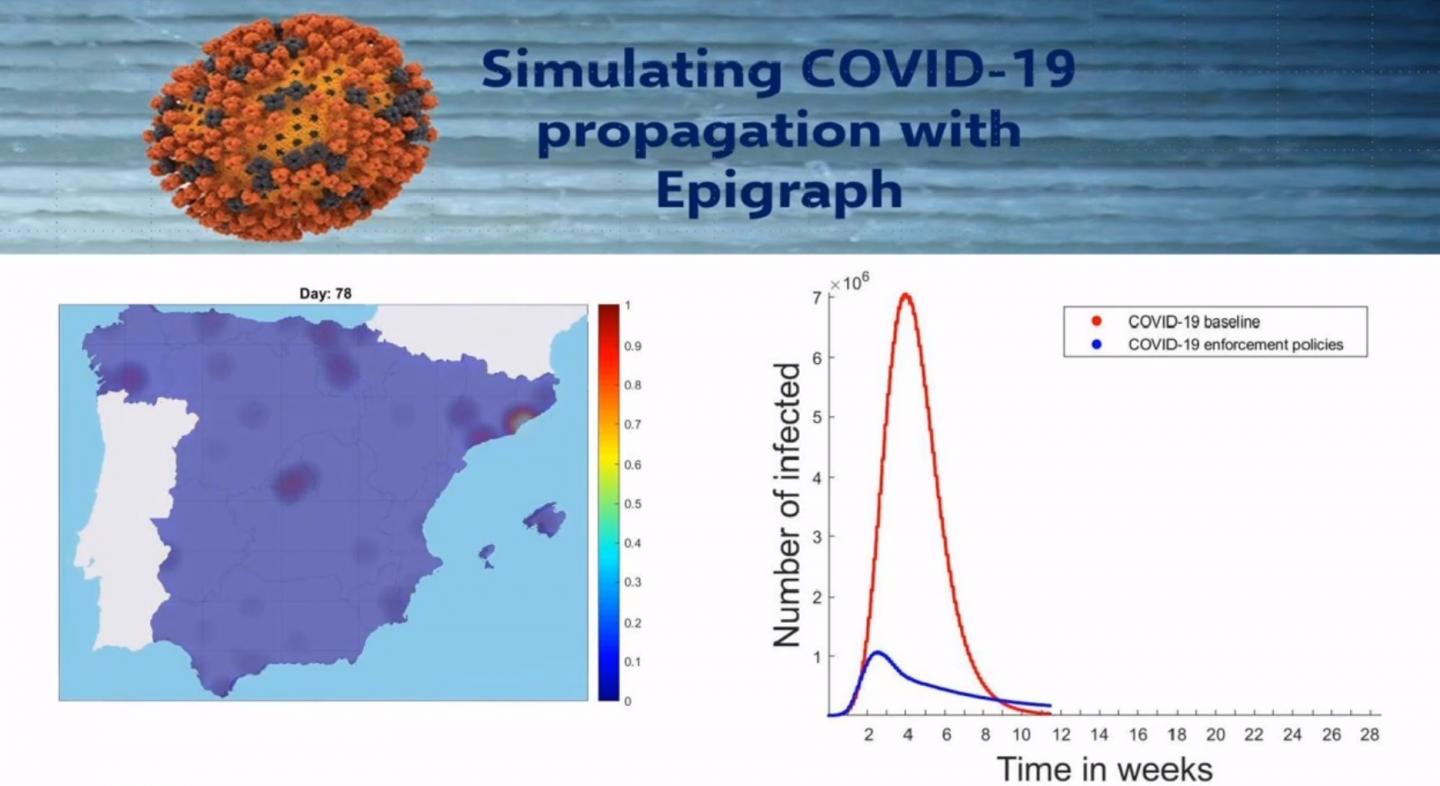
A team of Spanish researchers have designed and validated a simulator to enable study of the evolution of the COVID-19 illness in Spain and in all Europe, based on parameters such as climate, social distancing policies and transportation. This research work has been carried out by scientists and technologists from Universidad Carlos III de Madrid (UC3M), the Centro Nacional de Epidemiología (CNE) and the Consorcio Centro de Investigación Biomédica en Red (CIBER) from the Instituto de Salud Carlos III (ISCIII), in conjunction with the Barcelona Supercomputing Center – Centro Nacional de Supercomputación (BSC-CNS).

This large scale simulator, called Epigraph, allows the evolution of the spread of the SARS-CoV-2 virus to be studied and the curve of the illness to be modeled, including the isolation measures, to predict its evolution depending on the activities that are permitted, and to assess the possible effect of a vaccination on the epidemic’s spread.

According to the first results obtained, the researchers point out that the possible number of cases in Spain could be greater than those detected at the national level, which would situate Spain as currently having more than three million people affected, including asymptomatic cases.

Another scenario that has been simulated is reincorporation to the workplace, finding that if workplace reincorporation is not accompanied by social distancing and personal protection, the epidemic would very likely be reproduced, with between three and fourteen million people being infected during the second curve, depending on the social distancing policy applied.

This simulator is able to recreate the social characteristics of diverse groups in the population (students, workers, seniors, and the unemployed), their relationships in different environments (school, work, home, and leisure) and a transportation model that simulates the spatial dynamics of the spread of the virus between different regions. In addition, EpiGraph also includes modeling of the interaction between the spread of COVID-19 and climate and meteorological factors, such as temperature, barometric pressure and humidity levels.

This work has been coordinated in the ARCOS (Computer Architecture, Communications and Systems)research group at UC3M, with experience in real-time simulation of systems and high performance computing, among other research lines. In addition to the participation of scientists and technologists from BSC-CNS and ISCIII, there has been collaboration from the Wuhan Center for Disease Control & Prevention.

###

Media Contact
Javier Alonso
[email protected]

Original Source

https://www.uc3m.es/ss/Satellite/UC3MInstitucional/en/Detalle/Comunicacion_C/1371288690098/1371215537949/Researchers_develop_a_computer_simulator_that_recreates_the_spread_of_COVID-19_in_Europe

Tags: Mathematics/StatisticsMedicine/HealthResearch/DevelopmentTechnology TransferTechnology/Engineering/Computer Science
Share12Tweet8Share2ShareShareShare2

Related Posts

Metformin-Alogliptin Combo vs. Monotherapy in Diabetes

December 3, 2025

Botanical Extracts’ Antibacterial Activity Boosted by Enhancers

December 3, 2025

Global Guidelines for Shared Decision-Making in Valvular Heart Disease

December 3, 2025

Hidradenitis Suppurativa Remission Achieved Using Bacteriophage Therapy

December 3, 2025
Please login to join discussion

POPULAR NEWS

  • New Research Unveils the Pathway for CEOs to Achieve Social Media Stardom

    New Research Unveils the Pathway for CEOs to Achieve Social Media Stardom

    204 shares
    Share 82 Tweet 51
  • Scientists Uncover Chameleon’s Telephone-Cord-Like Optic Nerves, A Feature Missed by Aristotle and Newton

    121 shares
    Share 48 Tweet 30
  • Neurological Impacts of COVID and MIS-C in Children

    107 shares
    Share 43 Tweet 27
  • MoCK2 Kinase Shapes Mitochondrial Dynamics in Rice Fungal Pathogen

    69 shares
    Share 28 Tweet 17

About

We bring you the latest biotechnology news from best research centers and universities around the world. Check our website.

Follow us

Recent News

Boosting Cancer Immunotherapy by Targeting DNA Repair

Evaluating eGFR Equations in Chinese Children

Metformin-Alogliptin Combo vs. Monotherapy in Diabetes

Subscribe to Blog via Email

Success! An email was just sent to confirm your subscription. Please find the email now and click 'Confirm' to start subscribing.

Join 69 other subscribers
  • Contact Us

Bioengineer.org © Copyright 2023 All Rights Reserved.

Welcome Back!

Login to your account below

Forgotten Password?

Retrieve your password

Please enter your username or email address to reset your password.

Log In
No Result
View All Result
  • Homepages
    • Home Page 1
    • Home Page 2
  • News
  • National
  • Business
  • Health
  • Lifestyle
  • Science

Bioengineer.org © Copyright 2023 All Rights Reserved.

