• HOME
  • NEWS
  • EXPLORE
    • CAREER
      • Companies
      • Jobs
    • EVENTS
    • iGEM
      • News
      • Team
    • PHOTOS
    • VIDEO
    • WIKI
  • BLOG
  • COMMUNITY
    • FACEBOOK
    • INSTAGRAM
    • TWITTER
Saturday, February 7, 2026
BIOENGINEER.ORG
No Result
View All Result
  • Login
  • HOME
  • NEWS
  • EXPLORE
    • CAREER
      • Companies
      • Jobs
        • Lecturer
        • PhD Studentship
        • Postdoc
        • Research Assistant
    • EVENTS
    • iGEM
      • News
      • Team
    • PHOTOS
    • VIDEO
    • WIKI
  • BLOG
  • COMMUNITY
    • FACEBOOK
    • INSTAGRAM
    • TWITTER
  • HOME
  • NEWS
  • EXPLORE
    • CAREER
      • Companies
      • Jobs
        • Lecturer
        • PhD Studentship
        • Postdoc
        • Research Assistant
    • EVENTS
    • iGEM
      • News
      • Team
    • PHOTOS
    • VIDEO
    • WIKI
  • BLOG
  • COMMUNITY
    • FACEBOOK
    • INSTAGRAM
    • TWITTER
No Result
View All Result
Bioengineer.org
No Result
View All Result
Home NEWS Science News Chemistry

Wits researchers unravel the mystery of non-cotectic magmatic rocks

Bioengineer by Bioengineer
April 2, 2020
in Chemistry
Reading Time: 2 mins read
0
IMAGE
Share on FacebookShare on TwitterShare on LinkedinShare on RedditShare on Telegram

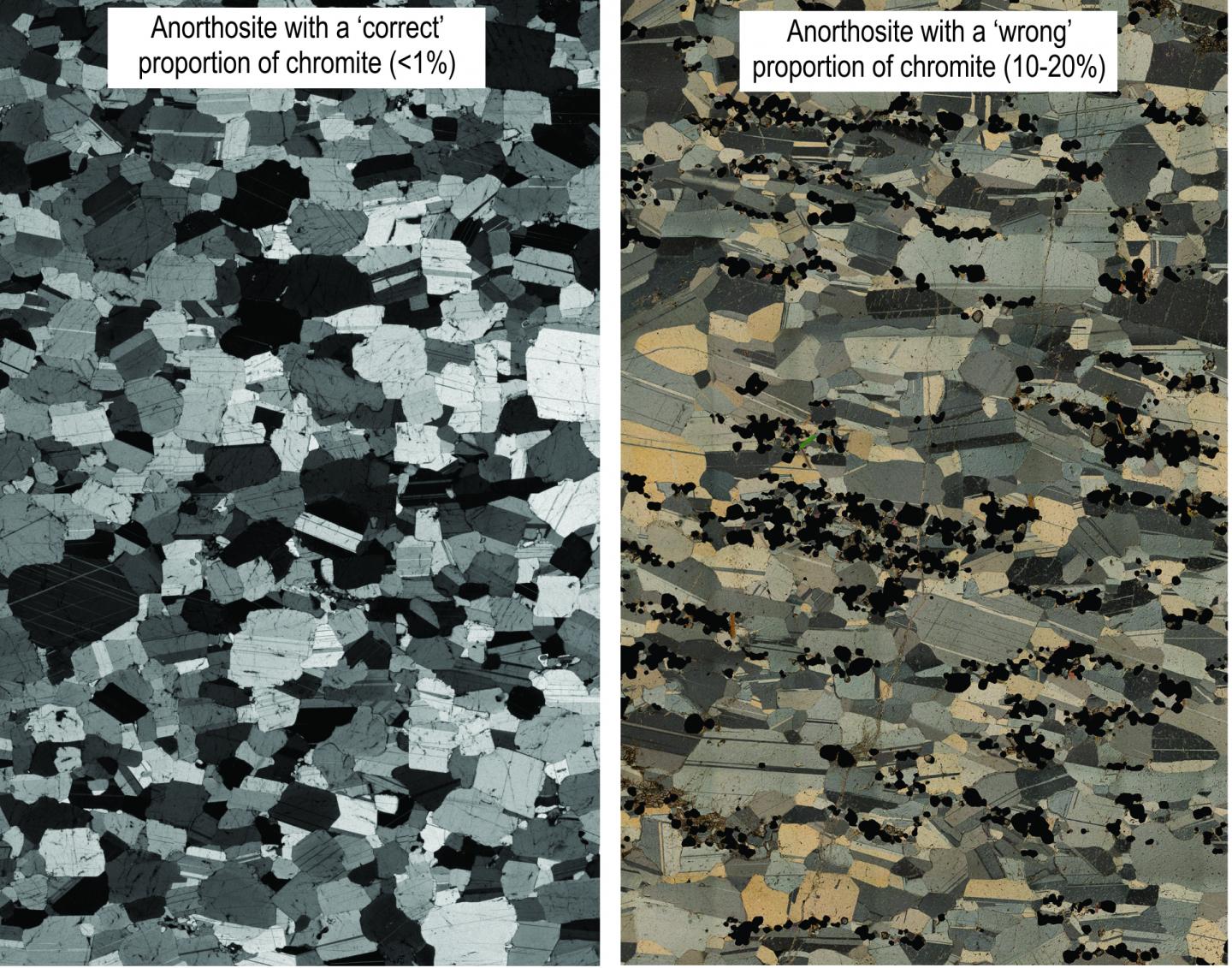
Research answers question on how some magmatic rocks contain random proportions of minerals than what is expected for rocks of their type.
IMAGE

Credit: Wits University

Researchers at Wits University in Johannesburg, South Africa, have found the answer to an enigma that has had geologists scratching their heads for years.

The question is that of how certain magmatic rocks that are formed through crystallisation in magmatic chambers in the Earth’s crust, defy the norm, and contain minerals in random proportions.

Normally, magmatic rocks consist of some fixed proportions of various minerals. Geologists know, for instance, that a certain rock will have 90% of one mineral and 10% of another mineral.

However, there are some magmatic rocks that defy this norm and do not adhere to this general rule of thumb. These rocks, called as non-cotectic rocks, contain minerals in completely random proportions.

One example is chromite-bearing anorthosite from the famous Bushveld Complex in South Africa. These rocks contain up to 15% to 20% of chromite, instead of only 1%, as would normally be expected.

“Traditionally, these rocks with a ‘wrong’ composition were attributed to either mechanical sorting of minerals that crystallised from a single magma or mechanical mixing of minerals formed from two or more different magmas,” says Professor Rais Latypov from the Wits School of Geosciences.

Seeing serious problems with both these approaches, Latypov and his colleague Dr Sofya Chistyakova, also from the Wits School of Geosciences, found that there is actually a simple explanation to this question – and it has nothing to do with the mechanical sorting or mixing of minerals to produce these rocks.

Their research, published in the journal Geology, shows that an excess amount of some minerals contained in these rocks may originate in the feeder conduits along which the magmas are travelling from the deep-seated staging chambers towards Earth’s surface.

“While travelling up through the feeder channels, the magma gets into contact with cold sidewalls and starts crystallising, thereby producing more of the mineral(s) than what should be expected,” says Chistyakova.

The general principle of this approach can be extended to any magmatic rocks with ‘wrong’ proportions of minerals in both plutonic and volcanic environments of the Earth.

“It is possible that a clue to some other petrological problems of magmatic complexes should be searched for in the feeder conduits rather than in magma chambers themselves. This appealing approach holds great promise for igneous petrologists working with basaltic magma complexes,” says Latypov.

###

Media Contact
Schalk Mouton
[email protected]

Original Source

https://www.wits.ac.za/news/latest-news/research-news/2020/2020-04/wits-researchers-unravel-the-mystery-of-magmatic-rocks-consisting-of-random-proportions-of-minerals.html

Related Journal Article

http://dx.doi.org/10.1130/G47082.1

Tags: Earth ScienceGeographyGeology/SoilGeophysicsGeophysics/GravityHistoryOld WorldPlanets/MoonsTemperature-Dependent Phenomena
Share12Tweet8Share2ShareShareShare2

Related Posts

blank

Breakthrough in Environmental Cleanup: Scientists Develop Solar-Activated Biochar for Faster Remediation

February 7, 2026
blank

Cutting Costs: Making Hydrogen Fuel Cells More Affordable

February 6, 2026

Scientists Develop Hand-Held “Levitating” Time Crystals

February 6, 2026

Observing a Key Green-Energy Catalyst Dissolve Atom by Atom

February 6, 2026
Please login to join discussion

POPULAR NEWS

  • Robotic Ureteral Reconstruction: A Novel Approach

    Robotic Ureteral Reconstruction: A Novel Approach

    82 shares
    Share 33 Tweet 21
  • Digital Privacy: Health Data Control in Incarceration

    63 shares
    Share 25 Tweet 16
  • Study Reveals Lipid Accumulation in ME/CFS Cells

    57 shares
    Share 23 Tweet 14
  • Breakthrough in RNA Research Accelerates Medical Innovations Timeline

    53 shares
    Share 21 Tweet 13

About

We bring you the latest biotechnology news from best research centers and universities around the world. Check our website.

Follow us

Recent News

Evaluating Pediatric Emergency Care Quality in Ethiopia

TPMT Expression Predictions Linked to Azathioprine Side Effects

Improving Dementia Care with Enhanced Activity Kits

Subscribe to Blog via Email

Success! An email was just sent to confirm your subscription. Please find the email now and click 'Confirm' to start subscribing.

Join 73 other subscribers
  • Contact Us

Bioengineer.org © Copyright 2023 All Rights Reserved.

Welcome Back!

Login to your account below

Forgotten Password?

Retrieve your password

Please enter your username or email address to reset your password.

Log In
No Result
View All Result
  • Homepages
    • Home Page 1
    • Home Page 2
  • News
  • National
  • Business
  • Health
  • Lifestyle
  • Science

Bioengineer.org © Copyright 2023 All Rights Reserved.