• HOME
  • NEWS
  • EXPLORE
    • CAREER
      • Companies
      • Jobs
    • EVENTS
    • iGEM
      • News
      • Team
    • PHOTOS
    • VIDEO
    • WIKI
  • BLOG
  • COMMUNITY
    • FACEBOOK
    • INSTAGRAM
    • TWITTER
Saturday, July 4, 2026
BIOENGINEER.ORG
No Result
View All Result
  • Login
  • HOME
  • NEWS
  • EXPLORE
    • CAREER
      • Companies
      • Jobs
        • Lecturer
        • PhD Studentship
        • Postdoc
        • Research Assistant
    • EVENTS
    • iGEM
      • News
      • Team
    • PHOTOS
    • VIDEO
    • WIKI
  • BLOG
  • COMMUNITY
    • FACEBOOK
    • INSTAGRAM
    • TWITTER
  • HOME
  • NEWS
  • EXPLORE
    • CAREER
      • Companies
      • Jobs
        • Lecturer
        • PhD Studentship
        • Postdoc
        • Research Assistant
    • EVENTS
    • iGEM
      • News
      • Team
    • PHOTOS
    • VIDEO
    • WIKI
  • BLOG
  • COMMUNITY
    • FACEBOOK
    • INSTAGRAM
    • TWITTER
No Result
View All Result
Bioengineer.org
No Result
View All Result
Home NEWS Science News Chemistry

Extreme high-frequency signals enable terabits-per-second data links

Bioengineer by Bioengineer
March 31, 2020
in Chemistry
Reading Time: 3 mins read
0
IMAGE
Share on FacebookShare on TwitterShare on LinkedinShare on RedditShare on Telegram

A team, including the man who invented DSL technology, attempted to scale up the original idea to use terahertz frequencies and discovered terabits-per-second data links are possible
IMAGE

Credit: Image courtesy of the authors

WASHINGTON, March 31, 2020 — Using the same technology that allows high-frequency signals to travel on regular phone lines, researchers tested sending extremely high-frequency, 200 GHz signals through a pair of copper wires. The result is a link that can move data at rates of terabits per second, significantly faster than currently available channels.

While the technology to disentangle multiple, parallel signals moving through a channel already exists, thanks to signal processing methods developed by John Cioffi, the inventor of digital subscriber lines, or DSL, questions remained related to the effectiveness of implementing these ideas at higher frequencies.

To test the transmission of data at higher frequencies, authors of a paper published this week in Applied Physics Letters, from AIP Publishing, used experimental measurements and mathematical modeling to characterize the input and output signals in a waveguide.

They used a device with two wires running parallel inside a sheath with a large diameter that facilitates increased mixing of the waveguide modes. These mixtures enable the transmission of parallel noninterfering data channels. Higher frequencies allow larger bandwidth and more data to travel through a channel, if the architecture of the channel is such that the data is not garbled by interference.

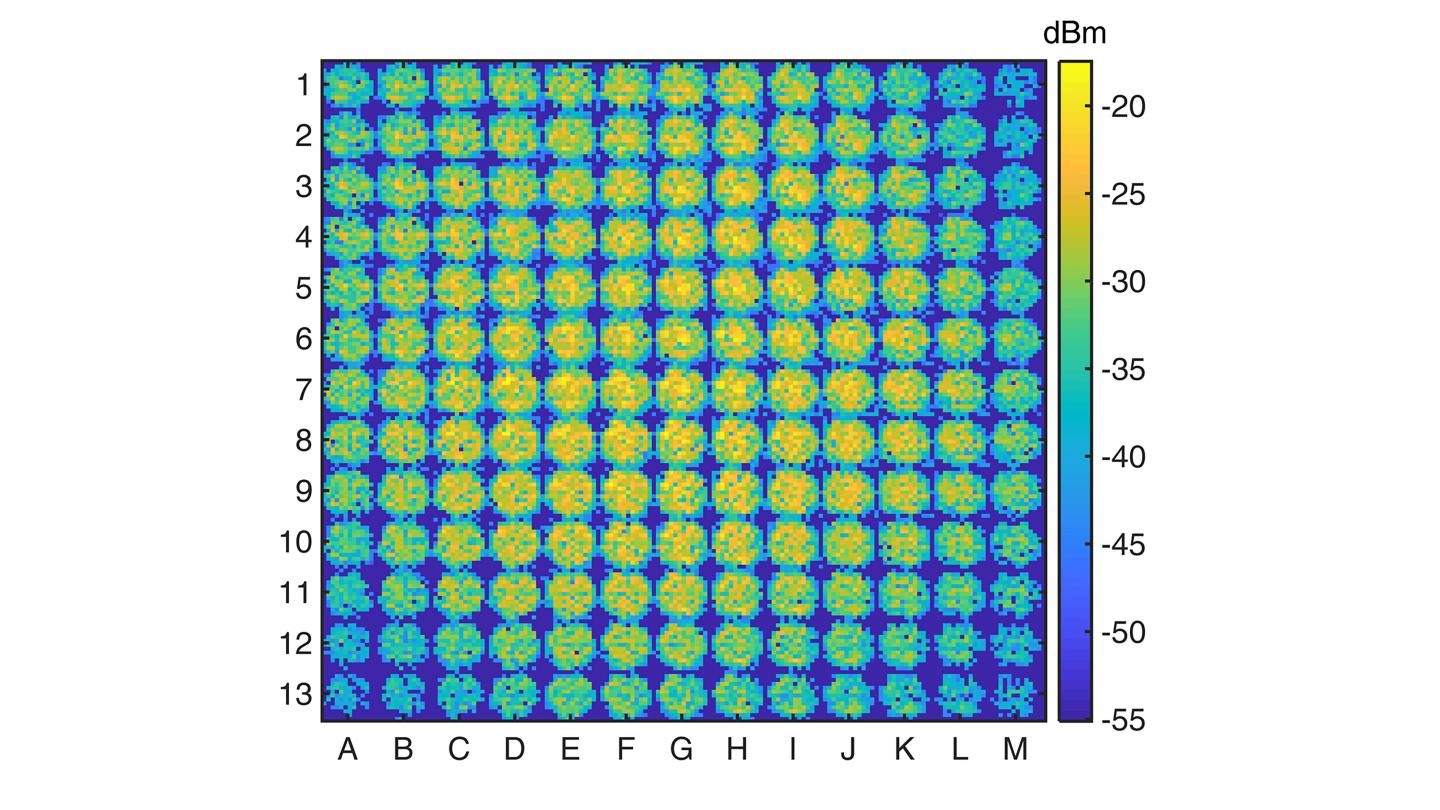
“To confirm and characterize this behavior, we measured the spatial distribution of energy at the output of the waveguide by mapping the waveguide’s output port, showing where the energy is located,” author Daniel Mittleman said.

The researchers created a 13- by 13-millimeter grid for the output of each possible input condition, resulting in a 169 x 169 channel matrix that provides a complete characterization of the waveguide channel. The results demonstrate a superposition of waveguide modes in the channel and allow estimation of data rates.

“It is exciting to show that a waveguide can support a data rate of 10 terabits per second, even if only over a short range. That’s well beyond what anybody has previously envisioned,” Mittleman said. “Our work demonstrates the feasibility of this approach to high-rate data transmission, which can be further exploited when the sources and detectors reach the appropriate level of maturity.”

The researchers intend to further investigate ohmic losses, a function of the resistance of each of the cell components and caused by the metal hardware of the waveguide, which dictate the limit on the length of the channel. Their work could be used in applications that require large amounts of data to move quickly over short distances, such as between racks in a data center or for chip-to-chip communication.

###

The article, “A wire waveguide channel for terabit-per-second links,” is authored by Rabi Shrestha, Kenneth Kerpez, Chan Soo Hwang, Mehdi Mohseni, John Cioffi and Daniel M. Mittleman. The article will appear in Applied Physics Letters on March 31, 2020 (DOI: 10.1063/1.5143699). After that date, it can be accessed at https://aip.scitation.org/doi/10.1063/1.5143699.

ABOUT THE JOURNAL

Applied Physics Letters features rapid reports on significant discoveries in applied physics. The journal covers new experimental and theoretical research on applications of physics phenomena related to all branches of science, engineering, and modern technology. See https://aip.scitation.org/journal/apl.

Media Contact
Larry Frum
[email protected]

Related Journal Article

http://dx.doi.org/10.1063/1.5143699

Tags: Algorithms/ModelsChemistry/Physics/Materials SciencesComputer ScienceElectrical Engineering/ElectronicsMaterialsTechnology/Engineering/Computer ScienceTelecommunications
Share12Tweet8Share2ShareShareShare2

Related Posts

Intelligent Microgrid Management Promises Lower Household Energy Bills and Reduced Diesel Emissions — Chemistry

Intelligent Microgrid Management Promises Lower Household Energy Bills and Reduced Diesel Emissions

July 4, 2026
Graz University of Technology Deciphers the Structural Secrets of MOF Thin Films — Chemistry

Graz University of Technology Deciphers the Structural Secrets of MOF Thin Films

July 2, 2026

Breaking Thermodynamic Limits: Wavelength-Driven Catalysis Advances Ammonia Synthesis

July 2, 2026

From Quantum Mechanics to AI-Powered Materials Discovery: MARVEL Marks 12 Years of Transforming Computational Science

July 2, 2026
Please login to join discussion

POPULAR NEWS

  • Detection of EDCs in Breast Milk and Infant Urine Up to Six Months Highlights Early Exposure Risks

    77 shares
    Share 31 Tweet 19
  • Saying Goodbye to PGY-6: Pediatric Fellowship Realities

    103 shares
    Share 41 Tweet 26
  • New Drug Candidate Developed at McMaster Shows Potential for Treating Brain Cancer

    58 shares
    Share 23 Tweet 15
  • KTU Researchers Explore Ultrasound’s Role in Enhancing Blood Flow Beyond Diagnostics

    53 shares
    Share 21 Tweet 13

About

We bring you the latest biotechnology news from best research centers and universities around the world. Check our website.

Follow us

Recent News

Quasi-Bound States Boost Quantum Well Photoresponse

Lysine Pyruvylation Links Glycolysis to Epigenetics

Multiphysics Coupling: Single vs. Multiple DeepONet Branches

Subscribe to Blog via Email

Enter your email address to subscribe to this blog and receive notifications of new posts by email.

Join 83 other subscribers
  • Contact Us

Bioengineer.org © Copyright 2023 All Rights Reserved.

Welcome Back!

Login to your account below

Forgotten Password?

Retrieve your password

Please enter your username or email address to reset your password.

Log In
No Result
View All Result
  • Homepages
    • Home Page 1
    • Home Page 2
  • News
  • National
  • Business
  • Health
  • Lifestyle
  • Science

Bioengineer.org © Copyright 2023 All Rights Reserved.