HKU study shows that control of anthropogenic atmospheric emissions can improve water quality in China’s coastal Seas
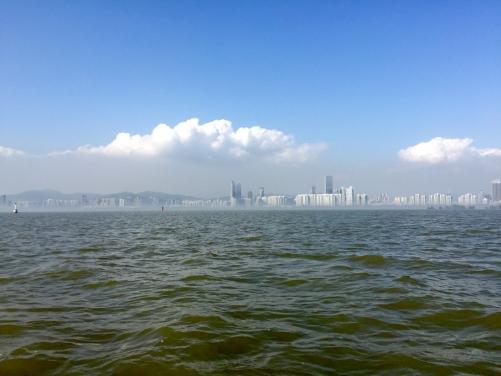
Credit: Photo courtesy: Dr Thibodeau @HKU
A new research led by MPhil student Miss Yu Yan Yau and supervised by Dr Benoit Thibodeau from the Department of Earth Sciences and the Swire Institute of Marine Science, the University of Hong Kong (HKU), highlighted the importance of reducing fossil fuel combustion not only to curb the trend of global warming, but also to improve the quality of China’s coastal waters. The findings were recently published in the prestigious journal Environmental Science & Technology.
Fossil fuel burning is strongly associated with global warming. However, atmospheric and marine pollution linked to energy production, transportation and industrial activity are often overlooked. Production of nitrogen oxides (NOx) emissions via fossil fuel burning and the manufacturing of fertilizer pollutes the atmosphere and leads to the formation of ground-level ozone, smog, acid rain and contributes to global warming through the greenhouse effect. Moreover, nitrogen is a natural fertilizer and thus when atmospheric nitrogen oxides deposit in the water, it can also have a fertilizing effect. This fertilizing effect can lead to ‘eutrophication’; a chain reaction starting with the addition of nutrients (here nitrogen oxides), which enhance the production of algae, which, in turn, die and sink to the bottom of the ocean and decompose. During the decomposition of this organic material, oxygen is consumed from the water, lowering the dissolved oxygen content at the bottom of the ocean. Constant reductions of dissolved oxygen scan lead to hypoxia, a level of oxygenation that is too low for most organisms to sustain their normal activities.
The study used Intergovernmental Panel on Climate Change (IPCC) – projected trends in atmospheric emissions of NOx coupled with a biogeochemical model to estimate the impact of the deposition of nitrogen oxides in four major Chinese coastal seas: The South China Sea, the East China Sea, the Yellow Sea and the Bohai Sea. The researchers found that although atmospheric deposition is not as important as riverine nitrogen input, it can still fuel up to 15% of the total amount of organic matter found at the bottom of the ocean, increasing significantly (up to 5%) the area of hypoxia. The good news is that it also found that a reduction of emissions can lead to a significant decrease of hypoxic zones, and that the South China Sea is the most sensitive area to nitrogen input.
“I hope our study brings more attention to the potential benefit of reducing fossil fuel burning on human and ecosystem health but also on local economic activities like fisheries, which are severely affected by hypoxia,” said Miss Yau.
“Low levels of oxygen are observed in many coastal seas around the world and it is important to find better ways to tackle this problem. While we understand that sewage and nutrient input from the Pearl River drive most of the hypoxia in the Greater Bay Area, we observe low levels of oxygen in regions that are not directly under the influence of these sources. Thus, it is important to investigate the impact of atmospheric deposition more locally,” Dr Thibodeau remarked.
###
This work was partly funded by the cross-universities RGC-funded project OCEAN-HK, which aims at providing a diagnosis and prognosis of intensifying eutrophication, hypoxia and the ecosystem consequences around Hong Kong waters.
About the journal paper
“Quantifying the Impact of Anthropogenic Atmospheric Nitrogen Deposition on the Generation of Hypoxia under Future Emission Scenarios in Chinese Coastal Waters”, Environmental Science & Technology
About the research team
Miss Yu Yan Yau, an MPhil student at HKU Science and her supervisor Dr Benoit Thibodeau, Research Assistant Professor in the Department of Earth Sciences and the Swire Institute of Marine Science.
Dr David Baker, Associate Professor in the School of Biological Sciences and the Swire Institute of Marine Science.
Media Contact
Cindy Chan
[email protected]
852-391-75286
Original Source
https:/
Related Journal Article
http://dx.