• HOME
  • NEWS
  • EXPLORE
    • CAREER
      • Companies
      • Jobs
    • EVENTS
    • iGEM
      • News
      • Team
    • PHOTOS
    • VIDEO
    • WIKI
  • BLOG
  • COMMUNITY
    • FACEBOOK
    • INSTAGRAM
    • TWITTER
Friday, September 25, 2026
BIOENGINEER.ORG
No Result
View All Result
  • Login
  • HOME
  • NEWS
  • EXPLORE
    • CAREER
      • Companies
      • Jobs
        • Lecturer
        • PhD Studentship
        • Postdoc
        • Research Assistant
    • EVENTS
    • iGEM
      • News
      • Team
    • PHOTOS
    • VIDEO
    • WIKI
  • BLOG
  • COMMUNITY
    • FACEBOOK
    • INSTAGRAM
    • TWITTER
  • HOME
  • NEWS
  • EXPLORE
    • CAREER
      • Companies
      • Jobs
        • Lecturer
        • PhD Studentship
        • Postdoc
        • Research Assistant
    • EVENTS
    • iGEM
      • News
      • Team
    • PHOTOS
    • VIDEO
    • WIKI
  • BLOG
  • COMMUNITY
    • FACEBOOK
    • INSTAGRAM
    • TWITTER
No Result
View All Result
Bioengineer.org
No Result
View All Result
Home NEWS Science News Chemistry

‘Little Foot’ skull reveals how this more than 3 million year old human ancestor lived

Bioengineer by Bioengineer
March 17, 2020
in Chemistry
Reading Time: 3 mins read
0
IMAGE
Share on FacebookShare on TwitterShare on LinkedinShare on RedditShare on Telegram

Micro-CT scanning of ‘Little Foot’ skull reveals new aspects of the life of this more than 3-million year-old-human ancestor
IMAGE

Credit: Amélie Beaudet/Wits University


High-resolution micro-CT scanning of the skull of the fossil specimen known as “Little Foot” has revealed some aspects of how this Australopithecus species used to live more than 3 million years ago.

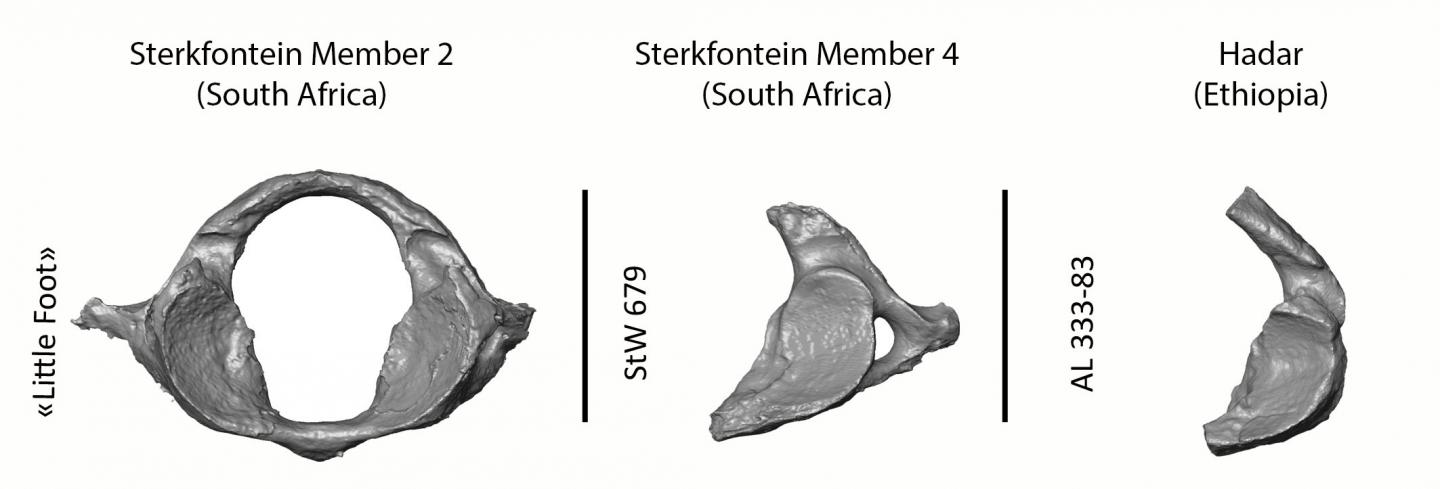
The meticulous excavation, cleaning and scanning of the skull of the ~3.67 million-year-old fossil specimen has revealed the most complete Australopithecus adult first cervical vertebra yet found. A description of the vertebra by Wits University researchers Dr Amélie Beaudet and the Sterkfontein team was published in the Scientific Reports. This research program is supported by the the Centre of Excellence in Palaeosciences, Scientific Palaeontological Trust, National Research Foundation, University of the Witwatersrand and the French National Centre for Scientific Research through the French Institute of South Africa.

The first cervical vertebra (or atlas) plays a crucial role in vertebrate biology. Besides acting as the connection between the head and the neck, the atlas also plays a role in how blood is supplied to the brain via the vertebral arteries.

By comparing the atlas of “Little Foot” with other fossils from South and East Africa as well as living humans and chimpanzees, the Wits University team shows that Australopithecus was capable of head movements that differ from modern humans.

“The morphology of the first cervical vertebra, or atlas, reflects multiple aspects of an organism’s life,” says Beaudet, the lead author of the study. “In particular, the nearly complete atlas of ‘Little Foot’ has the potential to provide new insights into the evolution of head mobility and the arterial supply to the brain in the human lineage.”

The shape of the atlas determines the range of head motions while the size of the arteries passing through the vertebrae to the skull is useful for estimating blood flow supplying the brain.

“Our study shows that Australopithecus was capable of head movements that differ from us. This could be explained by the greater ability of Australopithecus to climb and move in the trees. However, a southern African Australopithecus specimen younger than ‘Little Foot’ (probably younger by about 1 million years) may have partially lost this capacity and spent more time on the ground, like us today.”

The overall dimensions and shape of the atlas of “Little Foot” are similar to living chimpanzees. More specifically, the ligament insertions (that could be inferred from the presence and configuration of bony tubercles) and the morphology of the facet joints linking the head and the neck all suggest that “Little Foot” was moving regularly in trees.

Because “Little Foot” is so well-preserved, blood flow supply to the brain could also be estimated for the first time, using evidence from the skull and vertebrae. These estimations demonstrate that blood flow, and thus the utilisation of glucose by the brain, was about three times lower than in living humans, and closer to the those of living chimpanzees.

“The low investment of energy into the brain of Australopithecus could be tentatively explained by a relatively small brain of the specimen (around 408cm3), a low quality diet (low proportion of animal products) or high costs of other aspects of the biology of Australopithecus (such as upright walking). In any case, this might suggest that the human brain’s vascular system emerged much later in our history.”

###

Media Contact
Schalk Mouton
[email protected]
27-827-399-637

Original Source

http://www.wits.ac.za/news/latest-news/research-news/2020/2020-03/little-foot-skull-reveals-how-this-human-ancestor-lived.html

Tags: AnthropologyArchaeologyBiomechanics/BiophysicsEvolutionneurobiologyNew WorldOld WorldPaleontologyPhysiology
Share12Tweet8Share2ShareShareShare2

Related Posts

Tea Compounds Show Surprising Power Against Cancer and Aging Proteins

Tea Compounds Show Surprising Power Against Cancer and Aging Proteins

September 25, 2026
Volcanic Rock Buoys Could End Microplastic Pollution in Oyster Farms

Volcanic Rock Buoys Could End Microplastic Pollution in Oyster Farms

September 25, 2026

Metal-Organic Framework Nanoparticles Turn Biopolymer Hydrogel into Antibacterial Wound Dressing

September 25, 2026

Fig Latex and Sodium Phytate Team Up to Tenderize and Protect Cooked Beef

September 25, 2026
Please login to join discussion

POPULAR NEWS

  • Mild Pepper Virus Turned Into a Powerful Gene Tool for Crop Scientists

    29 shares
    Share 12 Tweet 7
  • Metabolite Fingerprint in Seminal Plasma Could Explain Hidden Male Infertility

    29 shares
    Share 12 Tweet 7
  • Baby Teeth Reveal a Narrow Window Around Birth When Arsenic Weakens Vaccine Immunity

    29 shares
    Share 12 Tweet 7
  • Cell Death Regulator BI-1 Emerges as Key Switch in Plant Immunity Against Oomycete Pathogens

    29 shares
    Share 12 Tweet 7

About

BIOENGINEER.ORG

We bring you the latest biotechnology news from best research centers and universities around the world. Check our website.

Follow us

Recent News

Mild Pepper Virus Turned Into a Powerful Gene Tool for Crop Scientists

Metabolite Fingerprint in Seminal Plasma Could Explain Hidden Male Infertility

Baby Teeth Reveal a Narrow Window Around Birth When Arsenic Weakens Vaccine Immunity

Subscribe to Blog via Email

Enter your email address to subscribe to this blog and receive notifications of new posts by email.

Join 85 other subscribers
  • Contact Us

Bioengineer.org © Copyright 2023 All Rights Reserved.

Welcome Back!

Login to your account below

Forgotten Password?

Retrieve your password

Please enter your username or email address to reset your password.

Log In
No Result
View All Result
  • Homepages
    • Home Page 1
    • Home Page 2
  • News
  • National
  • Business
  • Health
  • Lifestyle
  • Science

Bioengineer.org © Copyright 2023 All Rights Reserved.