• HOME
  • NEWS
  • EXPLORE
    • CAREER
      • Companies
      • Jobs
    • EVENTS
    • iGEM
      • News
      • Team
    • PHOTOS
    • VIDEO
    • WIKI
  • BLOG
  • COMMUNITY
    • FACEBOOK
    • INSTAGRAM
    • TWITTER
Tuesday, December 30, 2025
BIOENGINEER.ORG
No Result
View All Result
  • Login
  • HOME
  • NEWS
  • EXPLORE
    • CAREER
      • Companies
      • Jobs
        • Lecturer
        • PhD Studentship
        • Postdoc
        • Research Assistant
    • EVENTS
    • iGEM
      • News
      • Team
    • PHOTOS
    • VIDEO
    • WIKI
  • BLOG
  • COMMUNITY
    • FACEBOOK
    • INSTAGRAM
    • TWITTER
  • HOME
  • NEWS
  • EXPLORE
    • CAREER
      • Companies
      • Jobs
        • Lecturer
        • PhD Studentship
        • Postdoc
        • Research Assistant
    • EVENTS
    • iGEM
      • News
      • Team
    • PHOTOS
    • VIDEO
    • WIKI
  • BLOG
  • COMMUNITY
    • FACEBOOK
    • INSTAGRAM
    • TWITTER
No Result
View All Result
Bioengineer.org
No Result
View All Result
Home NEWS Science News Biology

Newly proposed method offers fermentable sugars from sustainable lignocellulosic biomass

Bioengineer by Bioengineer
March 11, 2020
in Biology
Reading Time: 2 mins read
0
IMAGE
Share on FacebookShare on TwitterShare on LinkedinShare on RedditShare on Telegram

IMAGE

Credit: LIU Yajun


Fuel, animal feed, other major carbon-rich products could have a sustainable replacement with the help of a new approach to processing a plant biomass material produced naturally by plants during photosynthesis. Called lignocellulose, it comprises half of dry plant matter.

Researchers published a review of the work and current status on Feb. 24 in Biotechnology Advances.

“Lignocellulosic biomass is the most abundant sustainable carbon source on the planet and has enormous potential to substitute fossil resources on the premise of cost-effective conversion,” said LIU Yajun, paper author and researcher from the Qingdao Institute of Bioenergy and Bioprocess Technology (QIBEBT). “Lignocellulosic residues, especially the agricultural lignocellulosic wastes, represent one of the best substitutes of fossil resources because of its low price, high availability and wide distribution.”

The estimated annual world output of lignocellulosic biomass is more than 200 billion tons, providing an extensive, renewable resource – if it can be converted into a useful form.

“Lignocellulosic biomass is recalcitrant and difficult to deconstruct,” LIU said.

The main component of lignocellulose is cellulose, the tough material responsible for the strong structure of plant cell walls. Lignocellulose bioconversion to biofuels and biochemicals is possible, but, according the LIU, the cost and efficiency of the enzymes used to initiate the conversion is a concern.

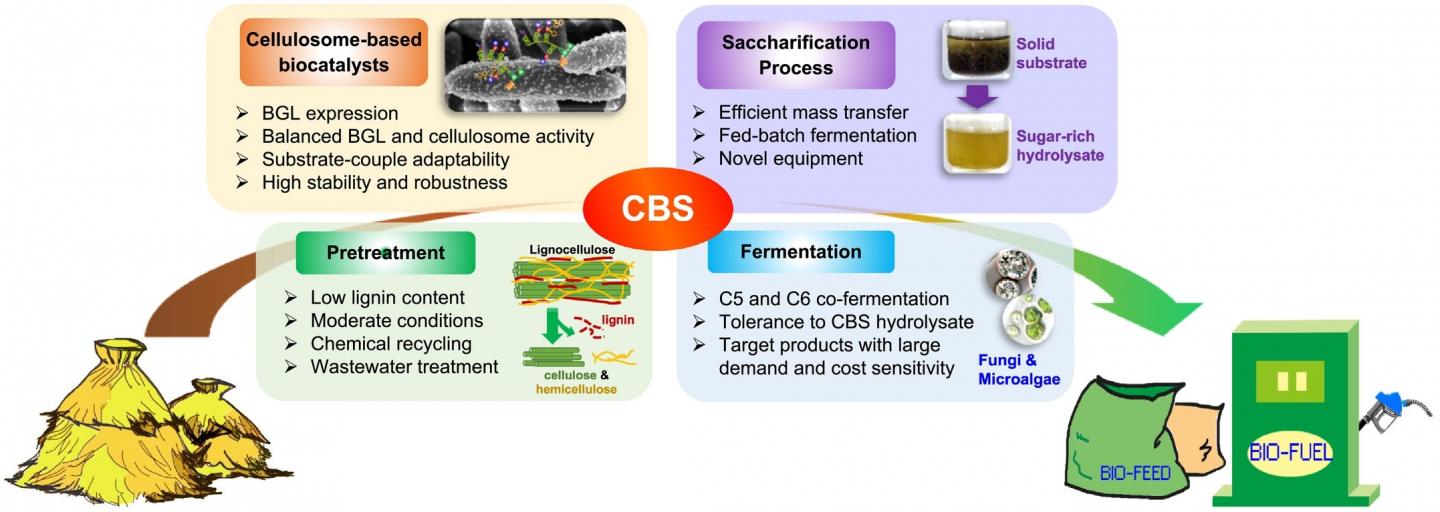
Previously proposed conversion methods involve separately producing enzymes, breaking down the lignocellulose, and then fermenting the resulting sugar or doing both simultaneously. The new method proposed by LIU and his team is called consolidated bio-saccharification, during which whole-cell biocatalysts are employed for lignocellulose deconstruction processing and the fermentation process is entirely separated.

Known as consolidated bio-saccharification, or CBS, this strategy aims for a final product of fermentable sugars, rather than end products such as biofuel. The produced sugars can then be used as the platform chemical in fermentation for later processes that produce biofuel or other biochemicals.

“CBS is considered promising to lead lignocellulose bioconversion into the real world because it shows tremendous advantages in reducing enzyme production costs and streamlining operational processes,” LIU said. “However, as a newly developed technology, CBS still needs improvement and innovation of existing processes and instruments to make breakthroughs in the real world.”

LIU and her team are currently piloting a demonstration of CBS, intending to provide further evidence of the method’s industrial applications and scalability.

###

Media Contact
CHENG Jing
[email protected]

Original Source

http://english.cas.cn/

Related Journal Article

http://dx.doi.org/10.1016/j.biotechadv.2020.107535

Tags: BiologyBiotechnologyEnergy/Fuel (non-petroleum)
Share12Tweet8Share2ShareShareShare2

Related Posts

Impact of Wildlife on Livestock Production in Zimbabwe

Impact of Wildlife on Livestock Production in Zimbabwe

December 30, 2025
Dictyostelium discoideum Adapts Gene Expression to Hypoxia

Dictyostelium discoideum Adapts Gene Expression to Hypoxia

December 30, 2025

Impact of Sex and Gender on Clinical Outcomes: Review

December 29, 2025

Thousands of Lytic Phages Found in Bacterial Genomes

December 29, 2025
Please login to join discussion

POPULAR NEWS

  • Robotic Waist Tether for Research Into Metabolic Cost of Walking

    NSF funds machine-learning research at UNO and UNL to study energy requirements of walking in older adults

    71 shares
    Share 28 Tweet 18
  • Exploring Audiology Accessibility in Johannesburg, South Africa

    51 shares
    Share 20 Tweet 13
  • Nurses’ Views on Online Learning: Effects on Performance

    71 shares
    Share 28 Tweet 18
  • PTSD, Depression, Anxiety in Childhood Cancer Survivors, Parents

    44 shares
    Share 18 Tweet 11

About

We bring you the latest biotechnology news from best research centers and universities around the world. Check our website.

Follow us

Recent News

Revolutionizing Retinal Vessel Classification with Y-Net Networks

Breaking Diffraction Limits: Sharper Eye Imaging Advances

Impact of Dominant Follicle Size on IVF Outcomes

Subscribe to Blog via Email

Enter your email address to subscribe to this blog and receive notifications of new posts by email.

Join 71 other subscribers
  • Contact Us

Bioengineer.org © Copyright 2023 All Rights Reserved.

Welcome Back!

Login to your account below

Forgotten Password?

Retrieve your password

Please enter your username or email address to reset your password.

Log In
No Result
View All Result
  • Homepages
    • Home Page 1
    • Home Page 2
  • News
  • National
  • Business
  • Health
  • Lifestyle
  • Science

Bioengineer.org © Copyright 2023 All Rights Reserved.