• HOME
  • NEWS
  • EXPLORE
    • CAREER
      • Companies
      • Jobs
    • EVENTS
    • iGEM
      • News
      • Team
    • PHOTOS
    • VIDEO
    • WIKI
  • BLOG
  • COMMUNITY
    • FACEBOOK
    • INSTAGRAM
    • TWITTER
Saturday, February 7, 2026
BIOENGINEER.ORG
No Result
View All Result
  • Login
  • HOME
  • NEWS
  • EXPLORE
    • CAREER
      • Companies
      • Jobs
        • Lecturer
        • PhD Studentship
        • Postdoc
        • Research Assistant
    • EVENTS
    • iGEM
      • News
      • Team
    • PHOTOS
    • VIDEO
    • WIKI
  • BLOG
  • COMMUNITY
    • FACEBOOK
    • INSTAGRAM
    • TWITTER
  • HOME
  • NEWS
  • EXPLORE
    • CAREER
      • Companies
      • Jobs
        • Lecturer
        • PhD Studentship
        • Postdoc
        • Research Assistant
    • EVENTS
    • iGEM
      • News
      • Team
    • PHOTOS
    • VIDEO
    • WIKI
  • BLOG
  • COMMUNITY
    • FACEBOOK
    • INSTAGRAM
    • TWITTER
No Result
View All Result
Bioengineer.org
No Result
View All Result
Home NEWS Science News Chemistry

Breakthrough made towards building the world’s most powerful particle accelerator

Bioengineer by Bioengineer
March 11, 2020
in Chemistry
Reading Time: 3 mins read
0
IMAGE
Share on FacebookShare on TwitterShare on LinkedinShare on RedditShare on Telegram

IMAGE

Credit: UNIST


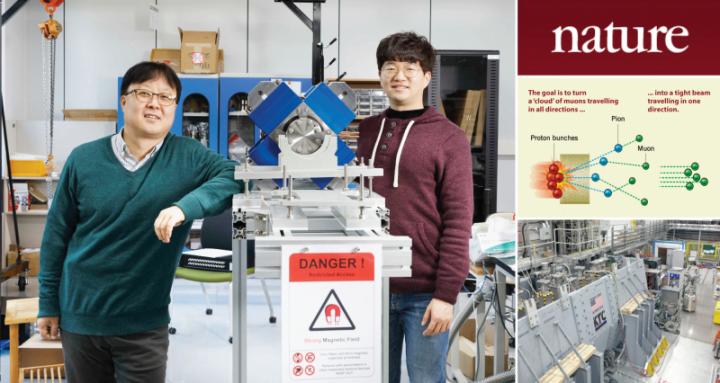
An international team of researchers, affiliated with UNIST has for the first time succeeded in demonstrating the ionization cooling of muons. Regarded as a major step in being able to create the world’s most powerful particle accelerator, this new muon accelerator is expected to provide a better understanding of the fundamental constituents of matter.

This breakthrough has been carried out by the Muon Ionization Cooling Experiment (MICE) collaboration, which includes many UK scientists, as well as Professor Moses Chung and his research team in the School of Natural Sciences at UNIST. Their findings have been published in the online version of Nature on February 5, 2020.

“We have succeeded in realizing muon ionization cooling, one of our greatest challenges associated with developing muon accelerators,” says Professor Chung. “Achievement of this is considered especially important, as it could change the paradigm of developing the Lepton Collider that could replace the Neutrino Factory or the Large Hadron Collider (LHC).”

Muons are naturally occurring particles that are generated in the Earth’s upper atmosphere by cosmic rays collisions, thus are regarded as a follow-on particle accelerator to replace the LHC. Protons, a type of hardon, are primarily used by the LHC and they partake in strong interactions. Leptons, like the electron and the muon, are not subject to the strong interaction, rather they interact via the weak force.

Muons have an extremely brief lifespan of two millionths of a second. They are produced by smashing a beam of protons into a target. These muons form a diffuse cloud, meaning that they are difficult to accelerate and there is a low chance of them colliding and producing useful interesting physical phenomena. To make the cloud less diffuse, a process known as ‘Beam cooling’ was suggested. This involves getting the muons closer together and moving in the same direction. However, due to the ultra-short lifespan of muons, it has been impossible to cool the beam with the traditional methods.

To tackle this challenge, the MICE collaboration team succeeded in channelling muons into a small enough volume to be able to study physics in new systems via a method, known as Ionization Cooling, which was previously suggested and developed into theoretically operable schemes in the 1980s.

The results of the experiment, carried out using the MICE muon beam-line at the Science and Technology Facilities Council (STFC) ISIS Neutron and Muon Beam facility on the Harwell Campus in the UK, clearly shows that the phase-space volume occupied by the muon beam can be controlled via the ionization cooling, as predicted by the theory.

###

This achievement is the result of 20 years of hard work, involving 100 researchers throughout the world. Professor Chung and ChangKyu Sung (Department of Physics, UNIST) were the only Korean researchers who partook in this collaboration. This research has been supported by the SRC project via the National Research Foundation (NRF).

Journal Reference

MICE collaboraboration, “Demonstration of cooling by the Muon Ionization Cooling Experiment,” Nature, (2020).

Media Contact
JooHyeon Heo
[email protected]
82-522-171-223

Original Source

https://news.unist.ac.kr/breakthrough-made-towards-building-the-worlds-most-powerful-particle-accelerator/

Related Journal Article

http://dx.doi.org/10.1038/s41586-020-1958-9

Tags: AstronomyAstrophysicsGrants/FundingGroup OrganizationIndustrial Engineering/ChemistryResearch/DevelopmentSpace/Planetary ScienceStars/The SunTechnology Transfer
Share12Tweet8Share2ShareShareShare2

Related Posts

blank

Breakthrough in Environmental Cleanup: Scientists Develop Solar-Activated Biochar for Faster Remediation

February 7, 2026
blank

Cutting Costs: Making Hydrogen Fuel Cells More Affordable

February 6, 2026

Scientists Develop Hand-Held “Levitating” Time Crystals

February 6, 2026

Observing a Key Green-Energy Catalyst Dissolve Atom by Atom

February 6, 2026
Please login to join discussion

POPULAR NEWS

  • Robotic Ureteral Reconstruction: A Novel Approach

    Robotic Ureteral Reconstruction: A Novel Approach

    82 shares
    Share 33 Tweet 21
  • Digital Privacy: Health Data Control in Incarceration

    63 shares
    Share 25 Tweet 16
  • Study Reveals Lipid Accumulation in ME/CFS Cells

    57 shares
    Share 23 Tweet 14
  • Breakthrough in RNA Research Accelerates Medical Innovations Timeline

    53 shares
    Share 21 Tweet 13

About

We bring you the latest biotechnology news from best research centers and universities around the world. Check our website.

Follow us

Recent News

Digital Health Perspectives from Baltic Sea Experts

Florida Cane Toad: Complex Spread and Selective Evolution

Exploring Decision-Making in Dementia Caregivers’ Mobility

Subscribe to Blog via Email

Enter your email address to subscribe to this blog and receive notifications of new posts by email.

Join 73 other subscribers
  • Contact Us

Bioengineer.org © Copyright 2023 All Rights Reserved.

Welcome Back!

Login to your account below

Forgotten Password?

Retrieve your password

Please enter your username or email address to reset your password.

Log In
No Result
View All Result
  • Homepages
    • Home Page 1
    • Home Page 2
  • News
  • National
  • Business
  • Health
  • Lifestyle
  • Science

Bioengineer.org © Copyright 2023 All Rights Reserved.