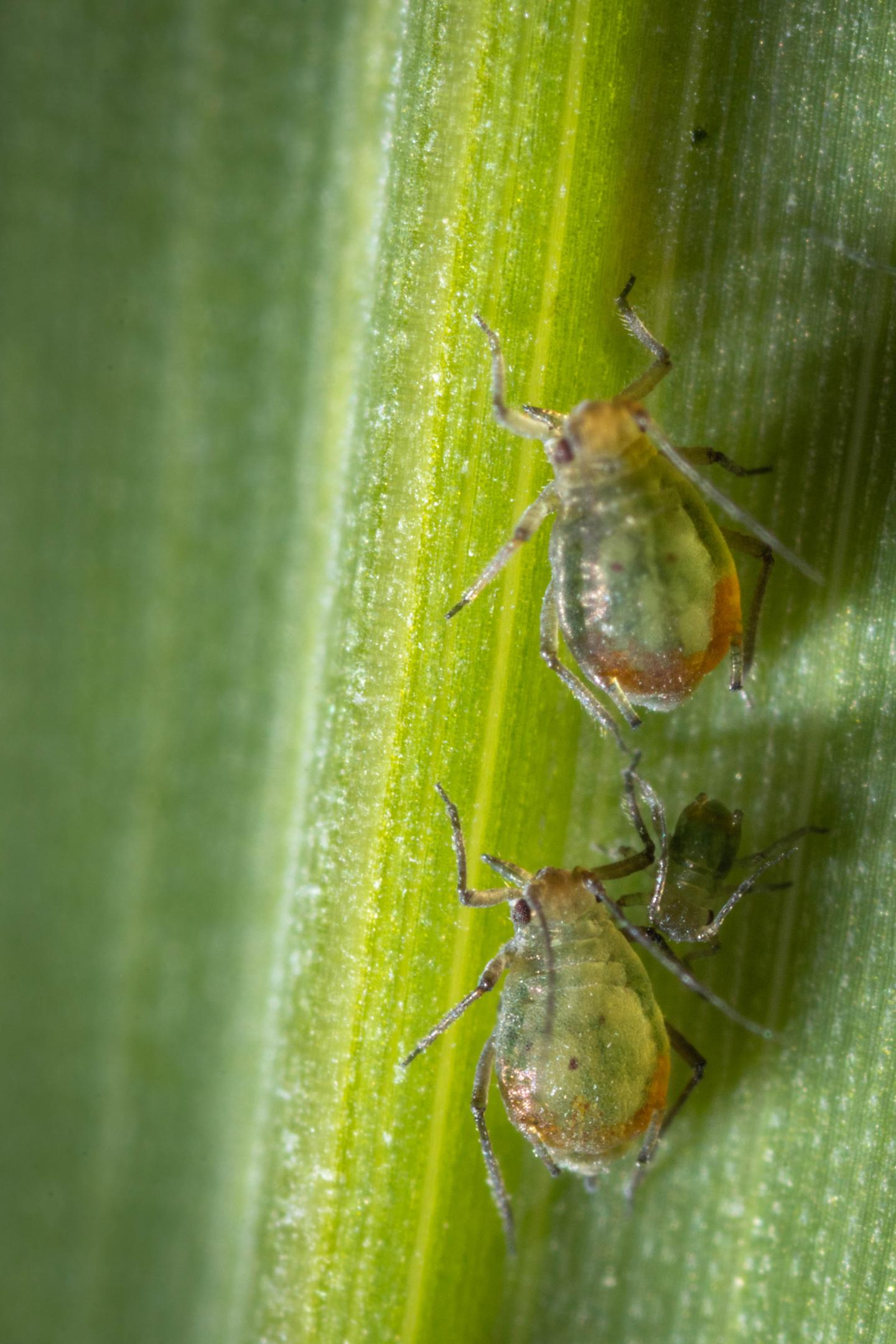
Credit: Nick Sloff, Penn State
UNIVERSITY PARK, Pa. — The virus that causes barley yellow dwarf, the most widespread disease of cereal crops, manipulates its host plant and insect vector to promote its own survival, according to an international team of researchers. The group found that the virus raises the temperature of its host plants along with the heat-tolerance of its aphid vectors to create regions on the plants where aphids can feed free from competing insects. The findings could have implications for crop health as the global climate warms.
“The effects of viruses on the thermal biology of vectors may be of particular interest in light of global climate,” said Mitzy Porras, postdoctoral scholar, Penn State. “Some species may be more successful under warming conditions, and this raises urgent questions about which insect vectors will cope and how they will impact ecological communities and our food crops.”
To investigate the effects of BYDV on the thermal tolerance of aphids, the team used two strains of BYDV and two species of aphid — BYDV-PAV, which is transmitted by Rhopalosiphum padi and BYDV-RMV, which is transmitted by a larger competing aphid species Rhopalosiphum maidis.
“We found that in the absence of competition both aphid species preferred the stems on the lower, cooler sections of the plants, even when infected with BYDV,” said Porras. “But when both aphid species were present, the smaller R. padi was able to move to the upper leaves of the plants where it was warmer.”
The findings appeared on March 4 in Nature Communications.
Looking more closely at the thermal tolerances of each of the aphid species, the scientists placed the insects, both with and without viruses, onto a critical temperature maxima setup and slowly increased the temperature until the aphids stopped moving. They recorded the maximum temperature as the point when the aphids turned upside down and could no longer return to an upright position. Afterward, they returned the aphids to their plants to recover. They found that when R. padi was infected with the virus it tolerated higher temperatures than it did without the virus, and it also tolerated higher temperatures than R. maidis.
An additional analysis provided further evidence that BYDV influences R. padi’s thermal tolerance. It revealed higher expression of three heat-shock protein genes when R. padi was infected with the virus.
“This enhanced thermal tolerance — which was associated with higher expression of three heat-shock protein genes — allowed aphids to occupy the higher and warmer regions of infected host plants when displaced from cooler plant regions by competition with the larger aphid species, R. maidis,” said Edwin Rajotte, professor of entomology. “In other words, the virus increased the vector’s fitness, along with its own chances of being acquired and transmitted to new host plants.”
Next, the team used infrared thermal imaging to examine the impacts of the viruses on the temperatures of the wheat plants. They found that infection by BYDV-PAV increased the temperature of both stem and leaf surfaces by 2 to 3 °C, while no similar effects were observed for infection by BYDV-RMV.
“Considering all of this data together, we show for the first time that a virus infection can increase both the host plant’s temperature and the vector’s heat tolerance, and that these changes allow certain aphids to occupy higher and warmer regions of infected host plants when displaced from cooler regions by competition with the larger aphid species,” said Porras.
###
The U.S. Department of Agriculture National’s Institute of Food and Agriculture supported this research.
Other authors on the paper include Carlos Navas, professor of biology, University of Sao Paulo; James Marden, professor of biology and associate director of the Huck Institutes of the Life Sciences, Penn State; Mark Mescher, adjunct professor of biology, Penn State; Consuelo De Moraes, adjunct professor of biology, Penn State; Sylvain Pincebourde, researcher, Universite de Tours; Andrés Sandoval-Mojica, postdoctoral researcher, University of Florida; Juan Raygoza-Garay, associate researcher, University of Toronto; German Holguin, professor of electrical engineering, Universidad Tecnologica de Pereira; and Tomas Carlo, associate professor of biology, Penn State.
Media Contact
Sara LaJeunesse
[email protected]
814-777-3833
Related Journal Article
http://dx.