• HOME
  • NEWS
  • EXPLORE
    • CAREER
      • Companies
      • Jobs
    • EVENTS
    • iGEM
      • News
      • Team
    • PHOTOS
    • VIDEO
    • WIKI
  • BLOG
  • COMMUNITY
    • FACEBOOK
    • INSTAGRAM
    • TWITTER
Saturday, March 28, 2026
BIOENGINEER.ORG
No Result
View All Result
  • Login
  • HOME
  • NEWS
  • EXPLORE
    • CAREER
      • Companies
      • Jobs
        • Lecturer
        • PhD Studentship
        • Postdoc
        • Research Assistant
    • EVENTS
    • iGEM
      • News
      • Team
    • PHOTOS
    • VIDEO
    • WIKI
  • BLOG
  • COMMUNITY
    • FACEBOOK
    • INSTAGRAM
    • TWITTER
  • HOME
  • NEWS
  • EXPLORE
    • CAREER
      • Companies
      • Jobs
        • Lecturer
        • PhD Studentship
        • Postdoc
        • Research Assistant
    • EVENTS
    • iGEM
      • News
      • Team
    • PHOTOS
    • VIDEO
    • WIKI
  • BLOG
  • COMMUNITY
    • FACEBOOK
    • INSTAGRAM
    • TWITTER
No Result
View All Result
Bioengineer.org
No Result
View All Result
Home NEWS Science News Biology

Fatal overproduction of antibodies

Bioengineer by Bioengineer
March 10, 2020
in Biology
Reading Time: 3 mins read
0
IMAGE
Share on FacebookShare on TwitterShare on LinkedinShare on RedditShare on Telegram

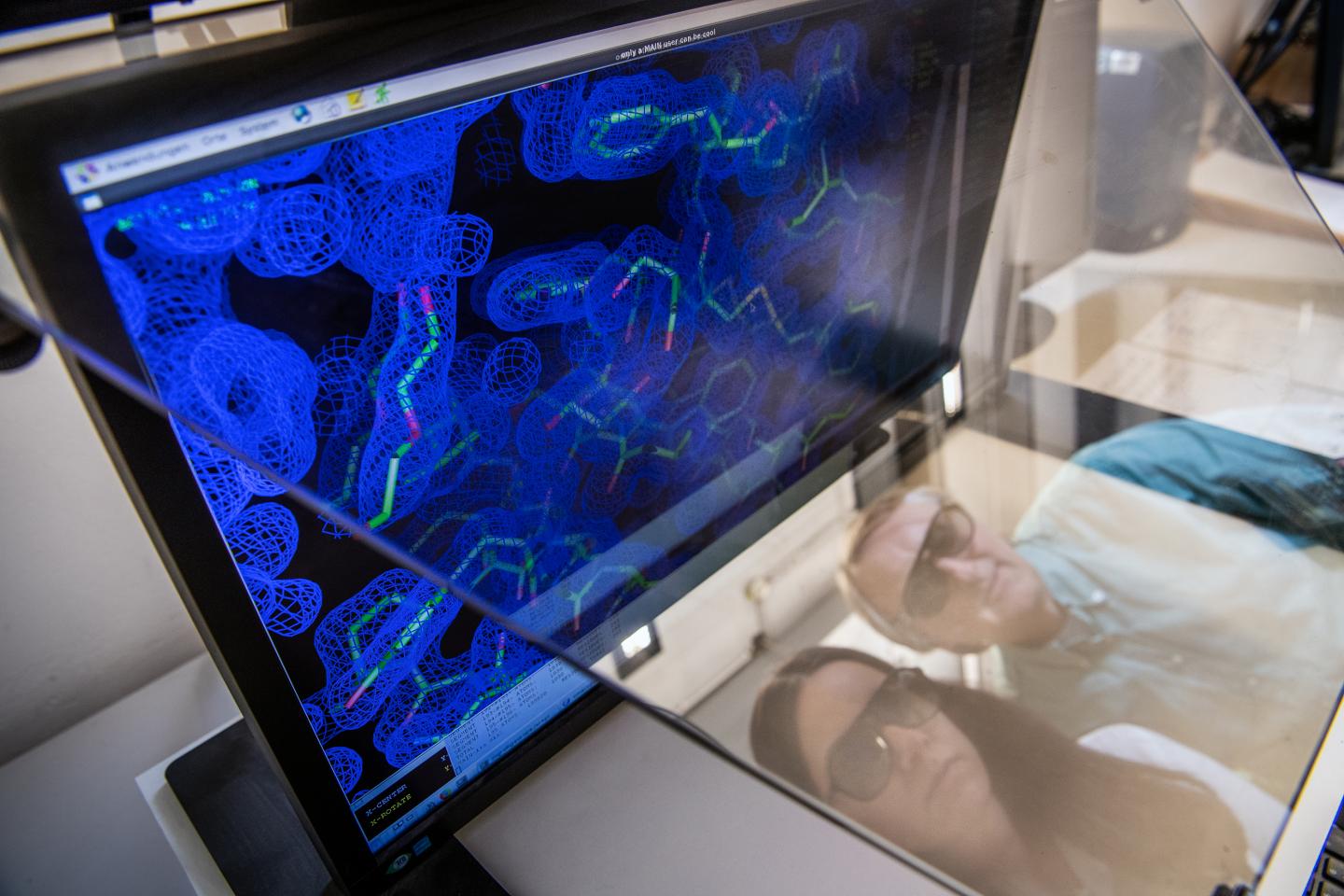
Mutations in plasma cells play a key role in light chain amyloidosis
IMAGE

Credit: Andreas Heddergott / TUM


Bone marrow plasma cells produce antibodies. These comprise two long and two short protein chains. The pathological proliferation of plasma cells can lead to an overproduction of the short chains. These associate to fibrils and deposit in organs. The result is fatal organ failure. A research team from the Technical University of Munich (TUM) and Heidelberg University has now identified the mutation behind the disease in a patient.

Antibodies are vital for the survival of human beings. They typically consist of two longer and thus heavier amino acid chains and two lighter ones. In rare cases, the plasma cells multiply excessively, flooding the body with light antibody chains.

In people suffering from light chain amyloidosis (AL amyloidosis), these light chains are deposited as extremely fine fibers, so-called amyloid fibrils, in tissue or in organs. The disease is often recognized only after the deposits already compromise the function of organs. In many cases AL amyloidosis is fatal.

“To date, little was known about the exact cause of this amyloidosis,” says Johannes Buchner, professor of biotechnology at the Technical University of Munich. “Depending on the organ affected, the symptoms vary considerably. Furthermore, each patient produces different types of antibodies. The disease is thus difficult to diagnose at an early stage.”

A mutation triggers the deadly disease

Using various analytical and database-supported methods, the team of scientists succeeded in identifying eleven mutations caused by the disease in the antibodies of a patient with advanced AL amyloidosis.

Further investigations showed that exactly one mutation was responsible for the destabilization and formation of the disease-causing amyloid fibrils. This mutation causes the unstable light chain to lose its structure after breaking into fragments, which then form the deadly amyloid fibrils.

“Our study shows that mutations that lead to unstable light chains are an important factor in the occurrence of amyloidosis,” says Pamina Kazman, who carried out the majority of the measurements. “In the long term, we hope that these and other studies will lead to new, earlier diagnostic methods and possibly even new treatment options.”

###

The research was funded by the German Research Foundation (DFG). The protein structures were determined at the synchrotron radiation sources of the Paul Scherrer Institute in Villigen (Switzerland) and the European synchrotron radiation source in Grenoble (France).

Publication:

Fatal amyloid formation in a patient’s antibody light chain is caused by a single point mutation

Pamina Kazman, Marie-Theres Vielberg, María Daniela Pulido Cendales, Lioba Hunziger, Benedikt Weber, Ute Hegenbart, Martin Zacharias, Rolf Köhler, Stefan Schönland, Michael Groll, Johannes Buchner

eLife, online: 10.03.2020 – DOI: 10.7554/eLife.52300

Media Contact
Dr. Andreas Battenberg
[email protected]
49-892-891-0510

Original Source

https://www.tum.de/nc/en/about-tum/news/press-releases/details/35938/

Related Journal Article

http://dx.doi.org/10.7554/eLife.52300

Tags: BiochemistryBiologyChemistry/Physics/Materials SciencesDiagnosticsInternal MedicineMedicine/HealthMolecular BiologyneurobiologyPhysiology
Share12Tweet8Share2ShareShareShare2

Related Posts

Two Salk Scientists Honored as 2025 AAAS Fellows

Two Salk Scientists Honored as 2025 AAAS Fellows

March 27, 2026
How to sway group opinions: Encourage opponents to stay undecided

How to sway group opinions: Encourage opponents to stay undecided

March 23, 2026

Deep Learning Model Maps How Individual Cells Shape Disease Outcomes

March 20, 2026

Removing only 15 female sharks annually could endanger the entire population, scientists warn

March 20, 2026
Please login to join discussion

POPULAR NEWS

  • blank

    Revolutionary AI Model Enhances Precision in Detecting Food Contamination

    96 shares
    Share 38 Tweet 24
  • Imagine a Social Media Feed That Challenges Your Views Instead of Reinforcing Them

    1003 shares
    Share 397 Tweet 248
  • Uncovering Functions of Cavernous Malformation Proteins in Organoids

    54 shares
    Share 22 Tweet 14
  • Promising Outcomes from First Clinical Trials of Gene Regulation in Epilepsy

    51 shares
    Share 20 Tweet 13

About

We bring you the latest biotechnology news from best research centers and universities around the world. Check our website.

Follow us

Recent News

In-Sensor Cryptography Links Physical Process to Digital Identity

Can Psychosocial Factors Influence Cancer Risk?

Depression Factors in Elderly: Pre vs. Post-COVID Analysis

Subscribe to Blog via Email

Success! An email was just sent to confirm your subscription. Please find the email now and click 'Confirm' to start subscribing.

Join 78 other subscribers
  • Contact Us

Bioengineer.org © Copyright 2023 All Rights Reserved.

Welcome Back!

Login to your account below

Forgotten Password?

Retrieve your password

Please enter your username or email address to reset your password.

Log In
No Result
View All Result
  • Homepages
    • Home Page 1
    • Home Page 2
  • News
  • National
  • Business
  • Health
  • Lifestyle
  • Science

Bioengineer.org © Copyright 2023 All Rights Reserved.