• HOME
  • NEWS
  • EXPLORE
    • CAREER
      • Companies
      • Jobs
    • EVENTS
    • iGEM
      • News
      • Team
    • PHOTOS
    • VIDEO
    • WIKI
  • BLOG
  • COMMUNITY
    • FACEBOOK
    • INSTAGRAM
    • TWITTER
Saturday, February 7, 2026
BIOENGINEER.ORG
No Result
View All Result
  • Login
  • HOME
  • NEWS
  • EXPLORE
    • CAREER
      • Companies
      • Jobs
        • Lecturer
        • PhD Studentship
        • Postdoc
        • Research Assistant
    • EVENTS
    • iGEM
      • News
      • Team
    • PHOTOS
    • VIDEO
    • WIKI
  • BLOG
  • COMMUNITY
    • FACEBOOK
    • INSTAGRAM
    • TWITTER
  • HOME
  • NEWS
  • EXPLORE
    • CAREER
      • Companies
      • Jobs
        • Lecturer
        • PhD Studentship
        • Postdoc
        • Research Assistant
    • EVENTS
    • iGEM
      • News
      • Team
    • PHOTOS
    • VIDEO
    • WIKI
  • BLOG
  • COMMUNITY
    • FACEBOOK
    • INSTAGRAM
    • TWITTER
No Result
View All Result
Bioengineer.org
No Result
View All Result
Home NEWS Science News Chemistry

New study presents neutral-colored transparent crystalline silicon photovoltaics

Bioengineer by Bioengineer
March 9, 2020
in Chemistry
Reading Time: 3 mins read
0
IMAGE
Share on FacebookShare on TwitterShare on LinkedinShare on RedditShare on Telegram

IMAGE

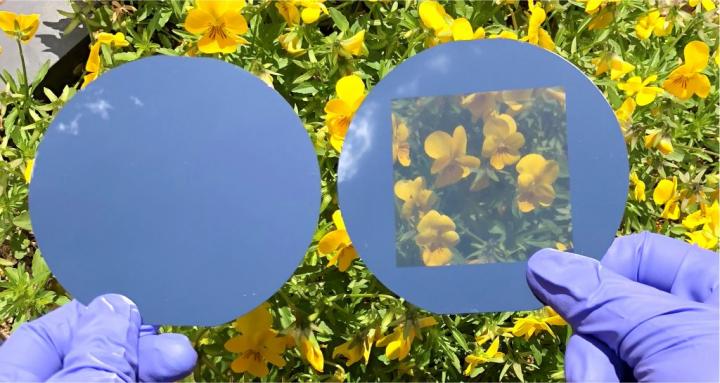
Credit: Kwanyong Seo (School of Energy and Chemical Engineering, UNIST)


Researchers are rushing to introduce transparent photovoltaic technologies. It won’t be too long before building windows or car sunroofs are being served as a battery element.

A research team, led by Professor Kwanyong Seo in the School of Energy and Chemical Engineering at UNIST has succeeded for the first time in making the crystalline silicon solar cell transparent with dark and muddy colors. It is a groundbreaking result of applying a new concept microstructure that cannot be recognized by the human eye.

Crystalline silicon solar cells produce electricity using “silicon with a regular atomic arrangement” as a “photoactive layer.” The photoactive layer converts solar energy into electrical energy (photoelectric conversion). In the case of crystalline silicon, photoelectric conversion efficiency is high and stability is also provided. Thanks to this, more than 90% of the solar cell market now occupies crystalline silicon solar cells. However, silicon solar cells are difficult to make transparent because they mainly absorb the sunlight in the visible range and produce electrical energy. In order to become a transparent solar cell, all visible light must be transmitted.

The research team introduced the “microstructure” on silicon to make transparent silicon solar cells. They punched tiny holes, invisible to the human eyes, in opaque solar cells and turn them transparent. This microstructure consists of structures that our eyes do not recognize and transmits sunlight. Therefore, visible light is transmitted through the microstructured part, and sunlight, including visible light, is absorbed in the silicon region that is not.

“This exhibits the same stability as the existing crystalline silicon technology. For this reason, I think that the feasibility of successful commercialization is huge,” says KangMin Lee (School of Energy and Chemical Engineering, UNIST), the first author of the research.

Researchers have created solar cells that are as transparent as glass with the efficiency levels of 12.2%. This was the highest colorless and transparent solar cell ever developed. The light transmittance can be adjusted in various ways, so that it can be applied to various fields from building windows to automobile sunroofs.

“Our findings solve two main issues with the existing transparent solar cells, including lower levels of flexibility and transparency,” says Namwoo Kim (School of Energy and Chemical Engineering, UNIST), the first co-author of the research.

The age of revolutionary new solar window is down the pike. This, we will soon witness the mass integration of solar cells into everyday infrastructure (i.e., Energy-generating vehicles and buildings made out of glass as large-scale solar batteries).

###

The findings of this research have been published in Joule, a sister journal to Cell on December 12, 2019. This research has been supported by the New Renewable Energy Core Technology Development Project of the Korea Institute of Energy Technology Evaluation and Planning (KETEP) from the Ministry of Trade, Industry and Energy.

Journal Reference

Kangmin Lee, Namwoo Kim, Kwangjin Kim, et al., “Neutral-Colored Transparent Crystalline Silicon Photovoltaics,” Joule, (2019).

Media Contact
JooHyeon Heo
[email protected]
82-522-171-223

Original Source

https://news.unist.ac.kr/neutral-colored-transparent-crystalline-silicon-photovoltaics/

Tags: Chemistry/Physics/Materials SciencesElectrical Engineering/ElectronicsIndustrial Engineering/ChemistryMaterialsResearch/DevelopmentSuperconductors/SemiconductorsTechnology Transfer
Share12Tweet8Share2ShareShareShare2

Related Posts

blank

Breakthrough in Environmental Cleanup: Scientists Develop Solar-Activated Biochar for Faster Remediation

February 7, 2026
blank

Cutting Costs: Making Hydrogen Fuel Cells More Affordable

February 6, 2026

Scientists Develop Hand-Held “Levitating” Time Crystals

February 6, 2026

Observing a Key Green-Energy Catalyst Dissolve Atom by Atom

February 6, 2026
Please login to join discussion

POPULAR NEWS

  • Robotic Ureteral Reconstruction: A Novel Approach

    Robotic Ureteral Reconstruction: A Novel Approach

    82 shares
    Share 33 Tweet 21
  • Digital Privacy: Health Data Control in Incarceration

    63 shares
    Share 25 Tweet 16
  • Study Reveals Lipid Accumulation in ME/CFS Cells

    57 shares
    Share 23 Tweet 14
  • Breakthrough in RNA Research Accelerates Medical Innovations Timeline

    53 shares
    Share 21 Tweet 13

About

We bring you the latest biotechnology news from best research centers and universities around the world. Check our website.

Follow us

Recent News

Evaluating Pediatric Emergency Care Quality in Ethiopia

TPMT Expression Predictions Linked to Azathioprine Side Effects

Improving Dementia Care with Enhanced Activity Kits

Subscribe to Blog via Email

Enter your email address to subscribe to this blog and receive notifications of new posts by email.

Join 73 other subscribers
  • Contact Us

Bioengineer.org © Copyright 2023 All Rights Reserved.

Welcome Back!

Login to your account below

Forgotten Password?

Retrieve your password

Please enter your username or email address to reset your password.

Log In
No Result
View All Result
  • Homepages
    • Home Page 1
    • Home Page 2
  • News
  • National
  • Business
  • Health
  • Lifestyle
  • Science

Bioengineer.org © Copyright 2023 All Rights Reserved.