• HOME
  • NEWS
  • EXPLORE
    • CAREER
      • Companies
      • Jobs
    • EVENTS
    • iGEM
      • News
      • Team
    • PHOTOS
    • VIDEO
    • WIKI
  • BLOG
  • COMMUNITY
    • FACEBOOK
    • INSTAGRAM
    • TWITTER
Tuesday, October 6, 2026
BIOENGINEER.ORG
No Result
View All Result
  • Login
  • HOME
  • NEWS
  • EXPLORE
    • CAREER
      • Companies
      • Jobs
        • Lecturer
        • PhD Studentship
        • Postdoc
        • Research Assistant
    • EVENTS
    • iGEM
      • News
      • Team
    • PHOTOS
    • VIDEO
    • WIKI
  • BLOG
  • COMMUNITY
    • FACEBOOK
    • INSTAGRAM
    • TWITTER
No Result
View All Result
Bioengineer.org
No Result
View All Result
Home NEWS Science News Chemistry

Optimum performance for life science microscopy

Bioengineer by Bioengineer
March 9, 2020
in Chemistry
Reading Time: 2 mins read
0
IMAGE
Share on FacebookShare on TwitterShare on LinkedinShare on RedditShare on Telegram

IMAGE

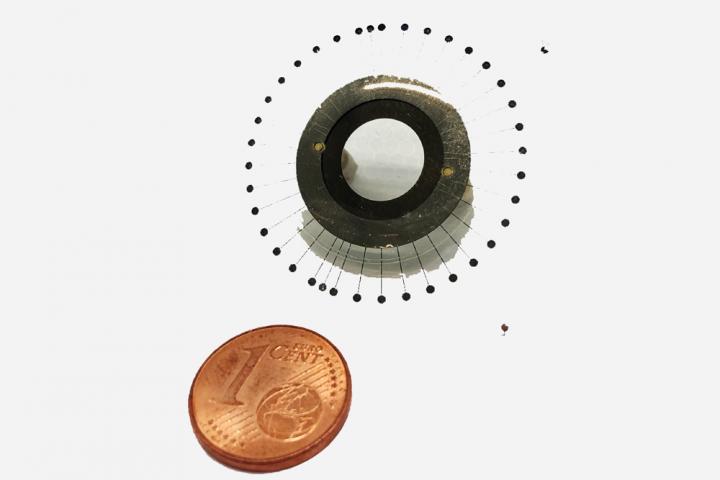
Credit: Photo: Pouya Rajaeipour


Together with the European Social Fund, the Federal Ministry for Economic Affairs and Energy (BMWi) is co-financing an EXIST Transfer of Research project within the Faculty of Engineering at the University of Freiburg with 745,000 euros. The project start date was Jan. 3, 2020.

The team at the Department of Microsystems Engineering (IMTEK) has developed a novel, transmissive optofluidic component for adaptive optics. Their Deformable Phase Plate (DPP) was developed for use in multiple fields such as optical communication, ophthalmology, optical testing and analysis methods, astronomy, material processing and microscopy. Adaptive optics improves the optical quality in all of the above-mentioned fields by compensating for disturbances to the optical systems in real time.

“In stark contrast to astronomy, in which adaptive optics today is standard in professional telescopes, its use in microscopy is still in its early stages. Not even the best microscopes are always able to achieve their full potential when imaging deep inside biological specimens. The technology underlying our DPP will fundamentally change the way adaptive optics improves the resolution and contrast of all microscopes,” explains project leader Dr. Stefan M. Weber.

Dr. Kaustubh Banerjee and Pouya Rajaeipur created the prototypes during their doctoral studies at IMTEK. The fundamental technology was invented by Dr. Ça?lar Ataman at the laboratory of Prof. Dr. Hans Zappe in the Department of Microsystems Engineering, a research group with more than 20 years of experience in optofluidics and imaging.

###

The EXIST Transfer of Research program supports outstanding research-based start-up projects that involve extensive and risky developments. The team was supported by the Founder’s Office at the University of Freiburg, which provides support to scientists with promising ideas who are interested in establishing a new start-up.

http://www.gruenden.uni-freiburg.de

Contact:

Department of Microsystems Engineering

University of Freiburg

Media Contact
Dr. Stefan M. Weber
[email protected]
49-302-218-0912

Tags: BiotechnologyNanotechnology/MicromachinesTechnology/Engineering/Computer Science
Share12Tweet8Share2ShareShareShare2

Related Posts

Cellulose-Based Sorbent Pulls Critical Metals from Organic Waste Streams in Minutes

Cellulose-Based Sorbent Pulls Critical Metals from Organic Waste Streams in Minutes

October 6, 2026
Magnetic Mesoporous Organosilica Catalyst Pulls Off Greener Suzuki Couplings in Water

Magnetic Mesoporous Organosilica Catalyst Pulls Off Greener Suzuki Couplings in Water

October 6, 2026

Konjac and Carrageenan Team Up to Shield Beta-Carotene in Novel Emulsion Gels

October 6, 2026

Computational Study Flags Benzimidazole Compounds That May Fight Inflammation and Allergy at Once

October 6, 2026
Please login to join discussion

POPULAR NEWS

  • Alloys That Shrink Their Own Grains: New PIX Mechanism Refines Metals With Heat Alone

    Alloys That Shrink Their Own Grains: New PIX Mechanism Refines Metals With Heat Alone

    29 shares
    Share 12 Tweet 7
  • Endurance Exercise Reshapes the Liver in Males and Females Through Distinct Molecular Routes

    29 shares
    Share 12 Tweet 7
  • Single Transcription Factor PU.1 Rapidly Converts Fibroblasts into Macrophage-Lineage Cells

    29 shares
    Share 12 Tweet 7
  • New Scale Measures How Ready Nurse Educators Really Are for the AI Era

    29 shares
    Share 12 Tweet 7

About

We bring you the latest biotechnology news from best research centers and universities around the world. Check our website.

Follow us

Recent News

Alloys That Shrink Their Own Grains: New PIX Mechanism Refines Metals With Heat Alone

Endurance Exercise Reshapes the Liver in Males and Females Through Distinct Molecular Routes

Single Transcription Factor PU.1 Rapidly Converts Fibroblasts into Macrophage-Lineage Cells

Subscribe to Blog via Email

Success! An email was just sent to confirm your subscription. Please find the email now and click 'Confirm' to start subscribing.

Join 85 other subscribers
  • Contact Us

Bioengineer.org © Copyright 2023 All Rights Reserved.

Welcome Back!

Login to your account below

Forgotten Password?

Retrieve your password

Please enter your username or email address to reset your password.

Log In
No Result
View All Result
  • Homepages
    • Home Page 1
    • Home Page 2
  • News
  • National
  • Business
  • Health
  • Lifestyle
  • Science

Bioengineer.org © Copyright 2023 All Rights Reserved.