• HOME
  • NEWS
  • EXPLORE
    • CAREER
      • Companies
      • Jobs
    • EVENTS
    • iGEM
      • News
      • Team
    • PHOTOS
    • VIDEO
    • WIKI
  • BLOG
  • COMMUNITY
    • FACEBOOK
    • INSTAGRAM
    • TWITTER
Monday, March 30, 2026
BIOENGINEER.ORG
No Result
View All Result
  • Login
  • HOME
  • NEWS
  • EXPLORE
    • CAREER
      • Companies
      • Jobs
        • Lecturer
        • PhD Studentship
        • Postdoc
        • Research Assistant
    • EVENTS
    • iGEM
      • News
      • Team
    • PHOTOS
    • VIDEO
    • WIKI
  • BLOG
  • COMMUNITY
    • FACEBOOK
    • INSTAGRAM
    • TWITTER
  • HOME
  • NEWS
  • EXPLORE
    • CAREER
      • Companies
      • Jobs
        • Lecturer
        • PhD Studentship
        • Postdoc
        • Research Assistant
    • EVENTS
    • iGEM
      • News
      • Team
    • PHOTOS
    • VIDEO
    • WIKI
  • BLOG
  • COMMUNITY
    • FACEBOOK
    • INSTAGRAM
    • TWITTER
No Result
View All Result
Bioengineer.org
No Result
View All Result
Home NEWS Science News Chemistry

New type of indoor solar cells for smart connected devices

Bioengineer by Bioengineer
March 4, 2020
in Chemistry
Reading Time: 3 mins read
0
IMAGE
Share on FacebookShare on TwitterShare on LinkedinShare on RedditShare on Telegram

IMAGE

Credit: Marina Freitag


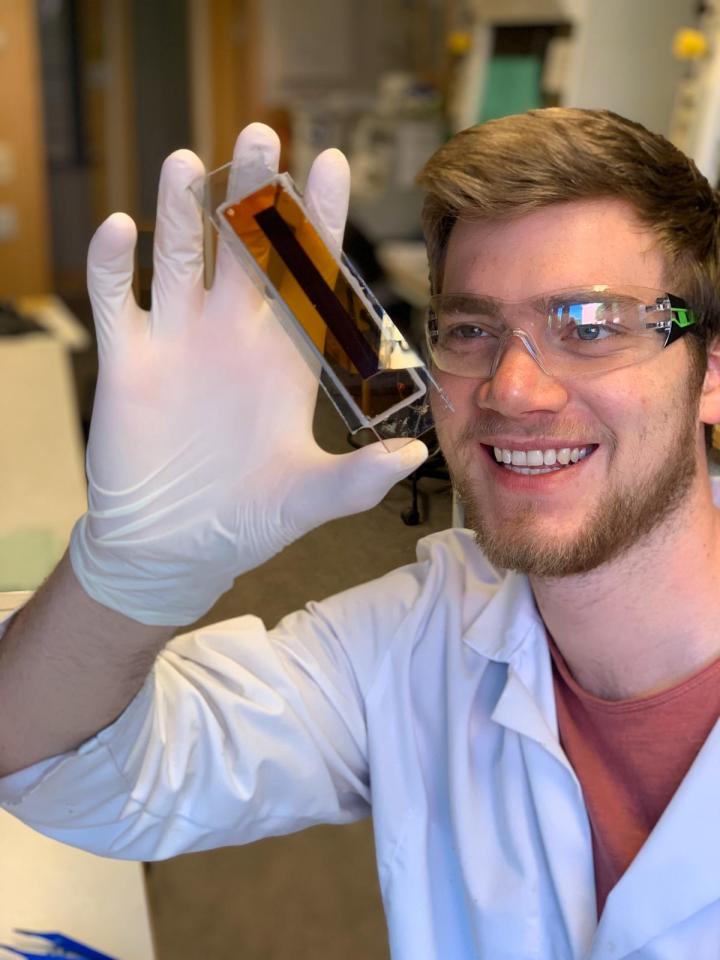
In a future where most things in our everyday life are connected through the internet, devices and sensors will need to run without wires or batteries. In a new article in Chemical Science, researchers from Uppsala University present a new type of dye-sensitised solar cells that harvest light from indoor lamps.

The Internet of Things, or IoT, refers to a network of physical devices and applications connected through the internet. It is estimated that by 2025, many facets of our lives will be mediated through 75 billion IoT devices, a majority of which will be located indoors. Broad installation of such IoT devices requires the devices to become autonomous, meaning that they should no longer need batteries or a grid connection to operate. To achieve this, it is crucial to identify a local low-maintenance energy source that can provide local power to IoT devices, especially in ambient conditions.

Towards this goal, a research team led by Marina Freitag, assistant professor at the Department of Chemistry, Uppsala University, has developed new indoor photovoltaic cells that can convert up to 34 per cent of visible light into electricity to power a wide range of IoT sensors. The team has designed novel dye-sensitised photovoltaic cells based on a copper-complex electrolyte, which makes them ideal for harvesting indoor light from fluorescent lamps and LEDs. The latest promising results establish dye-sensitised solar cells as leaders in power conversion efficiency for ambient lighting conditions, outperforming conventional silicon and solar cells made from exotic materials.

The research promises to revolutionise indoor digital sensing for smart greenhouses, offices, shelves, packages and many other smart everyday objects for the Internet of Things.

“Knowing the spectra of these light sources makes it possible to tune special dyes to absorb indoor light. While generating large amounts of energy, these indoor photovoltaics also maintain a high voltage under low light, which is important to power IoT devices,” says Freitag.

In cooperation with the Technical University of Munich, the researchers have further designed an adaptive ‘power management’ system for solar-powered IoT sensors. In contrast to their battery-limited counterparts, the light-driven devices intelligently feed from the amount of light available. Computational workloads are executed according to the level of illumination, minimising energy losses during storage and thus using all light energy to the maximum of its availability. Combining artificial intelligence and automated learning, the solar cell system can thus reduce energy consumption, battery waste and help to improve general living conditions.

In the future, scientists expect that billions of IoT devices self-powered by indoor solar cells will provide everything from environmental information to human-machine and machine-machine communications. Such advanced sensors can further enhance the next wave of robotics and autonomous systems currently in development.

“Ambient light harvesters provide a new generation of self-powered and smart IoT devices powered by an energy source that is largely untapped. The combination of high efficiency and low cost with non-toxic materials for indoor photovoltaics is of paramount importance to IoT sustainability,” says Freitag.

###

Media Contact
Marina Freitag
[email protected]
46-790-333-382

Original Source

https://www.uu.se/en/news-media/press-releases/press-release/?id=4982&typ=pm&lang=en

Related Journal Article

http://dx.doi.org/10.1039/C9SC06145B

Tags: Chemistry/Physics/Materials SciencesEnergy/Fuel (non-petroleum)Materials
Share12Tweet8Share2ShareShareShare2

Related Posts

Enhancing Weather Resistance in Perovskite Solar Cells

Enhancing Weather Resistance in Perovskite Solar Cells

March 29, 2026
Innovative Approach Achieves 29.76% Efficiency in All-Perovskite Tandem Solar Cells

Innovative Approach Achieves 29.76% Efficiency in All-Perovskite Tandem Solar Cells

March 29, 2026

Molecular Umbrella Shields Solar Cells for Enhanced Protection

March 29, 2026

Microwave Technology Transforms Moon Dust into Building Materials Without Earth Supplies

March 29, 2026
Please login to join discussion

POPULAR NEWS

  • blank

    Revolutionary AI Model Enhances Precision in Detecting Food Contamination

    96 shares
    Share 38 Tweet 24
  • Imagine a Social Media Feed That Challenges Your Views Instead of Reinforcing Them

    1005 shares
    Share 397 Tweet 248
  • Promising Outcomes from First Clinical Trials of Gene Regulation in Epilepsy

    51 shares
    Share 20 Tweet 13
  • Advancements in EV Battery Technology to Surpass Climate Change-Induced Degradation

    45 shares
    Share 18 Tweet 11

About

We bring you the latest biotechnology news from best research centers and universities around the world. Check our website.

Follow us

Recent News

Prioritize Intensity Over Duration: How Harder Exercise Lowers Disease and Mortality Risks

Squirrels Scale Greater Heights to Access Superior Snacks

New Zebrafish Study Sheds Light on Why Haploid Fish Embryos Often Fail to Fully Develop

Subscribe to Blog via Email

Enter your email address to subscribe to this blog and receive notifications of new posts by email.

Join 78 other subscribers
  • Contact Us

Bioengineer.org © Copyright 2023 All Rights Reserved.

Welcome Back!

Login to your account below

Forgotten Password?

Retrieve your password

Please enter your username or email address to reset your password.

Log In
No Result
View All Result
  • Homepages
    • Home Page 1
    • Home Page 2
  • News
  • National
  • Business
  • Health
  • Lifestyle
  • Science

Bioengineer.org © Copyright 2023 All Rights Reserved.