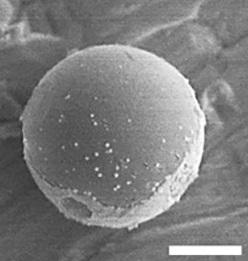
Credit: Adapted from Chemistry of Materials 2020, DOI: 10.1021/acs.chemmater.9b04873
Someday, microscopic robots could perform useful functions, such as diagnostic testing in lab-on-a-chip sensors, micropatterning surfaces or repairing equipment in tight spaces. But first, scientists need to be able to tightly control the microbots’ speed. Now, researchers reporting in ACS’ Chemistry of Materials have developed micromotors with three “engines” that they can control separately with chemical fuel, magnets and light.
Micromotors are tiny tools that convert stimuli, such as chemical fuel, light, magnetic fields or sound, into motion to perform tasks. Previously, researchers have demonstrated micromotors powered by one or two of these stimuli. For example, micromotors containing platinum nanoparticle engines can be powered by adding a small amount of hydrogen peroxide to a solution. The engine’s catalyst converts the hydrogen peroxide fuel into bubbles, which propel the micromotor through the liquid. Beatriz Jurado Sánchez, Alberto Escarpa and colleagues wanted to build a “supercharged” micromotor with three engines that run on different types of fuel.
To make their micromotors, the team coated polystyrene microspheres with layers of gold and 2D nanomaterials. Then, they attached three different nanoparticles that functioned as engines and that made the micromotors responsive to hydrogen peroxide, magnets and light. When the researchers exposed the micromotors to all three stimuli simultaneously, the speed increased by as much as 73% over that attained with micromotors containing only two engines. The supercharged micromotors could travel at relatively high speeds even through viscous fluids, including saliva, blood and milk. By varying factors, such as the hydrogen peroxide concentration, the type of catalyst used and the light intensity, the new micromotors offer a “myriad of controllable propulsion behaviors,” the researcher say.
###
The authors acknowledge funding from the Spanish Ministry of Science, Innovation and Universities (Ramón y Cajal, Plan Nacional de Investigación), the University of Alcalá and the Community of Madrid (TRANSNANOAVANSENS program, Programa de Estímulo a la Investigación de Jóvenes Doctores).
The abstract that accompanies this study is available here.
For more research news, journalists and public information officers are encouraged to apply for complimentary press registration for the ACS Spring 2020 National Meeting & Exposition in Philadelphia.
The American Chemical Society (ACS) is a nonprofit organization chartered by the U.S. Congress. ACS’ mission is to advance the broader chemistry enterprise and its practitioners for the benefit of Earth and its people. The Society is a global leader in providing access to chemistry-related information and research through its multiple research solutions, peer-reviewed journals, scientific conferences, eBooks and weekly news periodical Chemical & Engineering News. ACS journals are among the most cited, most trusted and most read within the scientific literature; however, ACS itself does not conduct chemical research. As a specialist in scientific information solutions (including SciFinder® and STN®), its CAS division powers global research, discovery and innovation. ACS’ main offices are in Washington, D.C., and Columbus, Ohio.
To automatically receive news releases from the American Chemical Society, contact [email protected].
Follow us on Twitter | Facebook
Media Contact
Katie Cottingham
[email protected]
301-775-8455
Related Journal Article
http://dx.