

• HOME
  • NEWS
  • EXPLORE
    • CAREER
      • Companies
      • Jobs
    • EVENTS
    • iGEM
      • News
      • Team
    • PHOTOS
    • VIDEO
    • WIKI
  • BLOG
  • COMMUNITY
    • FACEBOOK
    • INSTAGRAM
    • TWITTER
Thursday, January 1, 2026
BIOENGINEER.ORG
No Result
View All Result
  • Login
  • HOME
  • NEWS
  • EXPLORE
    • CAREER
      • Companies
      • Jobs
        • Lecturer
        • PhD Studentship
        • Postdoc
        • Research Assistant
    • EVENTS
    • iGEM
      • News
      • Team
    • PHOTOS
    • VIDEO
    • WIKI
  • BLOG
  • COMMUNITY
    • FACEBOOK
    • INSTAGRAM
    • TWITTER
  • HOME
  • NEWS
  • EXPLORE
    • CAREER
      • Companies
      • Jobs
        • Lecturer
        • PhD Studentship
        • Postdoc
        • Research Assistant
    • EVENTS
    • iGEM
      • News
      • Team
    • PHOTOS
    • VIDEO
    • WIKI
  • BLOG
  • COMMUNITY
    • FACEBOOK
    • INSTAGRAM
    • TWITTER
No Result
View All Result
Bioengineer.org
No Result
View All Result
Home NEWS Science News Health

Scientists find functioning amyloid in healthy brain

Bioengineer by Bioengineer
March 2, 2020
in Health
Reading Time: 2 mins read
0
IMAGE
Share on FacebookShare on TwitterShare on LinkedinShare on RedditShare on Telegram

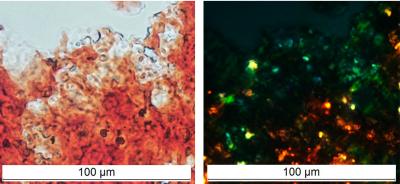
Researchers at the Department of Genetics and Biotechnology of St Petersburg University have discovered a functioning amyloid in a healthy brain.
IMAGE

Credit: SPbU


Scientists from St Petersburg University worked with their colleagues from the St Petersburg branch of the Vavilov Institute of General Genetics. They conducted experiments on laboratory rats and showed that the FRX1 protein in the brains of young and healthy animals functions in an amyloid form. The previously published reports indicate that this protein controls long term memory and emotions: mice that have the FRX1 gene “off” quickly remember even complex mazes, and animals that have too much of this protein do not suffer from depression even after severe stress. In addition, in humans, a failure in the gene encoding FRX1 is linked to autism and schizophrenia.

‘Our findings clearly show that developing a universal remedy that will destroy all amyloids in the brain is totally futile. Instead, we need to look for a cure for each specific pathology. The healthy brain was previously known to store only a few protein hormones in amyloid form. They are stored in secretory granules in the hypophysis, but when the time comes, the secretory granules burst and the proteins function in a normal, monomeric form,’ said Alexey Galkin, Professor of the Department of Genetics, Doctor of Biology. ‘We have initially proved that the protein can actually function in the brain in amyloid form, both as oligomers and as insoluble aggregates. Also, the amyloid form FRX1 can bind RNA molecules and protect them from degradation.’

The research was conducted by the Research Park of St Petersburg University with equipment provided by the resource centres “Chromas Core Facility” and “The Centre for Molecular and Cell Technologies”. The amyloid form of FXR1 protein was discovered by scientists using the amyloid proteome screening method developed by a research team in 2016. Amyloids generally play an important role in many organisms: for example, one of these proteins is found in human pigment cells and affects skin tanning. However, today, scientists are interested in amyloids primarily due to the need to find a cure for neurodegenerative diseases, where these proteins play a key role.

###

Media Contact
Polina Ogorodnikova
[email protected]

Original Source

https://english.spbu.ru/news/3417-scientists-at-st-petersburg-university-find-functioning-amyloid-in-healthy-brain

Related Journal Article

http://dx.doi.org/10.1038/s41598-019-55528-6

Tags: AlzheimerMedicine/Healthneurobiology
Share12Tweet8Share2ShareShareShare2

Related Posts

Gestational Diabetes Alters Weight Gain’s Impact on Outcomes

January 1, 2026

Coping Strategies in Rural Seniors with Chronic Illness

January 1, 2026

Physicians Embrace New Anemia Support in Hemodialysis

January 1, 2026

Preterm Birth’s Impact on Childhood Psychomotor Skills

January 1, 2026
Please login to join discussion

POPULAR NEWS

  • blank

    PTSD, Depression, Anxiety in Childhood Cancer Survivors, Parents

    108 shares
    Share 43 Tweet 27
  • NSF funds machine-learning research at UNO and UNL to study energy requirements of walking in older adults

    71 shares
    Share 28 Tweet 18
  • Exploring Audiology Accessibility in Johannesburg, South Africa

    52 shares
    Share 21 Tweet 13
  • SARS-CoV-2 Subvariants Affect Outcomes in Elderly Hip Fractures

    44 shares
    Share 18 Tweet 11

About

We bring you the latest biotechnology news from best research centers and universities around the world. Check our website.

Follow us

Recent News

Gestational Diabetes Alters Weight Gain’s Impact on Outcomes

Dual Delayed Fluorescence and Phosphorescence in Organics

Coping Strategies in Rural Seniors with Chronic Illness

Subscribe to Blog via Email

Enter your email address to subscribe to this blog and receive notifications of new posts by email.

Join 71 other subscribers
  • Contact Us

Bioengineer.org © Copyright 2023 All Rights Reserved.

Welcome Back!

Login to your account below

Forgotten Password?

Retrieve your password

Please enter your username or email address to reset your password.

Log In
No Result
View All Result
  • Homepages
    • Home Page 1
    • Home Page 2
  • News
  • National
  • Business
  • Health
  • Lifestyle
  • Science

Bioengineer.org © Copyright 2023 All Rights Reserved.

