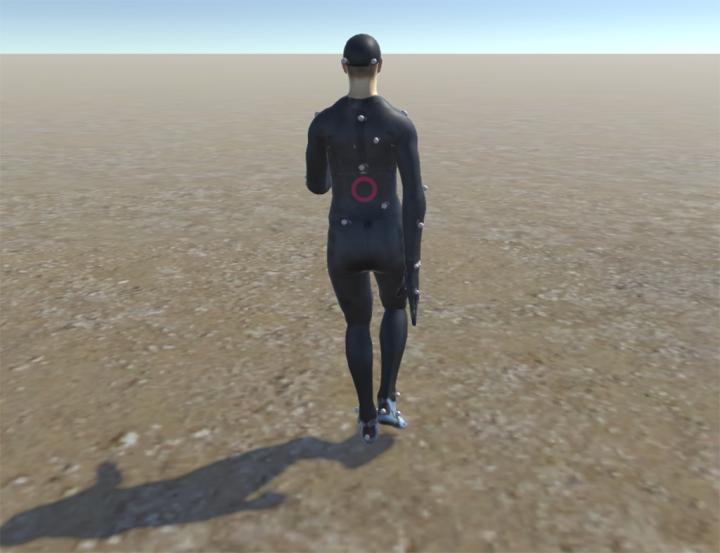
Credit: University of Warwick
- Current Physiotherapy techniques require patients to complete exercises at home, which doesn’t include much guidance
- Virtual reality (VR) combined with 3D Motion capture could allow movements to be translated onto an avatar the patient can follow, thanks to researchers at WMG, University of Warwick
- Consumer VR technologies can be used for both providing guidance to physiotherapy exercises, but also to make the exercises more interesting and encourage people to complete the course they need
Virtual reality could help physiotherapy patients complete their exercises at home successfully thanks to researchers at WMG, University of Warwick, who managed to combine VR technology with 3D motion capture.
Currently prescribed physiotherapy often requires patients to complete regular exercises at home. Outside of the clinic, patients rarely receive any guidance other than a leaflet of sketches or static photographs to instruct them how to complete their exercises. This leads to poor adherence, with patients becoming anxious about not getting the exercise right, or simply getting bored by the repetitiveness of the movements.
The advent of consumer virtual reality technology combined with 3D motion capture allows real movements to be accurately translated onto an avatar that can be viewed in a virtual environment. Researchers at the Institute of Digital Healthcare, WMG, University of Warwick are investigating whether this technology can be used to provide guidance to physiotherapy patients, by providing a virtual physiotherapist in the home to demonstrate the prescribed exercises.
Their paper, ‘Timing and correction of stepping movements with a virtual reality avatar’ published today the 28th of February, in the Journal PLOS ONE, has focused on whether people are able to accurately follow the movements of a virtual avatar.
Researchers had to investigate whether people were able to accurately coordinate and follow the movements of an avatar in a virtual environment. They asked participants to step in time with an avatar viewed through a VR headset.
Unknown to the participants, the researchers subtly slowed down or speeded up one of the avatar’s steps, such that the participants would have to correct their own stepping movement to stay in time. The effect this correction had on their step timing and synchronisation with the avatar was measured.
Lead author, Omar Khan from WMG, University of Warwick commented:
“If participants were observed to correct their own stepping to stay in time with the avatar, we knew they were able to accurately follow the movements they were observing.
“We found that participants struggled to keep in time if only visual information was present. However, when we added realistic footstep sounds in addition to the visual information, the more realistic multisensory information allowed participants to accurately follow the avatar.”
Dr Mark Elliott, Principal investigator on the project at WMG, University of Warwick added:
“There is huge potential for consumer VR technologies to be used for both providing guidance to physiotherapy exercises, but also to make the exercises more interesting. This study has focused on the crucial question of how well people can follow a virtual guide.”
Prof. Theo Arvanitis, co-author and Director of the Institute of Digital Healthcare, said:
“Our work and digitally-enabled technological solution can underpin transformative health innovations to impact the field of physiotherapy, and have a direct benefit to patients’ rehabilitation.
“We now plan to investigate other types of movements working closely in partnership with physiotherapists, to establish the areas of physiotherapy that will benefit most from this technology.”
###
NOTES TO EDITORS
High-res images available credit to WMG, University of Warwick at:
https:/
Caption: A screenshot of the avatar that patients would follow
https:/
Caption: The key findings displayed in a graph
Paper available to view at: https:/
FOR FURTHER INFORMATION PLEASE CONTACT:
Alice Scott
Media Relations Manager – Science
University of Warwick
Tel: +44 (0) 2476 574 255 or +44 (0) 7920 531 221
E-mail: [email protected]
Media Contact
Alice Scott
[email protected]
0247-657-4255
Related Journal Article
http://dx.