• HOME
  • NEWS
  • EXPLORE
    • CAREER
      • Companies
      • Jobs
    • EVENTS
    • iGEM
      • News
      • Team
    • PHOTOS
    • VIDEO
    • WIKI
  • BLOG
  • COMMUNITY
    • FACEBOOK
    • INSTAGRAM
    • TWITTER
Friday, January 23, 2026
BIOENGINEER.ORG
No Result
View All Result
  • Login
  • HOME
  • NEWS
  • EXPLORE
    • CAREER
      • Companies
      • Jobs
        • Lecturer
        • PhD Studentship
        • Postdoc
        • Research Assistant
    • EVENTS
    • iGEM
      • News
      • Team
    • PHOTOS
    • VIDEO
    • WIKI
  • BLOG
  • COMMUNITY
    • FACEBOOK
    • INSTAGRAM
    • TWITTER
  • HOME
  • NEWS
  • EXPLORE
    • CAREER
      • Companies
      • Jobs
        • Lecturer
        • PhD Studentship
        • Postdoc
        • Research Assistant
    • EVENTS
    • iGEM
      • News
      • Team
    • PHOTOS
    • VIDEO
    • WIKI
  • BLOG
  • COMMUNITY
    • FACEBOOK
    • INSTAGRAM
    • TWITTER
No Result
View All Result
Bioengineer.org
No Result
View All Result
Home NEWS Science News Chemistry

Chemists learn how to detect phenols in smoked food samples using vitamin B4

Bioengineer by Bioengineer
February 26, 2020
in Chemistry
Reading Time: 3 mins read
0
IMAGE
Share on FacebookShare on TwitterShare on LinkedinShare on RedditShare on Telegram

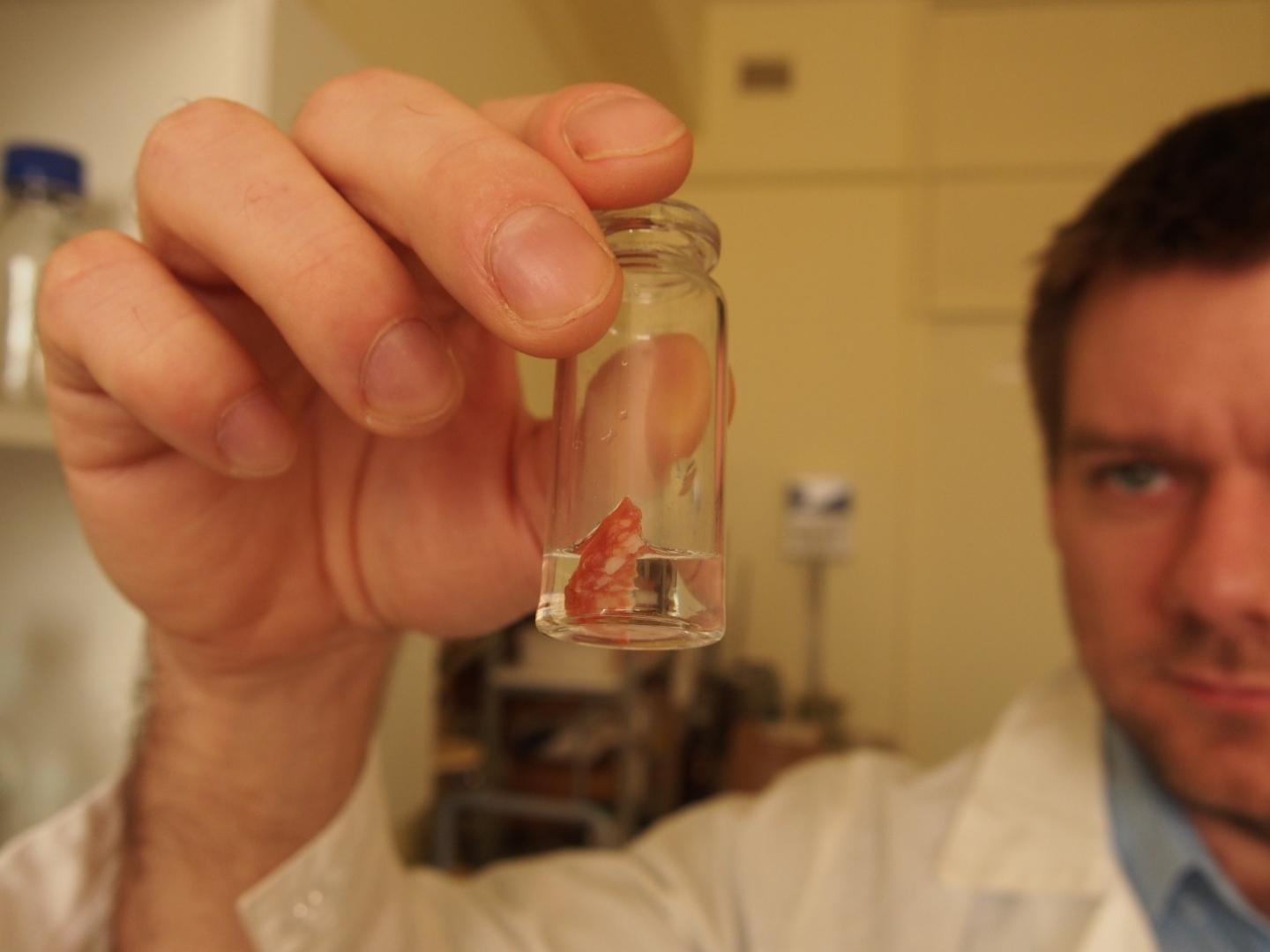
This method can be used in analytical laboratories at factories
IMAGE

Credit: SPbU

Today, phenols are used to produce medicines, paints, and inexpensive furniture made of chipboard or MDF panels and also to process food. Some of them are capable of imparting a pleasant smoky aroma to food, so they are often added to sausage or fish. But if we eat something that is high in phenols, it can have a deleterious effect on our health, so at factories they pay close attention to their concentrations in food. During tests, more often than not meat samples are dissolved in alkalis (in which phenols are very soluble), but the resulting emulsions require additional purification from the fats contained in sausage.

‘Our method is based on application deep eutectic solvents – very promising compounds that have been studied extensively over the last fifteen years,’ said Andrei Shishov, the project leader, who has a PhD in Chemistry and is an associate professor in the Department of Analytical Chemistry at St Petersburg University. ‘Usually, such solvents formed from two substances, which are then used to extract a third. But we got to thinking about it and wondered if it wouldn’t be a good idea to try deriving this substance not through a solvent but by means of the way it is formed. After all, phenols themselves produce such compounds when they bond with choline chloride – it’s the commonly known vitamin B4.’

This innovative approach involves only a few steps. First of all, a meat sample is minced and then mixed with organic solvent. After that, a piece of paper with a layer of choline chloride crystals, on which phenol is excreted, is immersed in the solution. The composition on the surface of the paper is washed off with water, and the concentration of phenols in it is determined by using, for example, a chromatograph – a special device for analysing a mixture of substances.

The paper membrane is impregnated in a special substance, choline chloride, which is used to discharge phenols. The meat sample is put in the solvent, in which the membrane has been placed on a needle. Phenols are excreted on its surface. After that, the phenols are washed off the surface of the membrane with water, and the resulting solution is analysed with the use of a special device.

Best of all, as the chemists in Professor Bulatov’s research team note, this technique is perfect for solid products, which are easy to grind up. Among its advantages are safety – after all, vitamin B4 is nontoxic – and speed – if all of the instruments are properly adjusted, an analysis takes no more than half an hour. What is more, this new approach makes it possible to determine whether a sausage has really been smoke-cured or liquid smoke has simply been added to it.

‘Besides, using this method, it is also possible to identify polyphenol compounds in edible oils, for example olive oil, and this is exactly what we are looking at now,’ said Mr Shishov. ‘It is known that these are the compounds that account for the antioxidant activity of edible oils, and they are beneficial for our health.’

###

Media Contact
Polina Ogorodnikova
[email protected]

Original Source

https://english.spbu.ru/news/3394-chemists-from-st-petersburg-university-learn-how-to-detect-phenols-in-sausage-using-vitamin-b4

Related Journal Article

http://dx.doi.org/10.1016/j.foodchem.2019.126097

Tags: Chemistry/Physics/Materials SciencesIndustrial Engineering/ChemistryToxicology
Share12Tweet8Share2ShareShareShare2

Related Posts

blank

New Route to Strychnos Alkaloids via Thiophene Cycloadditions

January 23, 2026
Lithium Metal Powers Electrochemical PFAS Reduction Breakthrough

Lithium Metal Powers Electrochemical PFAS Reduction Breakthrough

January 20, 2026

Creating Synthetic Protein-Binding DNA Systems in Cells

January 17, 2026

Chiral Catalysis Powers Rotary Molecular Motors

January 16, 2026
Please login to join discussion

POPULAR NEWS

  • Enhancing Spiritual Care Education in Nursing Programs

    156 shares
    Share 62 Tweet 39
  • PTSD, Depression, Anxiety in Childhood Cancer Survivors, Parents

    148 shares
    Share 59 Tweet 37
  • Robotic Ureteral Reconstruction: A Novel Approach

    80 shares
    Share 32 Tweet 20
  • Digital Privacy: Health Data Control in Incarceration

    62 shares
    Share 25 Tweet 16

About

We bring you the latest biotechnology news from best research centers and universities around the world. Check our website.

Follow us

Recent News

Overcoming Barriers: Access to HIV and TB Care

Exploring Eating Disorders in Older Adults: A Review

Muscle Mass’s Impact on Mortality in Chinese Cohort

Subscribe to Blog via Email

Enter your email address to subscribe to this blog and receive notifications of new posts by email.

Join 71 other subscribers
  • Contact Us

Bioengineer.org © Copyright 2023 All Rights Reserved.

Welcome Back!

Login to your account below

Forgotten Password?

Retrieve your password

Please enter your username or email address to reset your password.

Log In
No Result
View All Result
  • Homepages
    • Home Page 1
    • Home Page 2
  • News
  • National
  • Business
  • Health
  • Lifestyle
  • Science

Bioengineer.org © Copyright 2023 All Rights Reserved.