• HOME
  • NEWS
  • EXPLORE
    • CAREER
      • Companies
      • Jobs
    • EVENTS
    • iGEM
      • News
      • Team
    • PHOTOS
    • VIDEO
    • WIKI
  • BLOG
  • COMMUNITY
    • FACEBOOK
    • INSTAGRAM
    • TWITTER
Sunday, June 28, 2026
BIOENGINEER.ORG
No Result
View All Result
  • Login
  • HOME
  • NEWS
  • EXPLORE
    • CAREER
      • Companies
      • Jobs
        • Lecturer
        • PhD Studentship
        • Postdoc
        • Research Assistant
    • EVENTS
    • iGEM
      • News
      • Team
    • PHOTOS
    • VIDEO
    • WIKI
  • BLOG
  • COMMUNITY
    • FACEBOOK
    • INSTAGRAM
    • TWITTER
  • HOME
  • NEWS
  • EXPLORE
    • CAREER
      • Companies
      • Jobs
        • Lecturer
        • PhD Studentship
        • Postdoc
        • Research Assistant
    • EVENTS
    • iGEM
      • News
      • Team
    • PHOTOS
    • VIDEO
    • WIKI
  • BLOG
  • COMMUNITY
    • FACEBOOK
    • INSTAGRAM
    • TWITTER
No Result
View All Result
Bioengineer.org
No Result
View All Result
Home NEWS Science News Biology

Living cell imaging technique sheds light on molecular view of obesity

Bioengineer by Bioengineer
February 24, 2020
in Biology
Reading Time: 2 mins read
0
IMAGE
Share on FacebookShare on TwitterShare on LinkedinShare on RedditShare on Telegram

Utah State University researchers develop probes to help improve techniques to test drugs for obesity-related conditions
IMAGE

Credit: USU

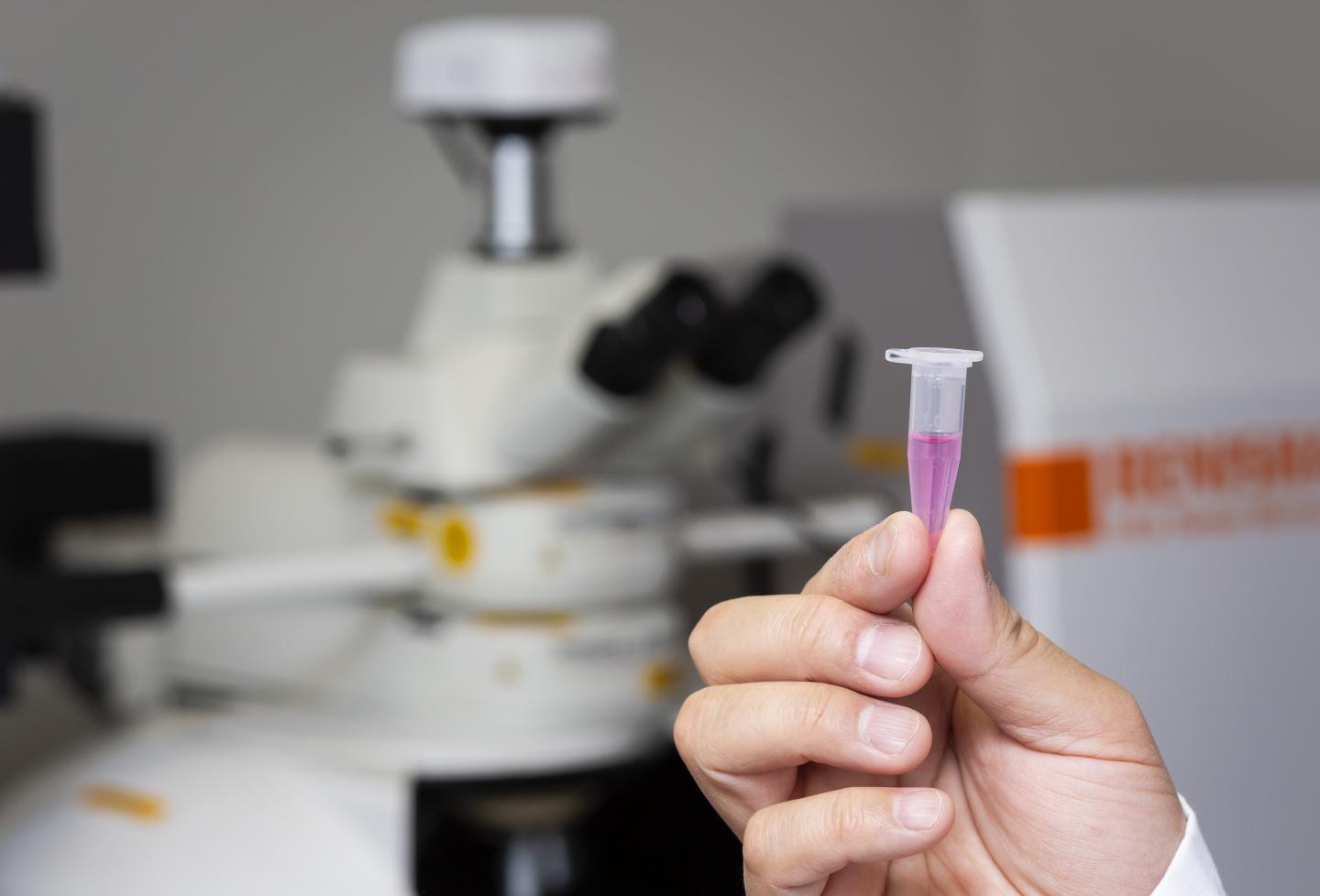
A collaborative team of researchers at Utah State University and the University of Central Florida developed a tool to track cellular events that may lead to obesity-related conditions in people.

The research findings were published Feb. 3 in the Proceedings of the National Academy of Sciences.

The team, led by Anhong Zhou, a professor in USU’s Department of Biological Engineering, developed a sensing optical imaging nanoprobe that uses scattered light to provide a structural fingerprint for molecules. The probes can be used to more easily identify and illustrate cell surface receptors that can either prompt or stop cellular responses to certain external stimuli. The probes make it possible to monitor multiple surface receptors on an individual cell and provide researchers an unprecedented view of cellular surface activity. Zhou and his team, including the biological engineering PhD student Wei Zhang, applied these novel nanoprobes to successfully detect the cell receptors that recognize fatty acids at the single living cell level.

The technique represents a major step in developing improved understanding of certain cellular events and could have widespread impact on the study of fat intake and the development of obesity. The new method could also be used as a simple screening technique for testing external stimuli that trigger the surface cell receptors and lead to the linking of fatty acids. This would make for an efficient test to ensure that new drugs accurately prompt the correct cellular activities that lead to obesity and other obesity-related conditions. Zhou and his team’s work is increasingly relevant as the prevalence of obesity impacts public health in the United States.

Zhou says the research represents an exciting collaboration between researchers and aligns well with his belief that biological engineering is an important frontier in the scientific community. “This is an excellent example that fulfills our long-term goal of applying engineering tools to solve biology-driven problems,” he said. “In the past several years, we have been thrilled to develop new cell-based assay technologies that potentially benefit human health problems like obesity. We are currently extending this technology for developing a new method for early cancer diagnosis.”

###

This work was primarily supported by the National Science Foundation.

Media Contact
Anhong Zhou
[email protected]
435-797-2863

Original Source

https://engineering.usu.edu/news/main-feed/2020/living-cell-imaging-technique-sheds-light-on-molecular-view-of-obesity?fbclid=IwAR3EEYHE6fXhB9r-35b_HWfEsFwdyXAksHES9vf5uH3I2cdqy2dk4GTsWbU

Related Journal Article

http://dx.doi.org/10.1073/pnas.1916238117

Tags: BiochemistryBiomedical/Environmental/Chemical EngineeringBiotechnologyDiet/Body WeightEating Disorders/ObesityMedicine/HealthNanotechnology/MicromachinesResearch/Development
Share12Tweet8Share2ShareShareShare2

Related Posts

Natural Hallucinogens: Evolution’s Ecological Tools, Not Mere Chemical Byproducts

June 25, 2026

This Famous Butterfly Revealed: Three Distinct Species Hidden in One

June 25, 2026

Scientists Attack Soybean Cyst Nematode by Starving Its Food Source

June 25, 2026

Decoding the Secret Code of a Crucial Immune Sensor

June 24, 2026
Please login to join discussion

POPULAR NEWS

  • Saying Goodbye to PGY-6: Pediatric Fellowship Realities

    103 shares
    Share 41 Tweet 26
  • Multi-Hospital Study Reveals Long Covid Burden Is Twice as High as Current Estimates

    92 shares
    Share 36 Tweet 23
  • Detection of EDCs in Breast Milk and Infant Urine Up to Six Months Highlights Early Exposure Risks

    77 shares
    Share 31 Tweet 19
  • New Drug Candidate Developed at McMaster Shows Potential for Treating Brain Cancer

    58 shares
    Share 23 Tweet 15

About

We bring you the latest biotechnology news from best research centers and universities around the world. Check our website.

Follow us

Recent News

Tracking Lanthanide-Labeled Microplastics in Plants

POSTECH Researchers Slash Cost of Reconstituted Cell-Free Systems by 95%

AI and Physics Collaborate to Design Advanced Hydrogen Storage Materials

Subscribe to Blog via Email

Success! An email was just sent to confirm your subscription. Please find the email now and click 'Confirm' to start subscribing.

Join 82 other subscribers
  • Contact Us

Bioengineer.org © Copyright 2023 All Rights Reserved.

Welcome Back!

Login to your account below

Forgotten Password?

Retrieve your password

Please enter your username or email address to reset your password.

Log In
No Result
View All Result
  • Homepages
    • Home Page 1
    • Home Page 2
  • News
  • National
  • Business
  • Health
  • Lifestyle
  • Science

Bioengineer.org © Copyright 2023 All Rights Reserved.