• HOME
  • NEWS
  • EXPLORE
    • CAREER
      • Companies
      • Jobs
    • EVENTS
    • iGEM
      • News
      • Team
    • PHOTOS
    • VIDEO
    • WIKI
  • BLOG
  • COMMUNITY
    • FACEBOOK
    • INSTAGRAM
    • TWITTER
Saturday, February 7, 2026
BIOENGINEER.ORG
No Result
View All Result
  • Login
  • HOME
  • NEWS
  • EXPLORE
    • CAREER
      • Companies
      • Jobs
        • Lecturer
        • PhD Studentship
        • Postdoc
        • Research Assistant
    • EVENTS
    • iGEM
      • News
      • Team
    • PHOTOS
    • VIDEO
    • WIKI
  • BLOG
  • COMMUNITY
    • FACEBOOK
    • INSTAGRAM
    • TWITTER
  • HOME
  • NEWS
  • EXPLORE
    • CAREER
      • Companies
      • Jobs
        • Lecturer
        • PhD Studentship
        • Postdoc
        • Research Assistant
    • EVENTS
    • iGEM
      • News
      • Team
    • PHOTOS
    • VIDEO
    • WIKI
  • BLOG
  • COMMUNITY
    • FACEBOOK
    • INSTAGRAM
    • TWITTER
No Result
View All Result
Bioengineer.org
No Result
View All Result
Home NEWS Science News Health

Study points to better medical diagnosis through levitating human blood

Bioengineer by Bioengineer
February 20, 2020
in Health
Reading Time: 2 mins read
0
IMAGE
Share on FacebookShare on TwitterShare on LinkedinShare on RedditShare on Telegram

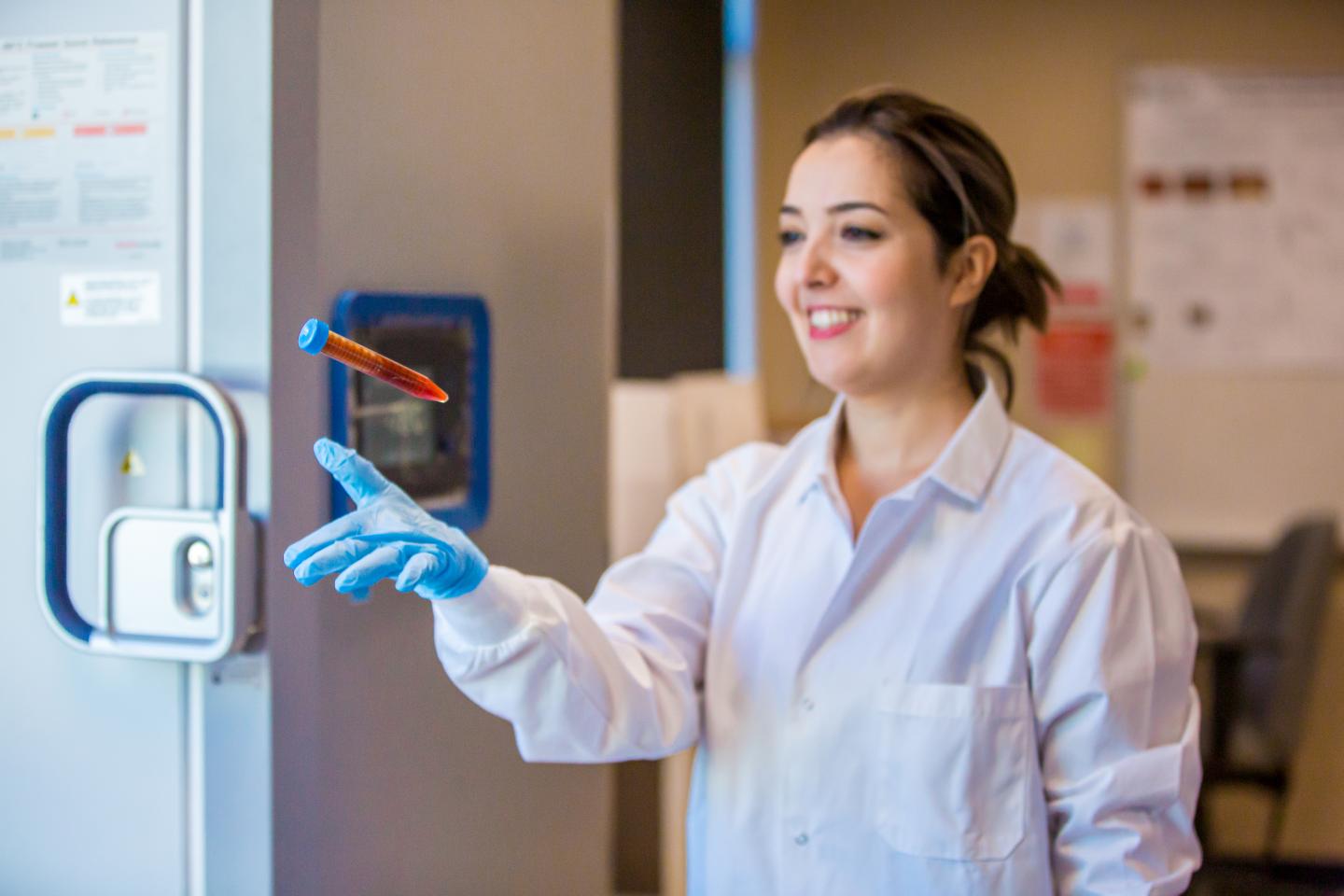
Floating human plasma helps researchers detect diseases like opioid addiction
IMAGE

Credit: UBCO


New research from the UBC’s Okanagan campus, Harvard Medical School and Michigan State University suggests that levitating human plasma may lead to faster, more reliable, portable and simpler disease detection.

The researchers used a stream of electricity that acted like a magnet and separated protein from blood plasma. Plasma is the clear, liquid portion of blood that remains after red blood cells, white blood cells, platelets and other cellular components are removed.

“Human plasma proteins contain information on the occurrence and development of addiction and diseases,” says Sepideh Pakpour, an assistant professor with UBCO’s School of Engineering and one of the authors of the research.

Pakpour is using the proteins to predict opioid dependencies and addictions, but the findings could one day lead to medical diagnoses using the technology.

As plasma proteins are different densities, when separated the proteins levitate at different heights, and therefore become identifiable. An evaluation of these types of proteins and how they group together can paint a picture that identifies whether a patient has the possibility of getting a disease or becoming addicted to drugs like opioids.

“We compared the differences between healthy proteins and diseased proteins to set benchmarks,” says Pakpour. “With this information and the plasma levitation, we were able to accurately detect rare proteins that are only found in individuals with opioid addictions.”

According to Pakpour, the researchers are particularly excited about the possibility of developing a portable and accurate new diagnostic tool for health care practitioners.

“More investigation is required, but our findings are certainly a step forward towards an optical imaging disease detection tool,” she adds.

The five-minute test, uses machine-learning and predictive models, may one day lead to tools that can not only diagnose diseases but also help practitioners prescribe medications that won’t lead to drug dependencies.

The researchers are now evaluating other dependencies and diseases to establish roadmaps for detection.

###

The research is supported by internal grants from the department of anesthesiology at Brigham and Women’s Hospital at Harvard Medical School, and the Precision Health Program at Michigan State University. It was published in Advanced Healthcare Materials.

Media Contact
Patty Wellborn
[email protected]
250-317-0293

Original Source

https://news.ok.ubc.ca/2020/02/20/study-points-to-better-medical-diagnosis-through-levitating-human-blood

Related Journal Article

http://dx.doi.org/10.1002/adhm.201901608

Tags: AddictionBacteriologyCell BiologyDiagnosticsHematologyInfectious/Emerging DiseasesMedicine/HealthMetabolism/Metabolic DiseasesMicrobiologyPharmaceutical Sciences
Share12Tweet8Share2ShareShareShare2

Related Posts

Evaluating Pediatric Emergency Care Quality in Ethiopia

February 7, 2026

TPMT Expression Predictions Linked to Azathioprine Side Effects

February 7, 2026

Improving Dementia Care with Enhanced Activity Kits

February 7, 2026

Decoding Prostate Cancer Origins via snFLARE-seq, mxFRIZNGRND

February 7, 2026
Please login to join discussion

POPULAR NEWS

  • Robotic Ureteral Reconstruction: A Novel Approach

    Robotic Ureteral Reconstruction: A Novel Approach

    82 shares
    Share 33 Tweet 21
  • Digital Privacy: Health Data Control in Incarceration

    63 shares
    Share 25 Tweet 16
  • Study Reveals Lipid Accumulation in ME/CFS Cells

    57 shares
    Share 23 Tweet 14
  • Breakthrough in RNA Research Accelerates Medical Innovations Timeline

    53 shares
    Share 21 Tweet 13

About

We bring you the latest biotechnology news from best research centers and universities around the world. Check our website.

Follow us

Recent News

Evaluating Pediatric Emergency Care Quality in Ethiopia

TPMT Expression Predictions Linked to Azathioprine Side Effects

Improving Dementia Care with Enhanced Activity Kits

Subscribe to Blog via Email

Success! An email was just sent to confirm your subscription. Please find the email now and click 'Confirm' to start subscribing.

Join 73 other subscribers
  • Contact Us

Bioengineer.org © Copyright 2023 All Rights Reserved.

Welcome Back!

Login to your account below

Forgotten Password?

Retrieve your password

Please enter your username or email address to reset your password.

Log In
No Result
View All Result
  • Homepages
    • Home Page 1
    • Home Page 2
  • News
  • National
  • Business
  • Health
  • Lifestyle
  • Science

Bioengineer.org © Copyright 2023 All Rights Reserved.